
Organized Satanism is not ancient. It was invented, largely from scratch, in 1966 by a former carnival worker and self-promoter in San Francisco, and it was designed as much for publicity as for theology. The occult tradition this series has been tracing has almost nothing to do with Satanism as a formal practice. The relationship between them is almost entirely a product of Christian propaganda, 20th-century moral panics, and LaVey’s own marketing genius.
This chapter matters because Satanism is the distorting lens through which most people encounter the occult tradition. Every time a grimoire gets mentioned, the word Satanism enters the conversation. Every time someone practices ceremonial magic, they’re suspected of Satanism. The framework is wrong. Understanding why it’s wrong clarifies what the tradition actually is.
Where Satan Came From
The figure of Satan as the principal adversary of God — the Lord of Hell commanding legions of demons, working against divine order — is a late theological development. It is not in the Hebrew Bible, at least not in the form later tradition assumes.
In the Hebrew Bible, ha-satan is a title, not a name. It translates roughly as “the adversary” or “the accuser.” The figure appears in Job as a member of the divine council who tests human beings — not a rebel against God but a functionary within God’s administration. The cosmic war between God and Satan, the rebel angel cast out of heaven, the tempter in the Garden — these are developments of the Second Temple period and the early Christian era, drawing on Persian Zoroastrian dualism, Greek mythology, and apocalyptic literature.
The Satan of medieval Christianity served an institutional purpose: a universal adversary who was present behind every deviation from orthodoxy explained heresy, alternative practice, and unauthorized contact with non-human entities in a single framework. Anything the Church didn’t control was working for Satan. The framework was as much about institutional power as theology.
The practitioners this series has been describing — the Egyptian priests performing heka, the Babylonian diviners, the Gnostic initiates, the medieval grimoire users — were not worshipping Satan. They were working with a contact protocol that predated the Satan mythology by millennia and operated on entirely different cosmological assumptions. The Church’s insistence that they were working for Satan was a political classification, not a description.
The Witch Trials: Not What You Were Told
The medieval and early modern witch trials produced an image of an organized Satanic conspiracy — the sabbath, the pact with the devil, the sex with demons — that has proven extraordinarily durable in the cultural imagination. This image was substantially manufactured.
The core of the witch trial mythology — that there was an organized underground religion worshipping Satan — was not based on observed practice. It was based on confessions extracted under torture, which by definition produced whatever the interrogators expected to find, and on theoretical theological literature developed by inquisitors to explain the phenomenon they believed they were investigating.
The historians who have done the archival work — Keith Thomas, Carlo Ginzburg, Emma Wilby — found something much stranger and more interesting. What the trial records show when read carefully is a folk magical practice with genuine operative content, involving contact with entities understood in various ways — fairy folk, the dead, spirit guides — with a completely different cosmological framework from the diabolism the inquisitors tried to impose. The people being tried were not Satanists. They were practitioners of a contact tradition operating outside Church control. The Satanist interpretation was the inquisitors’ overlay.
Anton LaVey and the Church of Satan
Anton Szandor LaVey (1930–1997) founded the Church of Satan in San Francisco on April 30, 1966 — Walpurgisnacht, chosen deliberately — and announced it with a press release.
LaVey was a former carnival barker and circus lion tamer who had absorbed significant occult literature before deciding to create a religion. The Satanic Bible, published in 1969, is the foundational text. Read without preconceptions, it is a fairly coherent piece of materialist philosophy dressed in provocative theatrical clothing. LaVey’s theology was explicitly atheist: Satan was a symbol of the self, of natural human drives unencumbered by religious guilt, of individualism against herd conformity. The Church of Satan did not claim to worship a literal entity.
The actual magical content drew on the grimoire tradition, on Crowley, and on Ayn Rand, whose objectivist philosophy LaVey acknowledged as a primary influence. The Will — the individual’s authentic desire — is the center of LaVeyan magic, as it is of Crowley’s Thelema. The symbol system and aesthetic differ radically. The underlying structure is similar.
LaVey was a media genius. He understood that the figure of Satan was the most effective possible brand for what he was selling — individualism, theatrical rebellion, and the de-sanctification of Christian cultural authority. He made the news constantly. The consequence was that his theatrical brand of philosophical Satanism became, in the public imagination, the face of the entire occult tradition. Every grimoire user was now a “Satanist.” Every witch was a “Satanist.” This served neither the practitioners nor most of LaVey’s own followers. It served the panic industry that was building toward the 1980s.
The Satanic Panic
The Satanic Panic of the 1980s is the most efficient demonstration in recent American history of how a manufactured narrative can cascade through institutional systems regardless of its relationship to reality.
Michelle Remembers (1980), a book claiming to recover memories of childhood Satanic ritual abuse, was the foundational text — subsequently completely discredited. Memories were implanted through repeated suggestion under hypnosis, and the events described were contradicted by documentary evidence. The McMartin Preschool trial, beginning in 1983, became the longest and most expensive criminal trial in American history and ended without a single conviction. Geraldo Rivera’s 1988 NBC special drew 19.8 million viewers with no credible evidence for its claims.
The FBI investigated the claims of widespread Satanic ritual abuse networks and found no evidence of any organized Satanic criminal conspiracy. A 1992 report by FBI agent Ken Lanning — the bureau’s leading expert on ritual abuse cases — concluded the evidence didn’t exist. The network that was supposed to be sacrificing thousands of children annually had left no bodies, no crime scenes, no physical evidence, and no corroborating witnesses beyond those produced by suggestive interviewing.
The panic destroyed lives — practitioners of Wicca, ceremonial magic, heavy metal fans, Dungeons & Dragons players, and innocent daycare workers convicted on fabricated testimony. The Satanic Panic was the 20th century’s most effective application of Thread Three from Chapter 6: the propaganda methodology. Jungian archetypes at scale. The figure of Satan as the organizational principle of social fear, deployed to control behavior, stigmatize deviance, and concentrate institutional power.
What Satanism Actually Is
Three distinct things get collapsed under the Satanism label:
Philosophical/atheistic Satanism (LaVey’s tradition, the contemporary Satanic Temple): uses Satan as a symbol of secular individualism, operates as essentially a political and aesthetic movement. The Satanic Temple’s legal campaigns against Christian privilege in public institutions are civil libertarian activism in theatrical clothing.
Theistic Satanism: a small number of practitioners who actually venerate Satan as a literal entity. This exists. It is extremely marginal in terms of numbers.
Everything else that got called Satanism: which includes the entire occult tradition, every non-Christian religious practice, every form of folk magic, every indigenous contact tradition, and everything else that Christian institutional power decided to classify as working for the adversary. This category contains almost everything of actual interest in the history of the occult.
The occult tradition, as this series has been describing it, is not about Satan at all. The grimoire practitioners were not Satanists. The Golden Dawn was not Satanist. Crowley was not a Satanist — he was a Thelemite. The CIA’s remote viewing programs were not Satanist. The contact phenomenon the tradition has documented for five thousand years operates entirely outside the Satan mythology. It predates it. It doesn’t fit into it.
The Baphomet Question
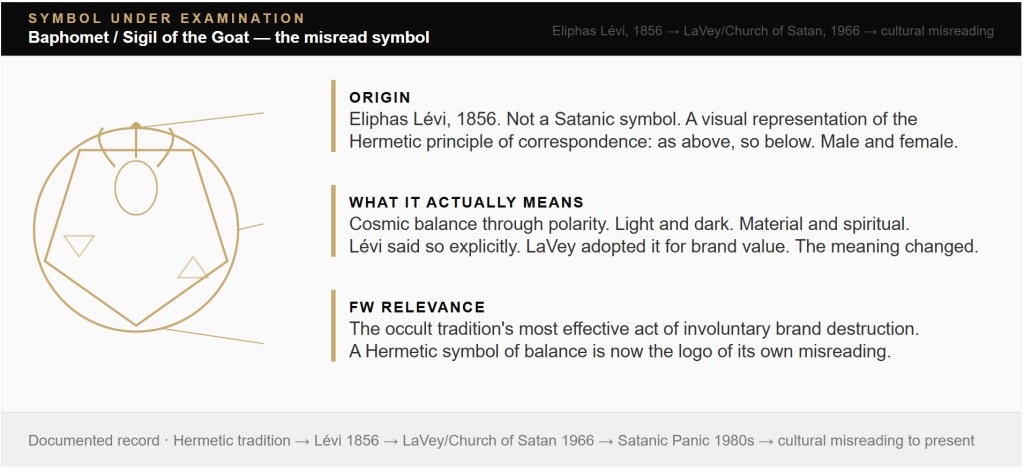
The Baphomet sigil — the goat-headed androgynous figure within a pentagram, used by the Church of Satan and widely reproduced as the symbol of Satanism — has a different history than LaVey’s marketing implied.
Eliphas Lévi created the famous Baphomet image in 1856. The winged, goat-headed hermaphroditic figure with a torch between its horns and hands pointing up and down is a visual representation of the Hermetic principle of correspondence: “as above, so below.” Male and female. Light and dark. Material and spiritual. It is not an image of Satan. It is an image of cosmic balance expressed through the human form. Lévi said so explicitly.
LaVey’s adoption of the Baphomet imagery as the Church of Satan’s symbol effectively erased Lévi’s intended meaning and substituted the Christian adversary reading, which served LaVey’s brand better. The consequence is that Lévi’s sophisticated Hermetic icon is now, in the cultural imagination, the logo of Satanism. This is the occult tradition’s most successful act of involuntary brand destruction.
Next: Chapter 9 — The Occult-UAP Interface. The connection between the grimoire tradition, the contact protocol, and what modern researchers describe as close encounter and UAP phenomena. Where this whole series has been pointing.
Previously in this series: Chapter 7 — The American Occult · Chapter 6 — The Occult and Power · Chapter 5 — The Orders · Chapter 4 — The Grimoires · Chapter 3 — The Transmission Problem · Chapter 2 — Origins: The Ancient World · Chapter 1 — What the Occult Actually Is

