
This is the first installment in Fortean Winds’ ongoing series on the history of the occult — what it is, where it came from, and why it keeps showing up in the same places we find everything else we research.
The word is the first problem. Say “occult” in most rooms and you’ve already lost half the audience to a mental image they got from a movie. Pentagrams on the floor. Candles. Someone in a robe doing something they shouldn’t. The other half hears it as a synonym for Satanism and shuts down from there.
Neither reaction is accurate. Both are worth correcting before going further.
Occultus is Latin. It means hidden. That’s it. The occult is, by definition, hidden knowledge — information about the nature of reality that isn’t freely available, passed through controlled channels, often requiring some form of initiation or demonstrated readiness before transmission. Secret knowledge. Esoteric knowledge. Knowledge that requires work to access.
That’s the actual definition. It encompasses alchemy, astrology, ritual magic, divination, ceremonial practice, and a dozen other traditions. What it doesn’t inherently contain is evil, Satanism, or any necessary connection to destructive intent. Those elements exist within certain occult currents. They don’t define the category.
This distinction matters for everything that follows.
The Structure of Hidden Knowledge
The easiest way to understand what the occult is — and why it persists across every civilization on record — is to look at what it does.
Every major occult tradition operates on some version of the same premise: the visible world is not the complete picture. There are forces, patterns, and correspondences operating beneath the surface of ordinary perception, and certain practices allow access to them. The person who develops that access gains capabilities unavailable to someone without it.
This sounds mystical. In some formulations it is. But the structure is identical to any other discipline that requires initiation into specialized knowledge — medicine, law, nuclear physics. The difference is that occult knowledge claims the hidden layer it’s accessing is consciousness, intent, or something upstream of the physical.
Whether that claim is correct is a separate question, and one Fortean Winds takes seriously. The historical record is clear that the claim has been made, tested in various ways, and acted upon by serious people for a very long time. That alone makes it worth studying.
Three domains dominate the occult across traditions:
Divination — the practice of reading information from the environment that isn’t available through ordinary observation. Astrology, tarot, scrying, extispicy, the I Ching. The theoretical premise is that the universe is sufficiently interconnected that patterns in one domain reflect patterns in another, and a trained reader can extract signal from what appears to be noise.
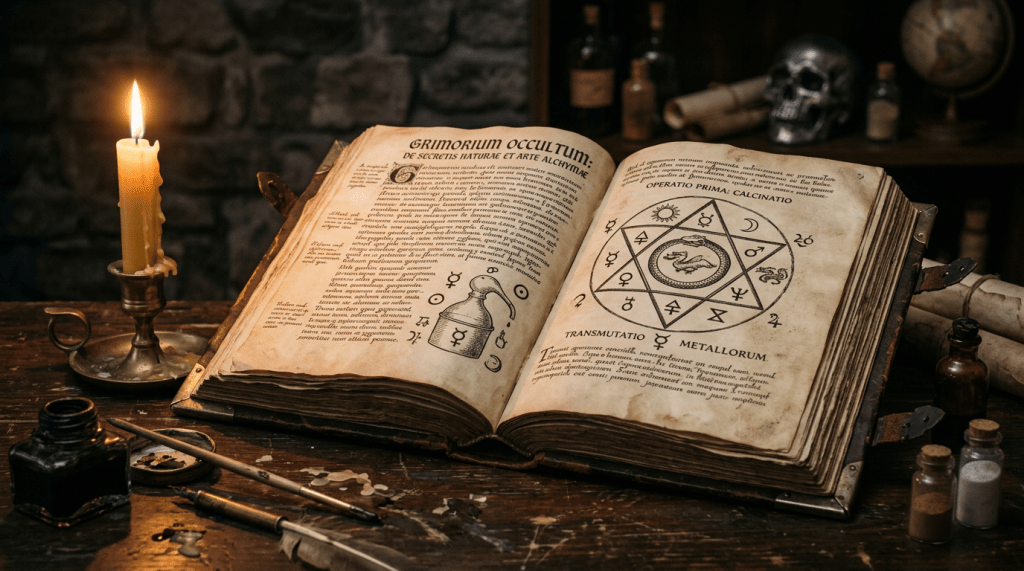
Alchemy — the attempt to work transformation, usually through carefully structured processes. Historically this meant the transmutation of metals. The historian’s view now is that the metallurgical goal was often secondary. The real subject was the transformation of the practitioner. The stages of alchemical work — nigredo, albedo, rubedo — were as much a map of psychological and spiritual process as they were a laboratory procedure.
Magic — the attempt to produce effects in the world through intention, ritual, and the invocation of non-physical forces. This is the domain most resistant to contemporary framing and the one with the most baggage. It’s also the one that turns up, in various forms, in every human culture that has ever been studied.
The overlap between these three is extensive. A serious alchemical practice incorporates divination and ritual. A serious magical working typically includes both. The boundaries are organizational conveniences, not hard walls.
The Philosopher’s Stone as Map, Not Goal
The most famous idea in Western occultism is the philosopher’s stone — the legendary substance that transmutes base metals into gold, that confers immortality. It’s been treated as a literal goal, a hoax, a metaphor, and a delusion, depending on who’s writing.
The more honest reading is that it was probably all of these things at different times and to different practitioners.
The transmutation of lead into gold works as a literal claim if you’re an early alchemist who hasn’t drawn the same lines between chemistry and magic that later centuries would draw. It works as a metaphor if you understand that the real process being described is the transformation of the self — turning what is base, reactive, and unconscious into something refined, intentional, and aware.
That second reading isn’t a modern reinterpretation. It’s in the original texts. Alchemists wrote about the inner work and the outer work together, often using them as mirrors for each other. The process of refining a substance and the process of refining a person were understood to be related. As above, so below. As within, so without.
This is also the reading that makes the most practical sense when you look at what occult initiation traditions actually ask people to do. They don’t primarily ask you to perform rituals. They ask you to change. The rituals are a technology for facilitating the change.
The parallel to UFO research is not incidental. The progression from “what are these craft and how do they fly” to “what is consciousness, what is reality, and what is the nature of these encounters” follows the same structure. You start with an external phenomenon. You end up inside a question about the nature of the person doing the investigating. That’s the alchemical pattern. It shouldn’t surprise anyone who’s been in this field long enough.
What the Occult Is Not
Occult is not inherently Satanic. The overlap of Satanism and occult tradition is real but late — the organized, explicitly Satanic strand of Western occultism doesn’t meaningfully predate the early medieval period, and even then it exists primarily as a reaction to Christian dominance. The occult itself predates Christianity by millennia. We’ll deal with Satanism specifically in a later chapter.
Occult is not inherently supernatural. Many of the most serious practitioners throughout history understood what they were doing as natural philosophy — the investigation of forces that existed in the natural world but weren’t yet understood. The 16th-century occultists who approached their work with something resembling a scientific method weren’t operating outside the framework of empirical inquiry. They were operating in a framework that hadn’t yet separated chemistry from alchemy, astronomy from astrology, or psychology from spirit.
Occult is not a single tradition. It’s a category containing dozens of distinct lineages, practices, and philosophical frameworks, many of which are in direct conflict with each other.
Occult is not for initiates only — not anymore. Most of the major texts are now freely available. What initiation traditions actually guard, when they guard anything, is not information but context. The Key of Solomon is on any occult bookstore’s shelf. Understanding what you’re looking at when you read it is a different matter.
The Secrecy Problem
Why is occult knowledge hidden in the first place? Three answers, all probably partly true.
The traditional answer: the knowledge is dangerous in unprepared hands. The Abramelin working is a six-month ritual operation that experienced practitioners actively discourage novices from attempting — not because of prohibition but because of documented consequences for those who underestimated what they were doing.
A more cynical answer: secrecy creates value. Knowledge controlled by a small group with the authority to grant or withhold access can be leveraged for money, loyalty, and power. The history of occult organizations is substantially a history of this dynamic. The manipulation vulnerability is real and documented. People at the top of these organizations often know this. The people lower down frequently don’t.
A third answer — the one most interesting from a research perspective — is that the knowledge itself tends toward hiddenness. Certain states of consciousness, certain experiences of the relationship between intention and effect, are genuinely difficult to transmit through ordinary language. The structures of initiation may be, at their most functional, attempts to create conditions in which a type of understanding that can’t be explained can be experienced.
Whether that understanding constitutes contact with something real or is a consistent feature of human neurology triggered through specific practices is a question this series will not resolve. It’s a question worth living inside.
The Continuity Question
Here’s what makes the occult relevant to Fortean research specifically:
The same structures — timing, symbol, altered state, intention, result — appear in the Egyptian heka tradition, in the Mesopotamian divination texts, in the Greek mystery cults, in the medieval grimoires, in the Renaissance ceremonial magic systems, and in the accounts of people who describe contact with non-human intelligences in the 20th century.
The ritual elements that practitioners use to enter the relevant states have been measured. They produce physiological states documented in people who describe contact experiences. That correlation has been noted by researchers in both fields. It hasn’t been explained.
The shamanic tradition should be in this picture. Knowledge passed from practitioner to practitioner under conditions of secrecy, accessed through altered states, involving apparent contact with non-human entities — this is occult practice by definition, and it predates every formalized occult tradition in the Western record. This is a thread worth following. The next chapter pulls it back to its beginning.
A Note on What This Series Is
This is not a practitioner’s guide. It’s not a debunking. It’s a history — an attempt to lay out what the occult tradition actually is, where it came from, how it traveled, who held it, who weaponized it, and where it intersects with the research Fortean Winds has been doing since the beginning.
The same questions we bring to UAP, to cryptid encounters, to poltergeist cases — what is the evidence, what does the pattern suggest, where does the official account fail — apply here. The occult has an official account, which is that it’s superstition dressed up in elaborate vocabulary. That account does not survive contact with the historical record.
What the record actually shows is more complicated and more interesting. Ten chapters to tell it.
Next: Chapter 2 — Origins: The Ancient World

