
Every major occult order in history has followed the same arc: synthesis, institutionalization, fracture. The knowledge gets assembled from available sources. An organization forms around it. A charismatic figure breaks the organization apart. The fragments scatter and recombine. The Golden Dawn ran this pattern in under twenty years. The OTO ran it in under ten. The Rosicrucians managed it without ever officially existing.
Chapter 3 traced how occult knowledge survived through institutional hosts. Chapter 4 established what that knowledge actually is: a contact protocol. This chapter covers what happens when serious practitioners try to institutionalize that protocol — to create organizations capable of preserving, transmitting, and extending it across generations.
The short version is that it keeps failing in the same way. Not because the knowledge is wrong, but because the institutional form introduces problems that the knowledge itself doesn’t have. Hierarchical initiation creates gatekeepers. Gatekeepers attract people who want the gate more than what’s behind it. The organization develops interests of its own. The original purpose gets diluted, corrupted, or captured. Eventually someone with real ability and real ambition decides the institution is in the way and blows it up.
This is the pattern. It ran with the Rosicrucians, the Golden Dawn, and Crowley’s OTO. It ran with the Nazi occult apparatus. It is running in every occult organization operating today.
The Rosicrucian Template
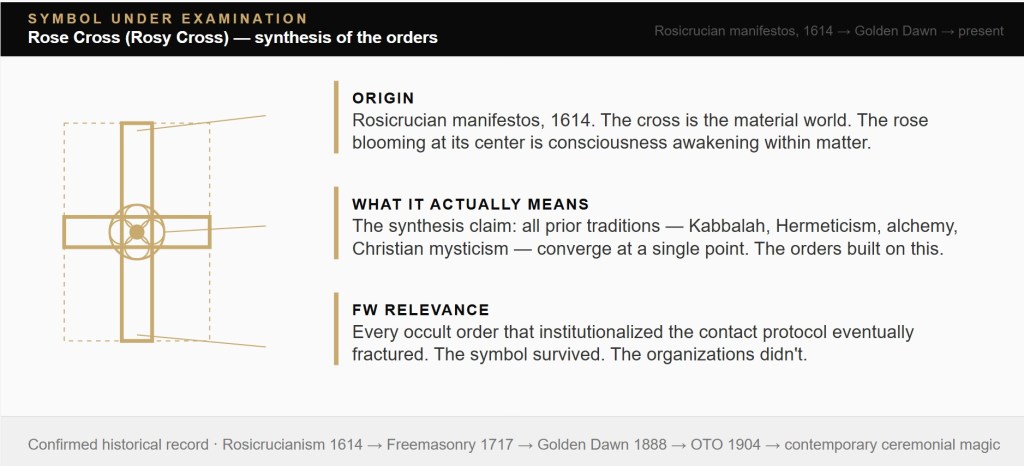
The Rosicrucians established the organizational template in 1614 by publishing a manifesto for an order that may or may not have existed.
The Fama Fraternitatis described a secret brotherhood of scholars in possession of ancient wisdom, founded by a mysterious traveler named Christian Rosenkreutz who had learned from Islamic masters in the East. The manifesto invited worthy candidates to contact the brotherhood. Hundreds responded. Nobody was ever definitively contacted.
Whether the Rosicrucian brotherhood existed as described is genuinely unresolved. What is documented is the effect: the manifestos created a social phenomenon in which people organized themselves around the pursuit of the described knowledge, forming de facto Rosicrucian communities simply by claiming to be in contact with the invisible fraternity. The organization was conjured into existence by the desire for it.
This turns out to be an efficient model. An invisible organization with claimed access to ancient wisdom attracts motivated self-selectors. The absence of a visible hierarchy prevents the corruption that visible hierarchies accumulate. The Rosicrucian template directly influenced Freemasonry, which formalized in the early 18th century with a similar structure: graded initiation, symbolic language, claims of ancient lineage, and a public presence that concealed whatever actual practice was occurring in the higher degrees. Freemasonry attracted Benjamin Franklin, Voltaire, Mozart, and most of the architects of the American republic.
The Golden Dawn: The Synthesis
The Hermetic Order of the Golden Dawn, founded in London in 1888 by William Wynn Westcott, Samuel Liddell MacGregor Mathers, and William Robert Woodman, represents the most ambitious synthesis of the Western occult tradition ever attempted.
The Golden Dawn absorbed everything: Kabbalah, Hermeticism, alchemy, astrology, Enochian magic from Dee’s system, Egyptian symbolism, tarot, Neoplatonism, Rosicrucian framework. It organized this material into a structured curriculum with graded initiations — ten levels corresponding to the Kabbalistic Tree of Life, each requiring demonstrated mastery of the previous level’s material before advancement. The system was rigorous. Initiates studied for years before reaching the inner order. The practice was not decorative.
The membership roster reads like a Who’s Who of late Victorian intellectual and artistic life: William Butler Yeats, Arthur Machen, Dion Fortune, and Aleister Crowley, who joined in 1898 and almost immediately became a problem. The Golden Dawn’s working method at the outer levels involved meditation, ritual, and the systematic development of the ability to operate in the astral. Members at the inner order level reported consistent contact with entities they understood as elemental and planetary intelligences.
What the Golden Dawn built was a functioning initiatory path. People went in not knowing how to do anything and came out with measurable skills and documented experiences. That’s what the hierarchy was for — not to exclude, but to structure a development process that actually worked.
The Fracture: Crowley vs. Yeats
The Battle of Blyth Road in 1900 is the moment the Golden Dawn broke.
Mathers, the primary architect of the system, had become increasingly unstable and dictatorial, governing the order from Paris and issuing erratic orders. Crowley, recently returned from an Abramelin working in Scotland and already demonstrating the combination of genuine ability and complete disregard for institutional norms that would define his career, allied with Mathers against the London reformers.
Yeats, leading the London faction, is famously said to have made Crowley physically ill through an act of magical working. Crowley backed off. The London faction expelled Mathers and effectively dissolved the original order. Various successor organizations formed from the fragments.
The fracture revealed something structural about occult organizations: the same knowledge that makes a genuine practitioner effective also makes them resistant to institutional authority. The people who get the furthest in the system are the ones least likely to accept being told what to do by it. Every occult order either solves this problem by never producing advanced practitioners, or it produces advanced practitioners who eventually destroy the organization.
Crowley: What He Actually Did
Aleister Crowley (1875–1947) is the most important occult practitioner of the 20th century and the most difficult to evaluate accurately because of the noise around him.
The noise: he cultivated the persona of “the Great Beast” and “the wickedest man in the world” as a deliberate strategy. He was genuinely difficult, genuinely hedonistic, and genuinely destructive of relationships and organizations. He died broke and largely discredited by mainstream culture.
What he actually did: he completed the Abramelin working and documented the results in detail. He developed and systematized the Enochian system beyond anything Dee had achieved. He received The Book of the Law in Cairo in 1904 — a three-day dictation from an entity identifying itself as Aiwass — and spent the rest of his life interpreting and implementing its instructions. He produced the most comprehensive practical grimoire of the 20th century (Magick in Theory and Practice). And in 1918, he drew a portrait of an entity he called Lam, with whom he claimed regular contact.
The Lam portrait shows a large-headed being with almond-shaped eyes, a triangular face, pale coloring, and a specific quality of presence. When Whitley Strieber published Communion in 1987, the cover image — based on Strieber’s description of what he encountered — looked like Crowley’s Lam. Crowley’s portrait predates Strieber’s cover by sixty-nine years. The visual correspondence is not explained by cross-contamination.
The FW research has flagged this directly: Crowley drew a description of a being that looked very similar to what we now call the Grays. Almond-shaped eyes, triangular head, same quality of pallor. If Crowley was being honest about something, that’s what he was being honest about.
The Book of the Law’s core instruction — “Do what thou wilt shall be the whole of the Law” — is typically misread as hedonistic license. Crowley was specific about what it meant: the True Will, each person’s genuine purpose in the cosmic plan, is not the same as ordinary desire. Finding and following the True Will requires the same kind of extended preparation and contact that the Abramelin working describes. The philosophy was not libertinism. It was a working map of how to align personal action with cosmic correspondence.
The OTO and After
The Ordo Templi Orientis, which Crowley took over in the 1910s and reformed around Thelemic principles, fragmented — like everything he touched organizationally — but survived in various forms and operates today.
More important than the OTO’s institutional history is what it transmitted. The system Crowley developed — integrating Enochian, Hermetic, Kabbalistic, and Thelemic elements into a coherent operative practice — became the foundational reference for virtually all serious Western ceremonial magic practiced in the 20th century. Dion Fortune, who disagreed with Crowley on almost everything, worked within a framework he had substantially shaped. The chaos magic movement of the 1980s was explicitly a reaction against Crowley’s systematization while being entirely dependent on it. Every occult organization operating today that has any serious operative content is working in Crowley’s shadow.
Jack Parsons and What Happened at JPL
The thread runs directly from Crowley to the space program, and this should disturb people more than it does.
John “Jack” Parsons was one of the founders of both the Jet Propulsion Laboratory and Aerojet Engineering Corporation. His work on solid rocket propellants was foundational to the American space program. He was also a devoted Thelemite, a practicing ceremonial magician, and the head of the Agapé Lodge of the OTO in Pasadena from the late 1930s until his death in 1952.
Parsons conducted the Babalon Working in 1946 — an extended series of ritual operations designed to invoke the Thelemic goddess Babalon into physical manifestation. He conducted these operations in the Mojave Desert with L. Ron Hubbard. Hubbard subsequently founded Scientology, an organization whose structure borrows extensively from Crowley’s system while eliminating the explicitly occult framing. The connection is documented.
The relevant observation: Parsons, Tsiolkovsky, and von Braun — three of the founding figures of modern rocketry — each claimed or implied contact with non-human intelligence as a factor in their work. Parsons believed he was working with such forces deliberately. Von Braun, at the end of his life, said publicly that the work could not be attributed entirely to human effort, and then declined to say more. Tsiolkovsky believed he was in contact with extraterrestrials.
Three founding figures of the technology that put humans in space. Each with a claimed connection to non-human intelligence. Whether this reflects genuine contact, the psychology of a certain kind of visionary mind, or the kind of thing ambitious people say without expecting anyone to take seriously — it is a pattern worth noting.
The Organizational Problem, Restated
The Golden Dawn’s twenty-year arc from synthesis to fracture. Crowley’s lifetime of brilliant work and organizational destruction. The OTO’s century of fragmentation and recombination. The Rosicrucians’ resolution of this problem by never formally existing.
The pattern suggests something about the relationship between the knowledge and any organizational form designed to house it. The knowledge, when it works, produces practitioners who are changed by it — who have experiences that reorient their relationship to ordinary reality, who have made contact with something that leaves them with a different frame of reference. People in that state do not make good members of hierarchical organizations.
The organizations that survive are the ones that stop producing advanced practitioners. The organizations that produce advanced practitioners tend to explode. This is not a flaw. It is the system working as designed.
Next: Chapter 6 — The Occult and Power: Nazis, MKUltra, Political Occultism. The point where the tradition collides with the 20th century’s most destructive institutional projects, and what that collision reveals about both.
Previously in this series: Chapter 4 — The Grimoires · Chapter 3 — The Transmission Problem · Chapter 2 — Origins: The Ancient World · Chapter 1 — What the Occult Actually Is

