
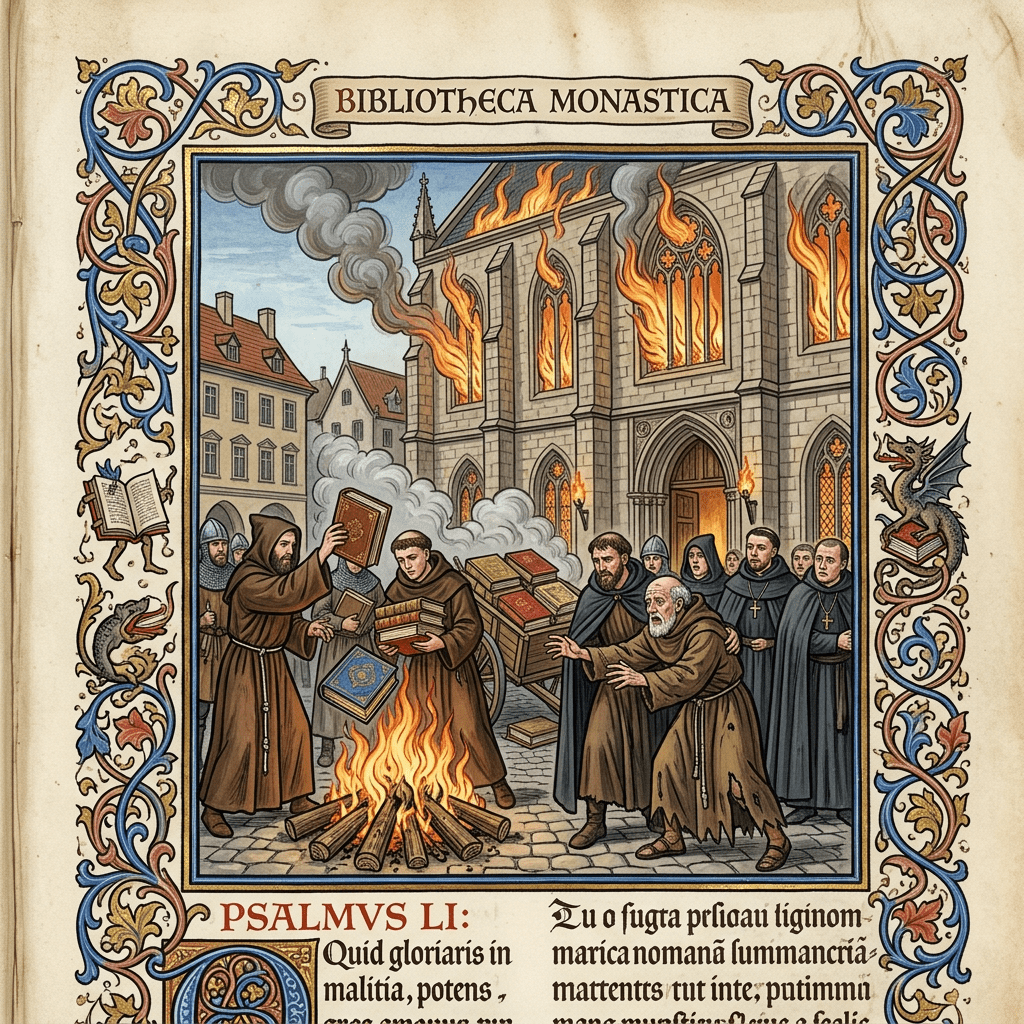
The ancient world had the knowledge. Then the ancient world ended. The question is how the knowledge got from there to here — through six centuries of institutional suppression, the near-total destruction of classical libraries, and a Church that officially condemned the practices while quietly preserving the texts.
The collapse of the Western Roman Empire in the 5th century CE is the first major stress test for the occult tradition. Egypt had been producing magical papyri for three thousand years. The Babylonian astronomical tradition had been feeding into Greek philosophy for seven centuries. The Hermetic synthesis had given the whole edifice a theoretical framework. And then Rome fell, the libraries burned, the trade routes collapsed, and the institutional structures that had housed this knowledge for millennia simply stopped operating.
What survived, and how it survived, is one of the most consequential stories in the history of ideas — and almost nobody tells it straight.
The short version is this: the knowledge went in three directions simultaneously. A significant portion went into the Catholic Church, which preserved it in ways that official Church history has never been particularly eager to discuss. A larger portion traveled east, where it was absorbed, translated, expanded, and systematized by Islamic scholars during the Golden Age. And a third stream went underground into initiatory traditions that operated outside institutional structures entirely. All three streams eventually converged in 15th-century Florence, producing the Renaissance occult revival — and that revival itself would be revived again in the 19th century, creating the direct lineage to everything that follows.
The First Suppression: What the Early Church Actually Did
Before we get to Rome’s collapse, there’s an earlier suppression that matters more and gets discussed less.
For the first three centuries after Christ, Christianity was not a single unified institution. It was a collection of competing movements, many of which had profound mystical and occult dimensions. The Gnostic sects — and there were dozens of them, not one — understood the material world as the creation of a lesser deity, the soul as trapped within it, and gnosis (direct, inner knowledge of the divine) as the path out. The Gospel of Thomas has Jesus saying “the Kingdom of God is within you, and all around you.” The Gospel of Mary frames discipleship as a mystical inner journey. These were books of the Bible for communities across the ancient Mediterranean.
Mysticism wasn’t removed from early Christianity — it was always there, for the first three hundred years after Christ’s death. What happened at the Council of Nicaea in 325 CE and in the decades that followed was a deliberate narrowing. Texts were excluded, councils decided what counted as scripture, and everything outside that perimeter got labeled heretical. A living, diverse tradition with extensive mystical and experiential content was compressed into an institutional form that could be controlled.
The people who held the excluded knowledge didn’t disappear. They went underground. Gnostic communities operated in secret, continuing to transmit initiatory knowledge through controlled channels. The Hermetic tradition — which wasn’t Christian but which had been in conversation with early Christian mysticism throughout — continued in the same underground currents. The suppression didn’t destroy the knowledge. It converted it into exactly the kind of hidden, transmitted-under-oath tradition that this series has been tracking since Chapter 1.
The Church that did the suppressing then did something structurally paradoxical: it became the primary archive of what it had suppressed.
The Church’s Complicated Custody
The official position of the Catholic Church on magic was condemnation. This position was applied with considerable inconsistency.
The grimoire tradition contains texts attributed to popes — the Grimoire of Pope Honorius, the Sworn Book of Honorius — and there is nothing surprising about this to anyone who has actually read the medieval historical record. The monasteries were the libraries of the dark ages. Everything that survived the collapse of Rome survived in monastic collections. This included the Hermetic texts, the Neoplatonic philosophical tradition, fragments of the Greek magical papyri, and the entire body of late antique astrological literature.
The monks copying these texts were not doing so as an act of rebellion. The distinction between magia naturalis — natural magic, the study of hidden forces in the natural world — and demonic magic was one that medieval scholars took seriously and debated extensively. Figures like Albertus Magnus and Roger Bacon worked within the occult philosophical tradition without understanding themselves to be doing anything incompatible with Christian orthodoxy. They were studying the hidden structure of creation.
The result is a paradox that runs through the entire medieval period: the Church was simultaneously the primary institutional suppressor of occult practice among the general population and the primary institutional preserver of occult knowledge within its own scholarly class. The Inquisition burned practitioners. The monasteries copied their texts.
Kabbalah traces a related path through this period. Jewish mystical tradition — rooted in the earlier Merkabah literature and eventually crystallized in the Zohar in 13th-century Spain — developed a sophisticated system of occult cosmology operating largely in parallel with, and in ongoing conversation with, Christian and Islamic traditions. The Sephiroth — ten divine emanations through which the infinite becomes finite — entered Western occultism through this channel. The Tree of Life became one of the central organizing maps of the entire ceremonial magic tradition.
Pico della Mirandola combined Hermetic philosophy with Kabbalistic cosmology in 900 theses he presented in Rome in 1487 and offered to defend against all comers. The Pope suspended the debate and investigated him for heresy. He was later cleared. The episode captures the whole ambiguity of the period in one event.
The Islamic Bridge
The part of this story that Western occult history consistently underweights is the Islamic Golden Age.
From the 8th century onward, the Islamic caliphates became the most significant centers of learning on earth. The translation movement of the 8th and 9th centuries, centered in Baghdad at the House of Wisdom (Bayt al-Hikma), systematically translated the entirety of Greek philosophical and scientific literature into Arabic — Aristotle, Plato, the Neoplatonists, the Hermetic texts, the mathematical and astronomical traditions of both Greece and Babylon. Material that had no surviving Greek originals was preserved only in Arabic translation.
This was not a passive archiving operation. Islamic scholars added to, critiqued, and expanded everything they translated. The astronomical tradition in particular was dramatically advanced — Al-Battani, Ibn Yunus, and Al-Biruni produced observational and mathematical work that wouldn’t be surpassed in Europe until Copernicus and Kepler, both of whom were building directly on the Islamic astronomical tradition.
The Picatrix — Ghayat Al-Hakim in its original Arabic, “The Goal of the Wise” — is the most significant product of this synthesis for the occult tradition specifically. Compiled in 11th-century Andalusia from Arabic and older Babylonian and Sabian source material, it is the most comprehensive systematic treatment of astral magic produced before the Renaissance. After its translation into Latin in 13th-century Toledo, it became one of the primary source texts for the Renaissance magical tradition.
The translation centers of Toledo and Sicily in the 12th and 13th centuries were where the Islamic Golden Age poured back into European intellectual culture. Albertus Magnus and Thomas Aquinas were studying Aristotle from Arabic translations. The occultists of the same generation were studying the Picatrix from the same translation workshops. The Renaissance didn’t recover ancient wisdom from rubble. It received it through a 600-year chain of custody that ran through Baghdad and Cordoba.
The Underground Stream
Not everything went through institutions.
The Cathars, the Waldensians, the Gnostic revival movements that kept appearing across southern France and northern Italy from the 11th century onward — all maintained positions on the nature of reality structurally similar to the Hermetic and Neoplatonic traditions. A hidden divine order. A corrupt material world. The possibility of direct access to higher reality through disciplined practice. Heresy trials provide some of the best documentation we have of what these groups actually believed and did.
The Knights Templar, suppressed in 1307 under charges that included heresy and the worship of a figure called Baphomet, represent a similar case. Whether the specific charges were accurate — most historians consider them coerced — the Templars demonstrably had access to and interest in non-Christian knowledge traditions through their extended presence in the Holy Land and their contact with Islamic and Jewish scholarly communities.
Freemasonry claims a lineage from the Templars, a claim historians treat as unverified. The craft guild origins of Masonic lodges are better documented: medieval operative stonemasons maintained initiatory structures, controlled technical knowledge, and developed symbolic vocabularies absorbed into speculative Freemasonry in the 17th and 18th centuries. Whether the deeper cosmological content came from the guild tradition, from Rosicrucian influence, from Templar inheritance, or was constructed from available Hermetic literature by sophisticated 17th-century intellectuals remains genuinely unresolved.
Toledo to Florence: The Reconnection
The moment where the three streams converge is 15th-century Florence, and the mechanism is a manuscript.
In 1460, a monk arrived in Florence from Macedonia carrying a copy of the Corpus Hermeticum — the same texts compiled in Hellenistic Egypt, preserved in Byzantine collections, translated into Arabic, preserved again, and now returning to the West. Cosimo de’ Medici ordered Marsilio Ficino, already working on Plato, to drop Plato immediately and translate the Hermetic texts first. Ficino completed the translation in 1463.
The Corpus Hermeticum was read in Florence as ancient wisdom — far older than Plato, potentially the original source from which all Greek philosophy derived. This was incorrect: the texts are almost certainly products of the first centuries CE, not ancient Egypt. But the misattribution of their antiquity made them more authoritative, not less. The entire Renaissance occult project operated under the assumption that it was recovering original ancient wisdom. That mistake wasn’t corrected until Isaac Casaubon dated the texts accurately in 1614, by which point the Renaissance occult revival had been running for a century and a half and had produced Agrippa’s Three Books of Occult Philosophy, Paracelsus’s alchemical medicine, the Rosicrucian manifestos, and John Dee’s Enochian system.
The Rosicrucian manifestos — the Fama Fraternitatis and Confessio Fraternitatis, published in Germany in 1614 and 1615 — represent the transmission problem folding back on itself. They claimed the existence of a secret brotherhood in possession of ancient wisdom. Whether the brotherhood actually existed as described is debated. What happened was not: the manifestos detonated across European intellectual culture. Hundreds of people published responses trying to contact the brotherhood. The occult tradition was pulled out of esoteric circles and into public intellectual discourse for the first time in centuries.
The 19th-Century Revival: Blavatsky and the Modern Lineage
The chain doesn’t stop at the Renaissance. It runs forward.
The 19th century produced the occult revival that directly creates everything recognizable in the modern tradition. Helena Blavatsky, who founded Theosophy in 1875, was by any serious assessment the most influential single individual in Western occultism between the Renaissance and the 20th century.
Blavatsky claimed contact with adept masters in possession of ancient knowledge. Her work — Isis Unveiled (1877) and The Secret Doctrine (1888) — synthesized Eastern and Western esoteric traditions at a scope that hadn’t been attempted since the Renaissance. She was drawing on the same source material: Egypt, India, Kabbalah, Neoplatonism, alchemy. But she was routing it through a 19th-century framework that made it accessible to a Victorian intellectual audience simultaneously losing faith in conventional Christianity and suspicious of materialist science.
The Hermetic Order of the Golden Dawn, founded in 1888, absorbed and operationalized what Theosophy had revived. William Butler Yeats, Aleister Crowley, and Dion Fortune all came through this lineage. Crowley’s work — covered in Chapter 5 — is incomprehensible without understanding that it emerged directly from the Golden Dawn’s synthesis of Kabbalah, Hermeticism, and Egyptian magical practice. The Golden Dawn didn’t invent its system. It assembled it from the same components the Renaissance occultists had assembled centuries earlier.
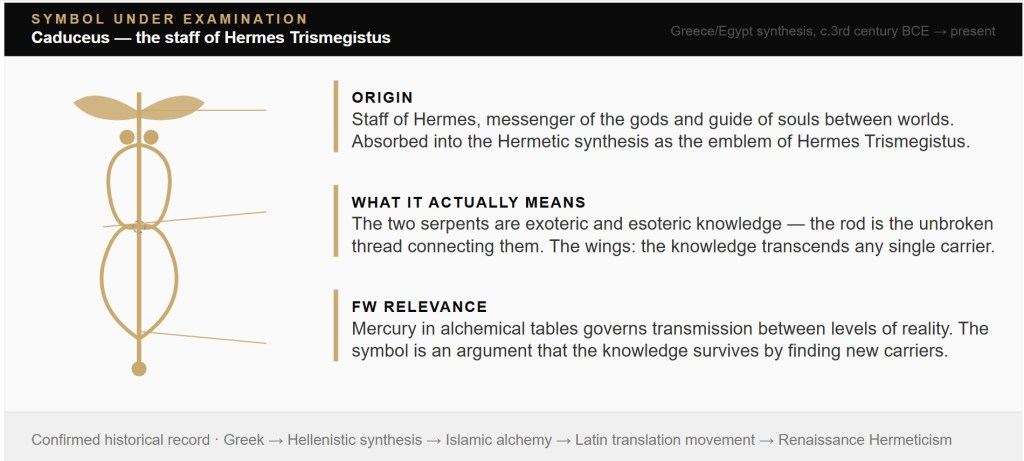
Hermeticism revived by Blavatsky, turned toward Theosophy, influencing the Golden Dawn and Crowley in different ways. That’s the chain of custody from Florence 1463 to the 20th century. The same knowledge. Different carriers. As the Caduceus is designed to illustrate — the rod runs through all of them.
Caduceus — symbol dissection, Chapter 3 SYMBOL UNDER EXAMINATION Caduceus — the staff of Hermes Trismegistus Greece/Egypt synthesis, c.3rd century BCE → present ORIGIN Staff of Hermes, messenger of the gods and guide of souls between worlds. Absorbed into the Hermetic synthesis as the emblem of Hermes Trismegistus. WHAT IT ACTUALLY MEANS The two serpents are exoteric and esoteric knowledge — the rod is the unbroken thread connecting them. The wings: the knowledge transcends any single carrier. FW RELEVANCE Mercury in alchemical tables governs transmission between levels of reality. The symbol is an argument that the knowledge survives by finding new carriers. Confirmed historical record · Greek → Hellenistic synthesis → Islamic alchemy → Latin translation movement → Renaissance Hermeticism
What This Chapter Establishes
The transmission problem has an answer, and the answer is: the knowledge survived because it kept finding new institutional hosts, none of which fully understood what they were hosting.
The early Church suppressed the Gnostics while preserving their textual tradition in monastic libraries. Islamic scholars translated the Hermetic and Greek texts without believing them. The Medici funded the Hermetic revival because they wanted the best available intellectual product. The Rosicrucian manifestos spread the tradition by not existing. Blavatsky rebuilt it in the 19th century from pieces sitting in libraries for four hundred years.
The pattern holds across twelve centuries: knowledge that produces results when applied doesn’t need protective custody. It keeps re-emerging.
Next: Chapter 4 — The Grimoires: What They Actually Say. The Key of Solomon, Abramelin, Enochian, the Goetia — what’s actually in these texts, what the consistent elements reveal, and why the FW grimoire analysis found what it found.
Previously in this series: Chapter 2 — Origins: The Ancient World · Chapter 1 — What the Occult Actually Is

