
Grimoires are the most misread documents in the history of the occult. They get treated as props — dusty books of spells, conjuring fodder for horror films. That’s not what they are. They are technical literature. They are documentation of a methodology that was tested, refined, and transmitted across centuries. The question Fortean Winds put to them was the right one: do they point to a technology? The answer is yes.
FW published its grimoire analysis in December 2024 — a systematic pattern analysis across sixteen major texts, from the Lemegeton to Crowley’s Book of the Law. The findings are worth stating plainly before the history: every grimoire examined, across six centuries and multiple cultural contexts, converged on the same operational structure. Timing. Symbol. Chant. Psychological preparation. Expectation of contact.
That’s not a coincidence of literary convention. That’s a consistent methodology. The question is what the methodology is for.
What a Grimoire Is
The word is French, from the same root as grammar — a book of instructions for correct practice. Medieval grimoires were, at their most functional, technical manuals. Not devotional texts. Not theological treatises. Instruction sets.
The practitioners who used them understood themselves to be working with real forces in the natural world. The Hermetic framework — as above, so below — gave them a cosmological model in which those forces were accessible through correct alignment of timing, symbol, and intention. The grimoire was the reference document for that alignment. It told you which planetary hour to work in. Which seal to draw. Which names to invoke. Which state to achieve before beginning.
The Church’s discomfort with grimoires was not primarily about the content of the spells. It was about the claim implicit in the whole enterprise: that a private individual, following a written procedure, could access forces that official religious institutions claimed to mediate. The grimoire democratized access to the contact protocol. That was the threat.
The Major Texts
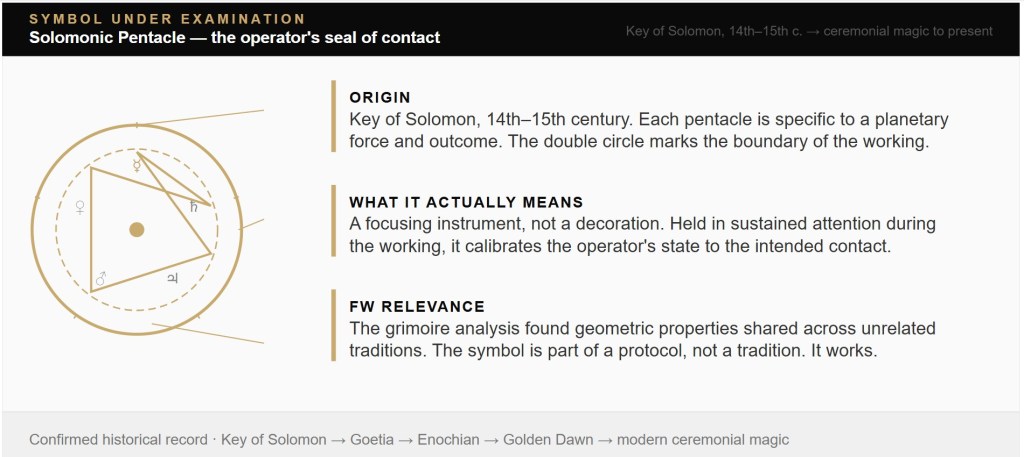
The Key of Solomon (Clavicula Salomonis), compiled in its current form in the 14th to 15th centuries, is the foundational text of Western ceremonial magic. It covers the construction of magical tools, the preparation of the practitioner, the use of the pentacles (seals associated with specific forces and outcomes), and the timing of operations by planetary hours. The emphasis on preparation is extensive. The operator must be in a specific physical and psychological state before any working begins. Impurity — defined broadly as physical uncleanliness, emotional disturbance, or failure to observe required fasting and abstinence — is treated as a technical failure, not a moral one. The system won’t work if the operator isn’t properly calibrated.
The Goetia (part of the Lemegeton, 17th century in current form) is a catalog of 72 spirits — their seals, their ranks, their domains of influence, and the procedures for summoning them. The popular reading misses almost everything important. The spirits are not invoked randomly. Each operates within specific domains — some provide knowledge, some teach skills, some produce specific practical effects. The practitioner is not demanding power over the spirit; the system is designed to negotiate. The seals serve as both identifiers and constraints. The planetary timing governs when the operation can succeed. The whole apparatus is structured more like a diplomatic protocol than a horror-movie conjuring.
The Book of Abramelin (attributed to Abraham of Worms, 14th to 15th century) is structurally different from most grimoires and more interesting for it. Rather than a catalog of operations, it is a single extended working: six months of progressively intensive preparation, culminating in the Knowledge and Conversation of the Holy Guardian Angel — direct communion with what the text describes as the practitioner’s higher genius or divine counterpart. The preparation phase is the entire point. Six months of isolation, prayer, increasing abstinence, and focused intention. The altered state being induced is not incidental to the system. It is the system.
The Enochian system, developed by John Dee and Edward Kelley between 1582 and 1589, is the most anomalous entry in the grimoire tradition and the one that intersects most directly with what we’d now call contact phenomena. Dee — mathematician, astronomer, advisor to Elizabeth I — and Kelley conducted hundreds of sessions with entities who provided, over seven years, a complete angelic language, a cosmological system, and operational instructions. Dee’s diaries are among the most detailed first-person accounts of sustained non-human contact in the historical record. The entities were consistent across sessions. They corrected errors. They provided information Dee subsequently verified. The Enochian system is a contact protocol documented in real time by a serious empirical researcher. That’s what it actually is.
The Picatrix (Ghayat Al-Hakim, 11th century Arabic) is the most technically rigorous of the astral magic texts. Its premise is that celestial forces have direct effects on terrestrial matter and consciousness, and that these effects can be amplified and directed by a practitioner who correctly aligns timing, symbol, substance, and intention with the relevant celestial configuration. The Picatrix is explicit about the mechanism: the practitioner’s own psychophysical state is the primary instrument. The external elements — timing, symbols, materials — are environmental calibration. The consciousness doing the work is what the whole apparatus is calibrated for.
The Consistent Elements
Across all of these texts — different centuries, different cultural contexts, different stated purposes — the following elements appear without exception:
Timing. Every major grimoire specifies when operations should be conducted. Planetary hours, lunar phases, specific days, seasonal alignments. The Goetia’s planetary hours. The Abramelin’s months-long schedule. The Enochian sessions’ specific calendrical structure. The Picatrix’s astrological framework. The consistency of this element across the tradition is the first anomaly. If grimoires were purely literary constructions, the convergence on timing as a critical variable would have no explanation.
Symbol. Every major grimoire uses specific visual symbols — seals, sigils, pentagrams, geometric configurations — as central operational elements. The FW grimoire analysis found that these symbols share structural properties: sacred geometric relationships, flowing interconnected lines, and designs that appear in multiple traditions without documented cross-cultural contact.
Sound. Chanting, specific names spoken in specific rhythms, prolonged vocal toning. Present in every tradition. The acoustic frequencies involved in ritual chanting have been measured. They produce documented physiological effects — alterations in brainwave activity, changes in autonomic nervous system function, induction of specific states of consciousness. The grimoire tradition did not need to know the mechanism to document that the element was operationally necessary. It is present because it works.
Purification and psychological preparation. The insistence across all grimoires that the practitioner must be in a specific state before beginning — physically clean, emotionally settled, fasted, focused on the intention — is not religious moralizing. It is state management. The working requires a specific baseline state in the operator. The purification protocols are the procedures for achieving that baseline.
Expectation of contact. Every grimoire assumes that correctly executing the protocol will produce a response from something external to the practitioner. Not a psychological experience. Not a vision. A contact. An entity that provides information, produces effects, or responds to the invocation. The entire apparatus is built around this expectation because the tradition had accumulated enough successful instances to codify the conditions under which it reliably occurred.
The FW Finding
The grimoire analysis post framed it as a question: do these texts point to a technology?
The answer, stated directly: they describe a protocol for inducing a specific altered state in the practitioner, and that state has been documented in modern research as the same state reported by people who describe what we now call close encounter or contact experiences.
This is not speculation. The correlation between the physiological state induced by sustained ritual practice — timing, symbol, sound, prolonged focused attention, prior preparation — and the state documented in contact experiencers has been noted in peer-reviewed literature. The mechanism that produces the state in a Solomonic working and the mechanism that produces the state in a reported abduction experience produce measurably similar physiological signatures.
The grimoire tradition was not aware of this in mechanistic terms. What it was aware of, and documented extensively, is that the protocol reliably produced contact. The contact was consistent enough, across sufficient practitioners and centuries, to be worth codifying. Enough people got the same result from the same procedure that the procedure was worth recording, transmitting, and preserving.
That is what a technology is. A repeatable procedure that produces consistent results.
What the Numbers Say
The numbers 3, 7, and 12 structure timing hierarchies, entity classifications, and symbolic systems throughout the grimoire literature. They also appear, with documented frequency, in close encounter and UAP reports. Keel noted the significance of 3 in encounter cases. The number appears in the grimoire tradition with the same structural prominence — in triadic invocations, three-stage ritual structures, the triple divine name.
The most parsimonious explanation is the one nobody in either field wants to say: the same source is providing the same structural information to human practitioners across time, through both the ritual contact interface and the direct encounter interface. The grimoires document one channel. The UFO research documents another. The signal is consistent because the source is consistent.
This is a working hypothesis. It is also the hypothesis most consistent with all the available evidence.
The Abramelin Problem
The Book of Abramelin represents the most extreme version of what the grimoire tradition claims is possible — and the documented history of practitioners attempting it is genuinely strange.
The Abramelin working’s six-month protocol produces, if successfully completed, what the text describes as direct knowledge and conversation with the practitioner’s Holy Guardian Angel. In Crowley’s interpretation — and he completed a version of it in 1899 — this contact results in a fundamental reorientation of the practitioner’s entire relationship to their own consciousness. Not a vision. A permanent change in the structure of experience.
The pattern holds not just for Crowley. The documented cases of practitioners who completed extended preparatory workings and subsequently reported sustained contact with consistent entities over extended periods form a small but coherent body of evidence. The preparation changes something in the operator. The changed operator then has a different relationship to the contact. This is what the Abramelin tradition claims. It is also what the contact experiencer literature shows happening to people who undergo extended and repeated encounters without any ritual preparation whatsoever — the preparation happening to them rather than by them.
Why This Matters for the Broader Research
Chapter 1 established that the occult is a hidden knowledge tradition involving contact with non-human intelligence. Chapter 2 traced the origins of that tradition to the oldest documented human cultures. Chapter 3 traced how the knowledge survived. This chapter establishes what the knowledge actually is when you strip away the cultural packaging.
It is a contact protocol. Documented, tested, refined over millennia. The cultural frameworks that surround it — religious, astrological, demonological, angelic — are the interpretive overlays different civilizations placed on the same underlying phenomenon. The phenomenon itself is consistent.
The existing FW research at Quantifying the Mystical: Patterns and Practices in Grimoires established the pattern analysis. This chapter provides the historical context for why those patterns exist and what they mean. They are not coincidences of literary tradition. They are documentation of a methodology that works well enough that every serious practitioner who encountered it, across six centuries, found it worth preserving and transmitting.
That is the most important thing the grimoires actually say.
Next: Chapter 5 — The Orders: Rosicrucians, Golden Dawn, OTO. How the grimoire tradition got institutionalized, what Crowley actually did, and why the pattern of initiation-then-fragmentation keeps repeating.
Previously in this series: Chapter 3 — The Transmission Problem · Chapter 2 — Origins: The Ancient World · Chapter 1 — What the Occult Actually Is

