
America didn’t import the occult tradition. It grew its own, from the same roots as the European tradition but through a distinctly American process: democratic, entrepreneurial, institutionally suspicious, and prone to producing charismatic founders who receive direct transmissions from non-human entities. The pattern holds from Joseph Smith to L. Ron Hubbard. The country was built by Freemasons and has been producing contact experiencers and occult innovators ever since.
The founding generation’s relationship to the occult is hiding in plain sight. Benjamin Franklin and George Washington were Masons. The eye above the pyramid is on the dollar bill. The layout of Washington D.C. incorporates Masonic geometry deliberate enough that L’Enfant’s blueprints are still cited in occult literature. The founding fathers were products of the same Enlightenment-era synthesis that produced Freemasonry — natural philosophy, Hermetic correspondence, the belief that the structure of the universe was accessible to disciplined inquiry.
The occult was never suppressed by the American state the way it was by the Catholic Church in Europe. It went underground differently — not into monastic libraries but into fraternal orders, folk practice, and the religious revivals that swept the 19th century.
Joseph Smith and the Scryer
Joseph Smith (1805–1844) is the clearest American example of the contact-protocol-produces-religion pattern that runs through this entire series.
Smith grew up in upstate New York during the early 19th century, in a region so saturated with religious revivalism that historians call it the Burned-Over District. He was also, before he was a prophet, a scryer — a practitioner of crystal-gazing, specifically the use of a seer stone worn in a hat against the face to block light and perceive hidden things. This is not contested history. The LDS Church itself has acknowledged and released documentation of Smith’s seer stone practice. He used it to find buried treasure for local farmers, a common occupation in an era when folk magic and Protestant Christianity were not yet clearly separated.
The Book of Mormon was, by Smith’s own account, translated by placing the seer stone in the hat and reading the luminous text that appeared. The mechanism is identical to what the grimoire tradition calls scrying — a method for inducing a specific altered state in which information from an external source becomes legible.
The Joseph Smith case follows the exact pattern Keel documented: the phenomenon contacts a person, declares them special and on a mission to save the world, they believe it, and it ends badly. Smith was killed by a mob at 38. But he also founded a religion that now has seventeen million adherents — the most efficient demonstration in American history of how quickly the phenomenon’s transmissions can propagate into permanent institutional form.
Harry Reid — the Nevada senator who funded AATIP, the US government’s first acknowledged modern UAP research program — was Mormon. The Mormons are aware of the connection between their founding tradition and the contact phenomenon.
19th Century: The Respectable Period
The American occult had a respectable phase that is now largely forgotten because it’s inconvenient for both the religious and the secular narratives.
In the 19th century, before the hard split between scientific materialism and religious orthodoxy had completed, it was not unusual for educated, intellectually serious Americans to engage with occult phenomena. William James — the founder of American psychology, professor at Harvard — was a founding member of the American Society for Psychical Research in 1885. He took mediumship seriously enough to investigate it empirically over decades and wrote extensively about the significance of altered states of consciousness for understanding the nature of mind.
The Fox sisters’ Spiritualist movement, beginning in 1848 in upstate New York, is the textbook example. Within a few years the movement had millions of adherents and prominent intellectual supporters including Arthur Conan Doyle and Harriet Beecher Stowe. Many mediums were exposed as frauds. What the skeptical narrative misses is that the best-documented cases — the ones the Society for Psychical Research investigated seriously and couldn’t debunk — produced information and phenomena that don’t have ordinary explanations.
Transcendentalism — Emerson, Thoreau, Whitman — is the philosophical wing of the same current. The direct experience of the divine, accessible without institutional mediation, available through nature and consciousness. Emerson read Hermetic texts. Whitman’s Song of Myself is one of the most sustained descriptions of mystical direct experience in American literature.
New Thought — Mary Baker Eddy’s Christian Science, Ernest Holmes’ Religious Science — is the practical application wing. The mind can affect material reality. Consciousness is primary. Healing through directed intention. These traditions absorbed the operative insight of the occult and delivered it in a form compatible with Protestant Christianity, stripped of the more alarming elements.
The California Current
The specific American contribution to 20th-century occultism runs through California, and it runs in a straight line.
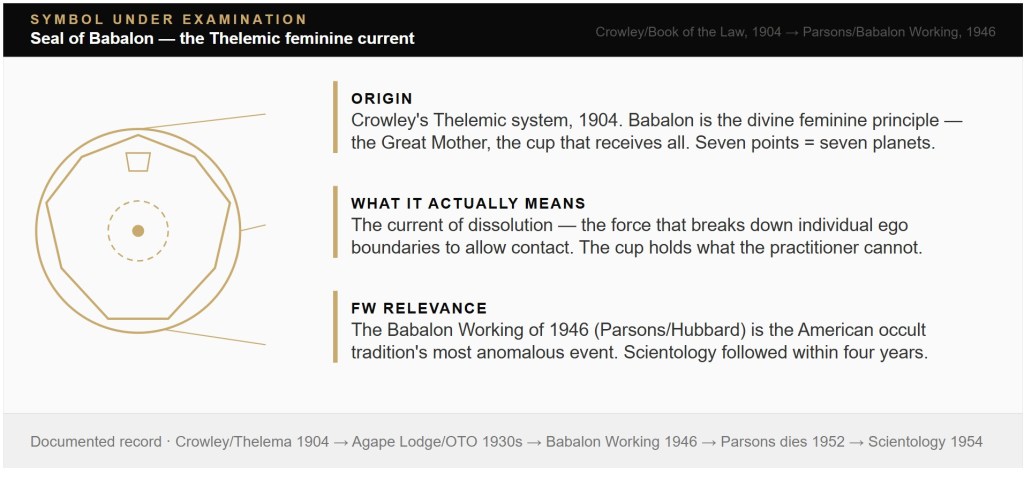
Chapter 5 covered Parsons and the Babalon Working at length. The downstream effects are the California story: Parsons conducted the Babalon Working with L. Ron Hubbard in the Mojave in 1946. Shortly after, Hubbard departed with Parsons’s girlfriend and a significant portion of his savings. Parsons died in a laboratory explosion in 1952 under disputed circumstances.
Hubbard founded Dianetics in 1950 and Scientology as a church in 1954. Scientology’s internal structure — graded levels of initiation, controlled transmission of increasingly advanced material, the concept of Operating Thetans, the Sea Org as an inner order, the extreme measures taken against defectors — maps structurally onto every occult order discussed in Chapter 5. Hubbard denied the Crowley connection publicly and consistently. Which is itself a data point.
The Process Church of the Final Judgment, founded in London in the 1960s and operating in California through the late 1960s, is the other California thread. Peter Levenda’s Sinister Forces documents the connections between the Process Church, Charles Manson, and the broader California occult underground of that period.
The 1906 San Francisco earthquake produced mass migration to Los Angeles at the same time that Crowley’s work was circulating and Pentecostalism was gaining momentum. Blavatsky’s Theosophical Society had a strong California presence. The Azusa Street Revival of 1906, which launched modern Pentecostalism, happened in Los Angeles within months of the earthquake. The city was simultaneously hosting Christian séances, Theosophist meetings, and the organizational infrastructure that would become the JPL twenty years later. These streams were not separate. They were mixing in the same rooms.
This is the environment Parsons grew up and operated in. It is also the environment that produced Hollywood — the American machine for the mass production and distribution of archetypal imagery, operating from the same geographic and cultural context as the most serious American occult practitioners of the 20th century.
American Folk Magic and the Invisible Tradition
The formal occult tradition — lodges, orders, ceremonial magic — is only part of the American story. The folk magic traditions that arrived with enslaved Africans and immigrant communities from Eastern Europe, the Caribbean, and Latin America operated in parallel and largely below the surface of the visible culture.
Hoodoo — the African American folk magic tradition drawing on West African religious practices, Native American herbalism, and European folk magic — is a practical tradition: rootwork, conjure, sympathetic magic. It does not have a cosmological system in the Hermetic sense. It has a tested methodology developed under conditions of extreme oppression, where operative results were a matter of survival.
Vodou, Candomblé, Santería — the Afro-diasporic traditions — are the more formally structured version of the same lineage. All involve direct contact with spiritual entities, ritual protocols for establishing and maintaining those relationships, and a sophisticated understanding of how the contact interface works. These traditions have been systematically suppressed and marginalized in American culture, classified as superstition or Satanism precisely because they represent an independent, non-European-institutional contact tradition with serious operative content. The pattern from Chapter 3 holds: the traditions that got suppressed were the ones that worked.
What Makes the American Occult American
The democratic claim. The European tradition always involved hierarchy and controlled access. The American tradition consistently moves toward democratization. Anyone can read Emerson. Anyone can buy a seer stone. Anyone can take the Dianetics course. This makes American occult movements prone to going mass quickly and losing the operative depth in the process.
The entrepreneurial form. Every major American occult movement has a founder, a product, and a revenue model. Smith’s church, Eddy’s Christian Science, Hubbard’s Scientology, Hill’s Think and Grow Rich. The occult insight gets packaged and sold. This is the most American possible thing to do with it.
The contact claim at the founding. Every significant American occult movement begins with a direct transmission from a non-human entity. Smith’s angel Moroni. Hubbard’s alien cosmology revealed at OT III. The channeled entities of the Spiritualist and New Age traditions. The phenomenon meets the practitioner in whatever cultural framework they’re operating in and produces results consistent with that framework. In 19th-century America, the framework was Protestant Christianity looking for validation. The phenomenon delivered tablets.
Next: Chapter 8 — Satanism: A Late Invention. Organized Satanism postdates early medieval Christianity by a millennium. LaVey’s Church of Satan as political theater. The Satanic Panic as manufactured hysteria. What Satanism actually is and isn’t in the context of the tradition this series has been tracing.
Previously in this series: Chapter 6 — The Occult and Power · Chapter 5 — The Orders · Chapter 4 — The Grimoires · Chapter 3 — The Transmission Problem · Chapter 2 — Origins: The Ancient World · Chapter 1 — What the Occult Actually Is

