
What Makes Someone a Fortean?
Is it a membership card?
A secret handshake?
A shelf bowing under the weight of Charles Fort, John Keel, and yellowing clippings about lights over nowhere?
No.
A Fortean is simpler than that, and harder.
You do not become a Fortean by believing everything. You become one by refusing to look away when reality misbehaves.
That’s the part people miss.
A Fortean is not a true believer. Not a debunker. Not a collector of novelty for novelty’s sake. The real Fortean stance is stranger and more difficult: you stay with the anomaly longer than most people can tolerate. You examine the witness, the data, the context, the hoax angle, the psychological angle, the institutional angle—and you do not rush to close the case just because closure feels good.
That’s what Charles Fort understood. That’s what Ian Miles argued in Why the Future is Fortean: Fortean inquiry lives in the territory of “damned data”—observations pushed outside the accepted map, not always because they are false, but because they are inconvenient, premature, contaminated, absurd-looking, or impossible to process inside the reigning model. And the real Fortean move is to stay skeptical of both the witness and the official explanation. Not because both are equally wrong. Because both deserve pressure.
That’s the club.
No dues. No doctrine. Just curiosity with teeth.
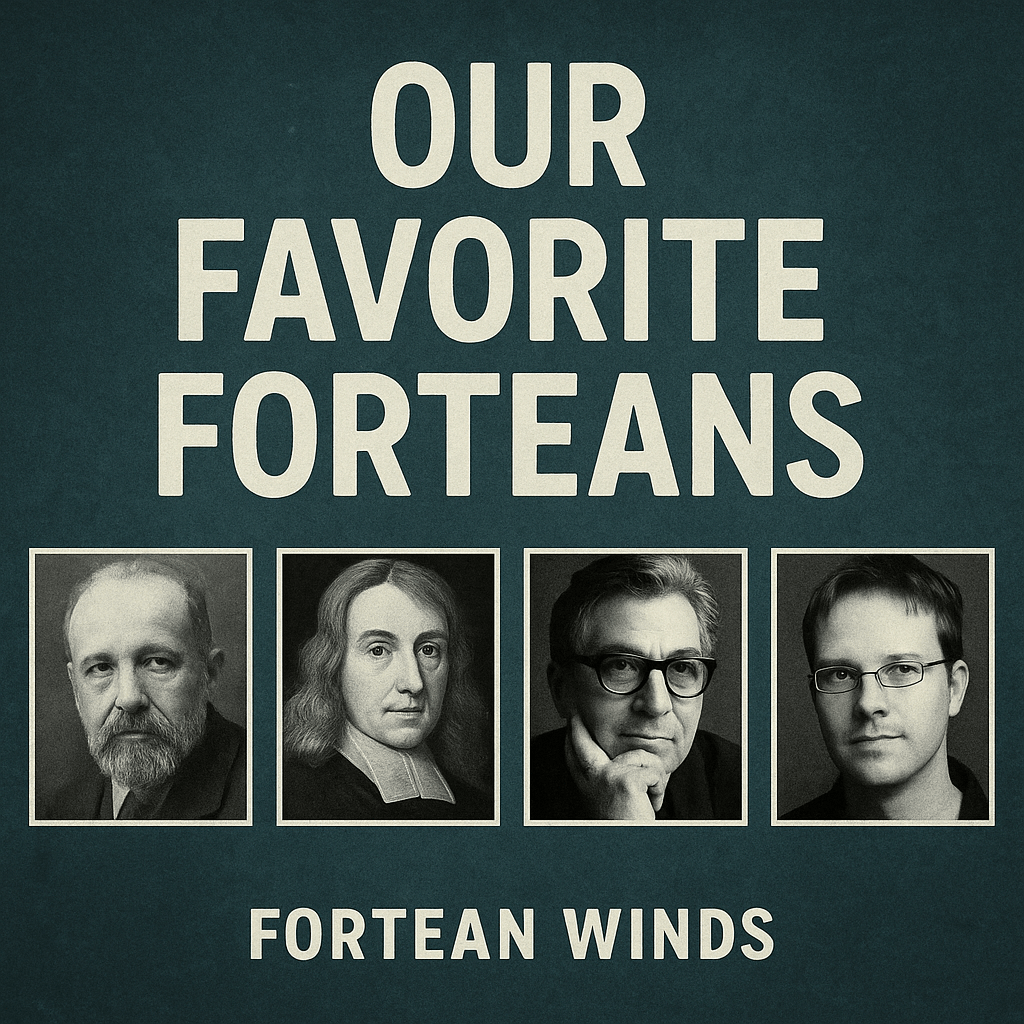
So here’s our list of favorite Forteans—not because they solved the phenomenon, but because they showed us how to remain inside the mystery without surrendering our brains.
1. Charles Fort (1874–1932): The Archivist of the Damned
Let’s start where the weather started.
Fort did not found a religion. He founded a method of irritation.
Before him, the weird was mostly scattered across ghost stories, folklore, rumor, and sensational print. Fort dragged it into a different register. He raided newspapers, scientific journals, niche reports, and forgotten books, then piled up anomaly after anomaly until certainty itself began to wobble. He didn’t just preserve weird reports. He used them like crowbars against intellectual arrogance.
That’s still the move.
Fort understood that the establishment does not only reject bad data. Sometimes it rejects inconvenient data. Data that arrives too early. Data that doesn’t fit the frame. Data that would force a rewrite of the story.
That is peak Fortean.
Notable Works: The Book of the Damned, Lo!
Fortean Hallmark: Treated anomalies as pressure points against dogma, and did it with style.
Why He’s on the List: Because he taught us that the first duty of the investigator is not belief. It is refusal to falsify reality for the comfort of the model.
For more on the kind of anomalies that still live in Fort’s shadow, see our coverage in Strange Science and UFOs/UAP.
2. Robert Kirk (1644–1692): The Minister at the Edge of the Map
Long before “interdimensional” became a content category, Robert Kirk was already taking testimony from the threshold.
His Secret Commonwealth was not written like a cheap hallucination log. It reads more like field notes from a world adjacent to ours—a world of faeries, second sight, hidden intelligences, and what he called “middle natures.” Kirk treated witness tradition seriously without pretending it was simple. He recorded it.
That alone makes him Fortean.
Because witness testimony is messy. It always has been. But dismissing it just because it is culturally contaminated is its own kind of stupidity. Kirk knew that stories accumulate around real experiences, and real experiences get narrated through available symbols. Sound familiar?
Then there’s the ending.
He dies under circumstances folklore immediately absorbs. In true Fortean fashion, the investigator becomes part of the archive.
Notable Work: The Secret Commonwealth
Fortean Hallmark: Took lived testimony seriously without flattening it into doctrine.
Why He’s on the List: Because he understood that folklore is not the opposite of data. Sometimes it’s the storage container.
If your Fortean instincts lean toward entities, hauntings, and liminal encounters, start with our Poltergeist Activity archive.
3. John A. Keel (1930–2009): The Man Who Refused the Easy Answer
If Fort built the archive, Keel walked into the storm.
He went into flap zones, interviewed witnesses, chased rumors, logged absurdities, and came back with a conclusion most people still can’t handle: the phenomenon does not behave like a simple extraterrestrial visitation narrative. It behaves like something more adaptive, more theatrical, more psychological, more symbolic, and more hostile to neat classification.
That insight aged well.
Keel’s genius was not that he gave us a final theory. It’s that he kept showing how the phenomenon mutates around belief. UFOs blur into hauntings. Contact narratives blur into folklore. Entities wear whatever mask the century can tolerate. That is a profoundly Fortean insight, because it refuses reduction while still insisting there is a there there.
Notable Works: The Mothman Prophecies, Operation Trojan Horse
Fortean Hallmark: Followed the pattern, not the preferred myth.
Why He’s on the List: Because he warned us that belief can become a trap laid by the phenomenon itself.
“Belief is the enemy.”
— John A. Keel
For readers tracing those overlaps between anomalous lights, cognition, symbolism, and high strangeness, our UFOs/UAP section is where that thread keeps resurfacing.
4. Mac Tonnies (1975–2009): The Future-Haunted Fortean
Mac Tonnies did something rare: he updated Fortean thinking without sterilizing it.
He understood that if the anomaly survives into the modern age, it is going to wear modern clothes. Not fairy silk. Signal noise. Simulation language. Hidden populations. Interface glitches. Evolutionary leftovers. Parallel intelligences. He brought futurism, cybernetics, transhuman unease, and old-school weirdness into the same room and let them fight.
That matters.
Because a good Fortean does not merely preserve old mystery. A good Fortean asks what mystery looks like now.
Tonnies’ Cryptoterrestrial Hypothesis remains powerful not because it is proven, but because it models the right kind of speculation: disciplined, unsettling, and tethered to possibility. Not certainty. Possibility.
That distinction is everything.
Notable Work: The Cryptoterrestrials
Fortean Hallmark: Expanded the frame without collapsing into fantasy.
Why He’s on the List: Because he proved you can think like a futurist and still keep one boot in the swamp.
His sensibility lives closest to the borderlands between Cryptids, Strange Science, and modern UAP inquiry.
5. You.
Yes, you.
Not because we’re trying to be charming. Because this is where Fortean inquiry actually survives.
Not in institutions alone. Not in think pieces. Not in conference panels. In notebooks. In screenshots. In archived PDFs. In the half-embarrassed decision to save a strange report because something about it won’t let go. In the discipline of not calling it solved too early. In the instinct to compare cases across decades, symbols, geographies, and media environments.
That is the work.
Ian Miles made an important point: even if many anomalous claims collapse into hoax, folklore, error, dream states, or media contagion, they still reveal something real about culture, authority, perception, and the machinery that decides which observations get blessed and which get buried. That means the Fortean is doing more than ghost-hunting. The Fortean is tracking the fault line between experience and permission.
That’s why you matter.
Notable Works: Your notes. Your saved tabs. Your recordings. Your case files.
Fortean Hallmark: Curiosity without surrender. Skepticism without anesthesia.
Why You’re on the List: Because every anomaly needs an observer who won’t kill it just to make the room feel rational again.
If you’re here for the long game, the wider Fortean Winds project, our podcast, and our about page all trace that same research-first ethic.
What Is Fortean Winds?
It is not just a title. It is a weather report.
Fort saw that anomalies do not always arrive as isolated curiosities. They gather. They cluster. They move in systems. A flap here. A symbolic echo there. A witness pattern in one decade resurfacing in another under different language. The pressure changes before the storm breaks.
That’s what we watch.
Not certainty.
Not orthodoxy with better branding.
Not content for the dopamine grinder.
We watch for the shift in the air.
The point is not to crown a final theory before the evidence is mature. The point is to notice when reality starts leaking through the seams of consensus. That is where the live wire is. That is where the next serious question begins.
And yes—sometimes the damned stay damned. Sometimes the story is fraud. Sometimes the witness is mistaken. Sometimes the official explanation is right.
A real Fortean can live with that.
Because the Fortean impulse is not about defending the weird at all costs. It is about keeping the inquiry honest when everyone else is rushing to close the file.
Final Thought
This was never about being first.
It was never even about being right in the immediate sense.
It was about noticing what gets ignored, what gets laughed off, what gets buried under professional reflex and cultural embarrassment—and recording it anyway.
That’s the Fortean way.
Not belief.
Not disbelief.
Pressure.
And if you’re still reading—still comparing notes, still holding the line between wonder and rigor—you’re already one of us.
You’re our favorite Fortean.

