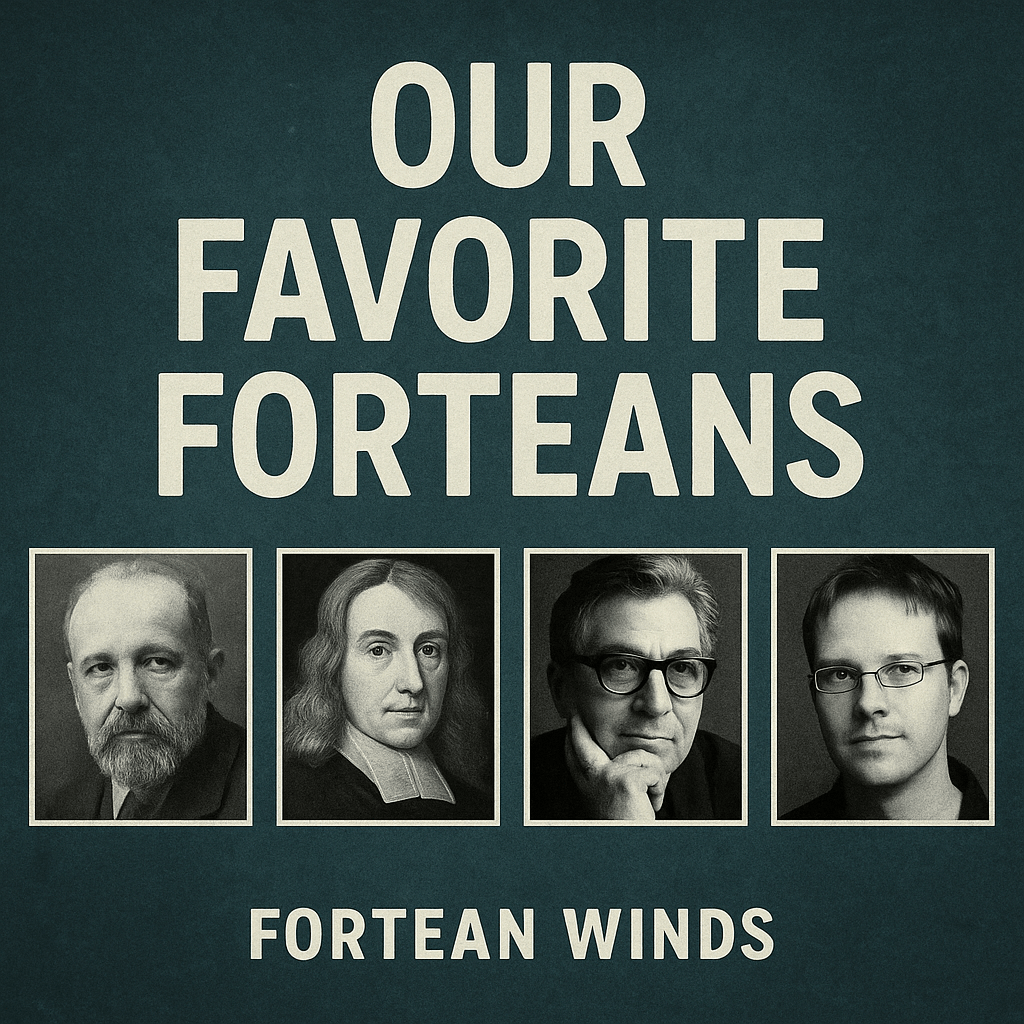
What makes someone a Fortean?
Is it a membership card? A secret handshake? A bookshelf sagging under the weight of paranormal reports?
Nope.
We’ve said it before and we’ll say it again: to be a Fortean, all you need is curiosity and an open mind. That said, some people do it better than others. They ask smarter questions. They collect better data. They don’t pretend to know the answers—and when they do speculate, they leave the door wide open for ridicule. That’s a good thing.
So here’s our list of favorite Forteans—not because they told us what the phenomenon is, but because they showed us how to stay in the mystery longer.
1. Charles Fort (1874–1932): The Patron Saint of Anomalies
Let’s start with the obvious. Charles Fort is the one who made all this weirdness feel like a movement. Before Fort, you had cranks and ghost stories. After Fort, you had data—thousands of strange reports from newspapers, scientific journals, and dusty old books. He didn’t just collect stories; he weaponized anomalies against the tyranny of scientific certainty.
- 📚 Notable Works: The Book of the Damned (1919), Lo! (1931)
- ⚡ Fortean Hallmark: Coined “teleportation,” proposed extraterrestrial life (in 1920!), and dared to question science with humor.
- 🧂 Why He’s on the List: Because he reminded us it’s okay to troll the establishment if it protects the anomaly.
2. Robert Kirk (1644–1692): The Proto-Fortean Pastor
Two centuries before Fort, Robert Kirk walked through the mists of the Scottish Highlands and came back with The Secret Commonwealth—a detailed account of faeries, fauns, and interdimensional intelligences long before those terms even existed. He was a minister, but his work read more like early ethnography. And then, of course, he disappeared. Possibly taken by the Good People he wrote about.
- 📖 Notable Work: The Secret Commonwealth (written 1691, published posthumously 1815)
- 🌫️ Fortean Hallmark: Described a hidden world of liminal beings and “middle natures.”
- 🧂 Why He’s on the List: Because he took witness testimony seriously—and then maybe became part of the phenomenon.
3. John A. Keel (1930–2009): The Field Operative
If Fort was the librarian, Keel was the man in the field. He rolled into Point Pleasant, West Virginia in the 1960s and came face to face with UFOs, cryptids, and something even stranger: the realization that it’s all connected. He moved beyond aliens to what he called ultraterrestrials—beings not from other planets, but from other realities, psychological states, or dimensions.
- 📚 Notable Works: The Mothman Prophecies (1975), The Eighth Tower (1975)
- 🧠 Fortean Hallmark: Coined “ultraterrestrial,” linked UFOs to psychic and paranormal phenomena.
- 🧂 Why He’s on the List: Because he never formed a belief—and warned us not to, either.
“Belief is the enemy.”
– John A. Keel
4. Mac Tonnies (1975–2009): The Posthuman Philosopher
Tonnies took Keel’s ideas and ran with them. But instead of just retelling the stories, he tried to recontextualize them for a 21st-century audience—mixing UFOlogy with futurism, cryptozoology with cybernetics. His Cryptoterrestrial Hypothesis suggested that we might be dealing with a hidden humanoid species that evolved alongside us and now hides in plain sight.
- 📚 Notable Work: The Cryptoterrestrials (2010, posthumous)
- 🧬 Fortean Hallmark: Blended science fiction with plausible natural theory, without falling into belief traps.
- 🧂 Why He’s on the List: Because he showed us that even “nuts and bolts” thinkers can embrace the weird without abandoning logic.
5. You. (Yes, You.)
We’re not trying to be cute here.
If you’re reading this, and you’re still interested—even after all the misinfo, disinfo, hoaxes, infighting, and charlatans—you’re in the club. You’re doing the work. You’re looking at the data and refusing to shut the book just because it doesn’t fit a model. You might not get famous, but Fort didn’t either. Neither did Kirk.
- 📖 Notable Works: Your notes. Your recordings. Your open browser tabs.
- 🔍 Fortean Hallmark: Curiosity, skepticism, and that nagging feeling something real is going on here.
- 🧂 Why You’re on the List: Because the phenomenon doesn’t stop—it just moves to a new observer.
What is Fortean Winds?
The term comes from Fort himself. He noticed that anomalies often arrive in clusters, like storms—waves of weirdness that make the world feel just a little less stable, and a little more alive. That’s what we look for. Not truth. Not belief. Just the breeze before the storm, the shiver down your spine, the patterns no one else is charting.
Final Thought
This isn’t about being right. It’s not even about being first.
It’s about noticing what others ignore—and recording it anyway. That’s the Fortean way.
And if you’re doing that?
You’re our favorite Fortean too.
 Fortean Winds: Scientific Research into the Unexplained, Paranormal and Anomalous
Leave a comment