
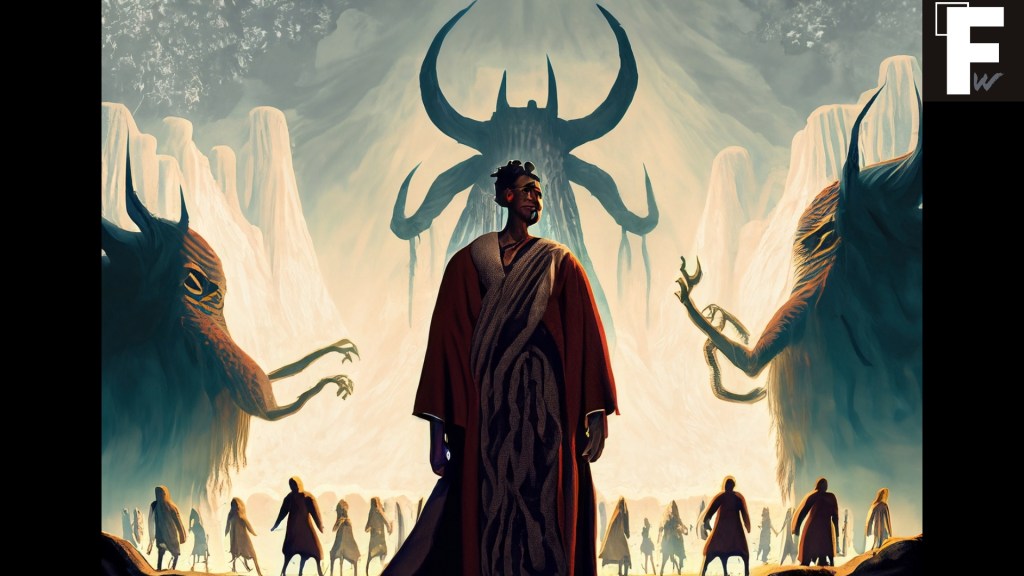
The Book of Enoch is one of the oldest surviving religious texts in the Abrahamic tradition. It predates the Gospels by centuries. It was found among the Dead Sea Scrolls in 1947, which means whoever buried those scrolls considered it worth preserving alongside Isaiah and Deuteronomy. The early Church knew it. The Book of Jude quotes it directly. The Ethiopian Orthodox Church still includes it in their canon.
It did not make the King James Bible. The standard explanation is that it’s an exegesis — an expansion — of a brief, strange passage in Genesis:
The Nephilim were on the earth in those days — and also afterward — when the sons of God went in to the daughters of humans, who bore children to them. These were the heroes that were of old, warriors of renown.
Genesis 6:4
Genesis gives you two sentences. Enoch gives you the full account. Whether that’s why it was excluded, or whether the account itself was the problem, is a question the text raises and does not answer.
What the Text Actually Says
The Watchers are a group of 200 angels assigned to observe humanity. The text names their leaders: Semjâzâ, Arâkîba, Râmêêl, Kôkabîêl, Tâmîêl, Râmîêl, Dânêl, Êzêqêêl, Barâqîjâl, Asâêl, Armârôs, Batârêl, Anânêl, Zaqîêl, Samsâpêêl, Satarêl, Tûrêl, Jômjâêl, Sariêl. Twenty named leaders. This is not mythology in the loose sense — it is specific, bureaucratic, structured.
The Watchers descend to Mount Hermon. They take human women as partners. The offspring are the Nephilim — giants, by most translations, but the Hebrew nefilim is more ambiguous: beings who cause others to fall, or who have fallen themselves. The text describes them as violent, consuming human food and then turning on humanity itself.
But the more consequential part of the account isn’t the genetics. It’s what the Watchers teach. Enoch catalogs specific knowledge that was transmitted to humanity by fallen beings:
- Asael taught metalworking — swords, shields, breastplates — and the cosmetics that led women to “practice fornication” and men to war
- Semjâzâ taught root-cuttings and enchantments
- Armaros taught the resolving of enchantments
- Baraqijal taught astrology
- Kokabel taught the constellations
- Ezeqeel taught cloud-knowledge
- Araqiel taught earth signs
- Shamsiel taught the signs of the sun
- Sariel taught the course of the moon
The text’s framing is that this knowledge was forbidden — not because it was wrong, but because humanity wasn’t ready for it and the beings who transmitted it were doing so without authorization. The punishment, when it comes, falls on the Watchers themselves: they are bound, imprisoned beneath the earth, and condemned to watch the destruction of their offspring before the final judgment.
The Nephilim die in the flood. The Watchers survive it, imprisoned. According to the text, they are still there.
Why This Was Suppressed
The formal reason given for excluding Enoch from the canon is that its authorship is disputed and its narrative is derivative. Both points are technically true. But they apply equally to several books that were included.
The more substantive issue may be what the text implies about the structure of reality. If the Watchers are real, then non-human intelligence has been interacting with humanity since before recorded history. It has a genetic interest in us. It transmits forbidden knowledge selectively. It operates outside the sanctioned order and is punished for doing so. And the beings responsible are not distant or abstract — they are named, they acted on specific dates and places, and the consequences of their actions are still with us.
That is a much more complicated cosmology than the one the canon supports. A God who is sovereign and omnipotent is harder to argue for when the text includes a detailed account of unauthorized beings operating within that God’s creation with significant autonomy. The Church fathers who assembled the canon were aware of this tension. Origen and Tertullian both engaged with Enoch extensively. The decision to exclude it was not made in ignorance of its contents.
The Behavioral Profile
This is where Fortean Winds shifts from theology to research. The question isn’t whether the Book of Enoch is literally true. The question is whether the behavioral pattern it describes matches anything in the current record.
It does. With specificity.
Descent to specific locations. The Watchers don’t appear randomly. They descend to Mount Hermon — a specific, named place. UAP sightings cluster geographically in ways that have been confirmed by machine learning analysis of 80,000 NUFORC reports: latitude accounts for 84% of predictive power. The phenomenon is not randomly distributed. It has preferred locations.
Genetic interest in humans. The Watchers’ primary transgression is breeding with human women. This is not a peripheral detail — it is the central act the text is built around. Independent abduction researchers across decades — John Mack at Harvard, David Jacobs, Budd Hopkins — have documented consistent accounts of biological collection and apparent hybridization programs in modern UAP contact cases. The specific concern about human genetics is documented in both the ancient text and the modern research record.
Transmission of forbidden knowledge. The Watchers teach specific technical and astronomical knowledge to humans outside the sanctioned order. The modern UAP contact record includes consistent accounts of experiencers receiving advanced knowledge — mathematical, physical, or technological — following encounters. Whether this is incidental or deliberate is unknown. That it recurs across independent cases is documented.
Consequences that follow people home. The Nephilim didn’t stay at Mount Hermon. The Watchers’ influence spread beyond the initial contact point. This maps directly onto what we call the Hitchhiker Effect — the documented pattern in which anomalous phenomena follow researchers and experiencers away from initial contact sites, affecting family members and colleagues who were never present at the original location.
Beings that are punished for contact. The Watchers are condemned specifically because they exceeded their sanctioned role. This implies a hierarchy — some beings are authorized to interact with humanity, others are not, and the unauthorized interactions carry consequences. Jacques Vallee’s control system hypothesis proposes something structurally similar: the phenomenon functions as a regulatory mechanism with internal governance. The interactions that go wrong — the hostile encounters, the physical damage — may represent the same category of violation Enoch describes: unsanctioned contact.
The Suppression Pattern
There is one more parallel worth noting, and it operates at a meta level.
The Book of Enoch was suppressed. Not destroyed — it survived in Ethiopia and in fragments at Qumran — but removed from the mainstream record that shaped Western civilization for two millennia. The beings it describes were effectively written out of the authorized cosmology. What remained was a two-sentence reference in Genesis that raises more questions than it answers, and a canon that does not provide the context needed to interpret it.
The modern UAP record has followed a structurally identical pattern. The phenomenon is documented — by military pilots, by government sensors, by scientific instruments, by thousands of independent witnesses. The documentation is real. The suppression is also real: Project Condign, the Robertson Panel, the Condon Committee, the classification of UAP sensor data as top secret. The public record contains fragments and references without the context needed to interpret them.
The shape of the suppression is the same. Whether the reason is the same is the open question.
What Fortean Winds Concludes
We are not arguing that the Book of Enoch is literally true. We are not arguing that the Watchers are the same entities encountered at Skinwalker Ranch or documented in modern abduction research. We do not know that.
What we are arguing is that the behavioral profile in the text — specific locations, genetic interest, knowledge transmission, contagious effects, internal governance with punishments for violations — matches the modern record with enough precision to warrant serious examination rather than theological dismissal or credulous enthusiasm.
The text is 2,000 years old. The pattern it describes is still showing up in current data. That is either a coincidence or it isn’t. Fortean Winds keeps the file open.


One response to “The Book of Enoch: What the Watchers Actually Say — and Why It Matters Now”
[…] go deeper on this in our analysis of the Book of Enoch — the text that was preserved at Qumran alongside the Dead Sea Scrolls and excluded from the […]
LikeLike