

The image of angels with white wings and golden hair did not come from the Bible. Nor did the image of chubby cherubs shooting arrows. The Bible describes angels as creatures of pure spirit who can take many forms — and when those forms are described in detail, they are genuinely strange. Most biblical scholars believe it’s impossible to know what form an angel might take as a matter of course. But angels do make specific appearances throughout scripture, and those appearances are worth going through one by one, because what the text actually says is very different from what ended up on the Sistine Chapel ceiling.
The short answer to what angels look like in the Bible: it depends entirely on which type of angel, and which encounter. Some look exactly like ordinary men. Some produce immediate terror. Some have six wings and stand in fire. Some have four faces — including an ox and an eagle — and travel with enormous wheels covered in eyes. The Bible is not internally inconsistent on this. It’s describing different orders of beings, and the descriptions are specific.
Invisible Angels: The Default State
“The angel of the LORD encamps all around those who fear Him, and delivers them.”
Psalm 34:7
The Bible gives multiple accounts of angels appearing invisible to humans while still affecting the physical world. Psalm 91:11 says God “will command his angels concerning you to guard you in all your ways.” Many Christians interpret this to mean angels are constantly present and involved in human affairs, just unseen. 2 Kings 6:17 is one of the clearest examples — the prophet Elisha prays that his servant will be able to see what Elisha already knows is there, and the servant’s eyes are opened to see the hillside full of horses and chariots of fire.
This sets up an important premise: the absence of a visible angel doesn’t mean the absence of an angel. The text treats invisibility as the default state, with physical appearance as the exception. That’s worth keeping in mind as we go through the specific descriptions, because it means we’re only ever getting part of the picture.
Angels Appearing as Humans: The Most Common Description
“Don’t forget to entertain strangers, because in this manner, some have entertained angels without knowing it.”
Hebrews 13:2
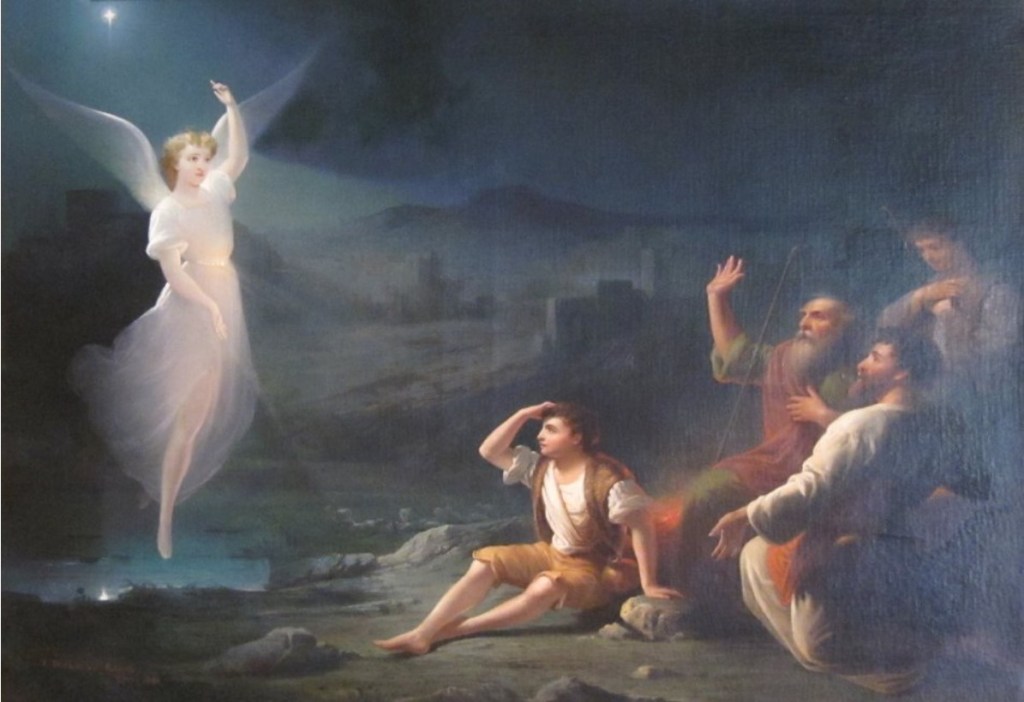
Angels appearing as ordinary men is one of the most consistent patterns in the biblical record. In Genesis 18, three men appear to Abraham at the entrance to his tent. He doesn’t know who they are. He runs out to greet them, offers them food, and they eat — they’re described simply as men. It’s only gradually clear that one of them is the Lord and the others are angels. Two of those same angels then travel to Sodom, and Lot sees them as men when they arrive at the city gate.
And he lifted up his eyes, and looked: and lo, three men stood by him, and when he saw them, he ran to meet them from the tent door, and bowed himself to the ground.
Genesis 18:2
Then there’s Jacob wrestling with an angel in Genesis 32. He wrestles with a man all night. At dawn the man asks to be released, puts Jacob’s hip out of joint with a touch, and tells him he will now be called Israel because he has “struggled with God and with humans and have overcome.” Jacob names the place Peniel — “because I saw God face to face, and yet my life was spared.” Whether this was God directly or an angel acting as God’s representative is debated, but the physical appearance was entirely human.
The New Testament continues this pattern. At the empty tomb, Mary Magdalene sees “two angels in white, seated where Jesus’ body had been, one at the head and the other at the foot” (John 20:12). But the account in Mark just says “a young man dressed in a white robe.” Matthew says “an angel of the Lord” whose “appearance was like lightning and his clothing was white as snow.” The same event, different levels of clarity about what exactly was being seen.
Hebrews 13:2 makes this category explicit: “Do not forget to show hospitality to strangers, for by so doing some people have shown hospitality to angels without knowing it.” That verse only works if the angel description is indistinguishable from a human one. You can’t accidentally host a six-winged fire being without noticing.
Gabriel: Description of a Named Angel in the Bible
Gabriel is the most named angel in the Bible, appearing in Daniel, Luke, and (in Islamic tradition) throughout the Quran. His physical descriptions are interesting because they span the human and the overwhelming.
In Daniel 8, Gabriel appears in a vision and Daniel describes him as having “the appearance of a man.” Daniel falls on his face. In Daniel 9, Gabriel “came to me in swift flight about the time of the evening sacrifice.” Daniel says he was “terrified” and fell prostrate. Gabriel touches him and says “Do not be afraid, Daniel.”
In Luke, Gabriel appears to Zechariah in the temple to announce the birth of John the Baptist. Zechariah is “gripped with fear.” Then Gabriel appears to Mary to announce the birth of Jesus. She is “greatly troubled.” In both cases the angel’s opening line is a variation of “do not be afraid” — which suggests the initial appearance was not reassuring.
There’s a pattern here worth noting. Angels appearing as regular humans cause no alarm. Gabriel, when he appears in his fuller form, consistently terrifies the people he’s visiting — even when he’s bringing good news. The “fear not” greeting implies there’s something about the appearance that requires active suppression of the fear response. Gabriel looks like a man but apparently not quite like a man.
The Angel in Daniel 10: The Most Detailed Physical Description
Daniel chapter 10 contains one of the most detailed physical descriptions of an angelic being in the entire Bible. Daniel sees a man beside the Tigris River:
“His body was like topaz, his face like lightning, his eyes like flaming torches, his arms and legs like the gleam of burnished bronze, and his voice like the sound of a multitude.”
Daniel 10:6
Daniel is alone when he sees this. The men with him don’t see the vision, but “such terror overwhelmed them that they fled and hid themselves.” Daniel himself loses all strength, his face turns “deathly pale” and he falls into a deep sleep. The being touches him, raises him to his hands and knees, then stands him upright. Daniel is trembling throughout.
This is one of the few biblical descriptions that gives you colour, material, and sound: topaz, lightning, flaming torches, burnished bronze, a voice that sounds like a crowd. The people nearby feel the effect even though they don’t see it. That detail — witnesses who sense something overwhelming without seeing what it is — appears in a number of angelic encounters and is easy to overlook.
Seraphim Description in the Bible: Six Wings and Fire
“Above him were seraphim, each with six wings: with two wings they covered their faces, with two they covered their feet, and with two they were flying.”
Isaiah 6:2
Seraphim appear only in Isaiah 6, where Isaiah has a vision of God on his throne in the temple. The name comes from the Hebrew root meaning “burning ones” or “fiery ones.” Six wings each. Two to cover their faces — even in the direct presence of God, they shield themselves from the sight. Two to cover their feet. Two for flight. They call to each other: “Holy, holy, holy is the Lord Almighty; the whole earth is full of his glory.” The sound of their voices shakes the doorposts and thresholds.
One of the seraphim flies to Isaiah with a live coal taken from the altar using tongs, touches his lips with it, and tells him his guilt is removed and his sin atoned for. Isaiah’s response to the whole vision is “Woe to me! I am ruined! For I am a man of unclean lips, and I live among a people of unclean lips, and my eyes have seen the King.” Being in the presence of these creatures is described as annihilating.
The seraphim description in the Bible is one of the stranger ones precisely because we have no earthly analog. The form itself is the message — something categorically different from anything on Earth is in this vision. Six wings, fire, voices that shake the architecture.
Cherubim Description in the Bible: Four Faces, Four Wings, Eyes Everywhere

Cherubim are the most described angelic beings in the Bible and also the furthest from the Valentine’s Day card version. God places cherubim at the entrance to Eden after the fall to guard the way to the tree of life — they’re the first angelic beings mentioned in Genesis. They’re described as being on the mercy seat of the Ark of the Covenant in Exodus, their wings spread upward. But Ezekiel gives us the full description, in extraordinary detail.
In Ezekiel 1 and 10, the prophet describes the cherubim he sees in his visions. Each has four faces: a human face in front, a lion’s face on the right, an ox’s face on the left, and an eagle’s face in back. Four wings each. Straight legs with feet like calves’ hooves, gleaming like burnished bronze. Human hands under their wings on all four sides. They move in any direction without turning, because wherever any of the four faces points, that’s the direction they go. Their appearance is “like burning coals of fire or like torches.” Lightning flashes between them.
The cherubim description in Ezekiel is different enough from any other biblical angel description that some readers miss that it’s the same category of being. The word “cherubim” appears over 90 times in the Old Testament. Most of those appearances are in the context of the Ark or the Temple. The full description of what a cherub actually looks like is largely confined to Ezekiel, which may be why the art history version drifted so far from the text.
The Ophanim: Wheels Within Wheels, Full of Eyes
“They sparkled like topaz, and all four looked alike. Each appeared to be made like a wheel intersecting a wheel. As they moved, they would go in any one of the four directions the creatures faced; the wheels did not change direction as the creatures went. Their rims were high and awesome, and all four rims were full of eyes all around.”
Ezekiel 1:16-18
These are the Ophanim — the wheel-beings. They appear alongside the cherubim in Ezekiel’s vision: massive wheels, intersecting each other, covered in eyes on their rims, moving with the cherubim in perfect coordination. “The spirit of the living creatures was in the wheels.” When the cherubim lifted up, the wheels lifted with them. When the cherubim stopped, the wheels stopped.
Ezekiel returns to this vision twice — in chapter 1 and again in chapter 10, where he identifies the beings as cherubim and makes clear the wheels are functionally part of them. The word “ophanim” simply means “wheels” in Hebrew. They don’t appear elsewhere in the Old Testament under that name, though they become significant in later Jewish mystical tradition, particularly the Merkabah (divine chariot) literature.
The Ophanim are the most anomalous angelic description in the Bible by some distance. Eyes on wheels. Wheels within wheels. Moving without turning. The spirit of living creatures residing in the mechanism. Whatever Ezekiel was trying to describe, it wasn’t something he had a vocabulary for, and the description reads that way — precise but straining against the limits of available language.
Michael: The Warrior Angel
Michael is the other named archangel in the Bible, appearing in Daniel, Jude, and Revelation. Unlike Gabriel, Michael is specifically described as a warrior — “one of the chief princes” in Daniel 10:13, “the great prince who protects your people” in Daniel 12:1. In Jude 9, he disputes with the devil over the body of Moses. In Revelation 12:7, he leads the angelic armies in war against the dragon.
What’s notable is that Michael receives no physical description in the canonical Bible. We know his role (warrior, protector, prince) but not his appearance. The elaborate iconography of Michael in art — armored, winged, sword raised — comes from tradition and apocryphal texts, not from biblical description. The Book of Enoch, preserved at Qumran and eventually excluded from the canon, describes Michael in more detail. But in the text that made it through, Michael is defined by function, not form.
The Angel of the Lord
“The angel of the Lord” is a recurring figure in the Old Testament who occupies a strange position — sometimes appearing to be an angel, sometimes speaking as God in the first person, sometimes being explicitly identified as God by the witness. Genesis 16 (Hagar), Genesis 22 (Abraham and Isaac), Exodus 3 (Moses and the burning bush), Judges 6 (Gideon), Judges 13 (Samson’s parents). In most of these accounts, the witness realizes after the fact that they were speaking with God, not merely a messenger.
Physically, the angel of the Lord in these encounters appears human enough to hold a conversation before the identity is revealed. In Judges 13, Manoah and his wife describe the angel as “a man of God” who looked “like an angel of God, very awesome.” When Manoah asks his name, the angel says it is “beyond understanding.” When Manoah offers a burnt offering, the angel ascends in the flame. They fall face down, convinced they will die. “We have seen God,” Manoah says to his wife.
The angel of the Lord appears human. It becomes clear it is not. The escalation from ordinary-looking stranger to something entirely outside normal categories is a consistent feature of these encounters.
Modern Accounts of Angels
Modern accounts of angels take many forms. Many people describe the felt presence of protection — a near-miss that shouldn’t have ended well, a warmth and calm at a moment of crisis. These experiences are extremely common and show up across every culture, not just Christian ones. Some describe a white-robed human figure with a glow, giving exactly the right warning at exactly the right time. That’s the version that popular fiction has settled on.
“And I was surprised they really did have wings, even more so that these wings reached from above their head to the ground.”
Seeing Angels: Emma Heathcote-James, 2009
What’s interesting is that the modern accounts that include physical detail tend to fall into the same categories the Bible describes: ordinary-looking humans, overwhelming luminous figures, or something in between. Very rarely do modern accounts describe the cherubim-level strangeness — the multi-faced, wheel-accompanied beings. Whether that means those were unique visions tied to specific prophets, or whether that level of appearance is simply reserved for a different kind of encounter, isn’t clear.
What the Art History Got Wrong
Our modern image of what angels look like is clearly shaped by art history, not scripture. Winged divine figures go back to Assyria and Egypt. When Christian art began in earnest after Constantine in the 4th century, angels were depicted without wings. Wings only became standard during the Renaissance. So the winged-human template that we all carry in our heads was largely assembled between the 5th and 16th centuries by painters who were working from aesthetic tradition, not textual description.
The Bible does mention angels with wings — it’s just that they have six of them, or four of them, and sometimes those wings are paired with faces that include a lion, an ox, and an eagle. Not many paintings of those. The cherubim God instructs to be placed on the Ark of the Covenant have two sets of wings and four faces. A long way from the Valentine’s Day card.
The Fortean Analysis
Here’s where the Fortean lens is useful. The descriptions in Ezekiel and Daniel — beings that emit light, have multiple faces, move in ways that don’t correspond to normal physical movement, produce a terror response in witnesses who then require reassurance that they’re not about to die — map onto the modern UAP contact record in ways that are genuinely interesting to think about. Not that UAPs are angels or angels are UAPs. But that witnesses separated by thousands of years and vastly different cultural contexts are describing encounters that share specific features: overwhelming luminosity, terror followed by calm instruction, amnesia or physical aftereffects, the sense of being in the presence of something that exists outside the normal order.
The “fear not” greeting that appears throughout these accounts is worth sitting with. It implies the first reaction to the appearance is fear — not wonder, not confusion, but fear — and that the beings involved know this and address it directly. Whatever these descriptions are recording, the witnesses were not comforted by what they saw before they were told to be calm.
We go deeper on this in our analysis of the Book of Enoch — the text that was preserved at Qumran alongside the Dead Sea Scrolls and excluded from the canonical Bible, which gives a much more detailed account of what these beings were doing and why. And if you want the full rabbit hole on how ancient texts across traditions may have been encoding something more systematic, the Grimoire Project is worth your time.
For now, the main thing to take away is simpler: the Bible’s actual descriptions of angels are far stranger, and far more interesting, than anything that ended up in the stained glass.


3 responses to “Angel Descriptions in the Bible: What They Actually Look Like”
Good info. Biblically accurate and respectful. Even and objective presentation I like it
LikeLike
[…] our perceptions of angels and demons within the Judeo-Christian tradition. Prior to this narrative, angels were often viewed as divine messengers and servants of God, embodying purity and obedience. However, the Watchers’ rebellion […]
LikeLike
[…] Angelic Descriptions in the Bible — what the historical record actually says about entity encounters […]
LikeLike