
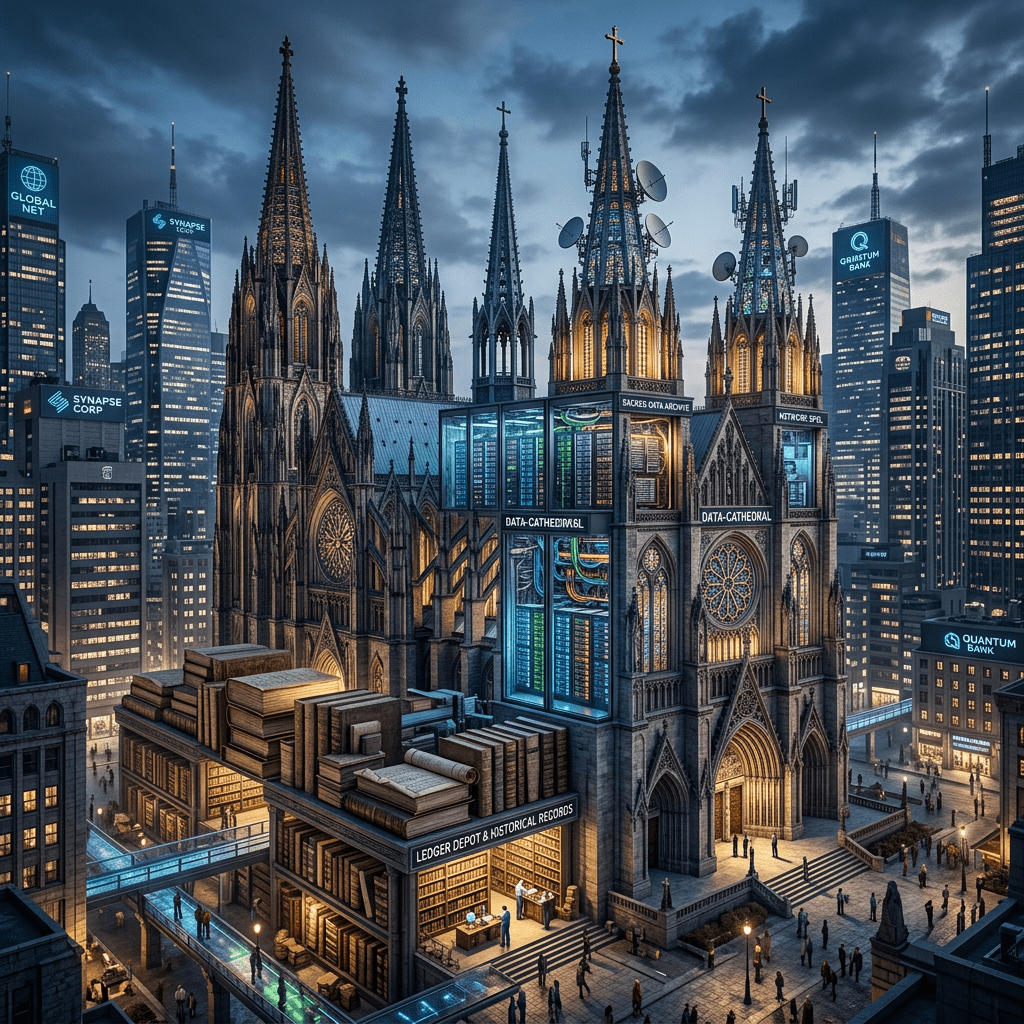
This article is the companion piece to the Fortean Winds podcast episode “The Cadre and the Cathedral.” It extends the analysis from our episode Who Really Runs the World and connects directly to our Occult History series, specifically the chapter on political occultism.
March 2026. Rome. A private venue at the Palazzo Taverna, walking distance from the Vatican. No cameras. No transcripts. An invitation, seen by the Associated Press, promising a lecture on the Antichrist.
The man delivering it co-founded PayPal and Palantir Technologies — a company that sells surveillance and battlefield intelligence software to governments, named after a magical seeing-stone from a story about a war between good and evil. He has funded the political rise of a sitting Vice President. He is, by any reasonable measure, one of the primary financiers of the intellectual movement this article maps.
That is not a metaphor we constructed. It is a lecture series. It happened in San Francisco in the fall of 2025. It happened again in Rome in March 2026. It may happen again.
This piece maps what a specific, wealthy, well-documented faction wants to build — and why the theology arriving now matters as much as the economics that preceded it.
The Precondition: A Wealth Transfer Without Precedent
Any account of this movement that starts with the ideas skips the part that made the ideas actionable. Before there was a theory of elite replacement, there was the largest concentration of private wealth in modern history — and it happened inside a two-year window almost nobody discusses in the same breath as the ideology that followed it.
The numbers, from Oxfam’s tracking of the pandemic period: the world’s ten richest men saw their combined wealth double — from $700 billion to $1.5 trillion — between March 2020 and the pandemic’s height. That works out to roughly $15,000 per second, sustained across two years. Nine of those ten men were American. Most of the gains were concentrated in technology. Billionaires as a class gained more wealth in the first twenty-four months of COVID-19 than in the preceding twenty-three years combined.
The mechanism was straightforward and well-documented: massive government stimulus flowed into asset markets, which are disproportionately owned by those who already hold assets; and a forced, overnight migration of economic life onto digital platforms landed almost entirely on a small number of companies positioned to capture it. The people who founded or controlled those companies did not simply get richer. They emerged from the pandemic controlling a share of global capital and infrastructure unmatched by any private class in recorded history.
This is the precondition for everything that follows. The ideas mapped below are not a fringe internet philosophy that happened to find a wealthy audience. They are the operating theory of a class working out, in real time and increasingly in public, what to do with a position of concentrated power that arrived faster than any comparable shift in modern economic history.
The Cathedral: The Diagnosis
Curtis Yarvin — who wrote for years under the pseudonym Mencius Moldbug and now publishes under his own name — supplies the clearest statement of the underlying critique. He calls the current order “the Cathedral”: not a building, but a description of how power actually functions inside a modern liberal democracy. An informal, self-reinforcing alliance of elite universities, legacy media institutions, and the permanent administrative bureaucracy sets the boundaries of acceptable thought and policy, largely independent of which party holds elected office. Nobody votes these institutions into power. Nobody can vote them out. The visible government changes hands; the argument goes that the actual government does not.
This diagnosis deserves a fair hearing before any critique of the prescription. Distrust in credentialed institutions is not confined to any single ideological camp, and in a number of measurable respects that distrust has been earned. The steelman matters: a large and politically diverse share of the public senses, correctly, that formal democratic accountability and actual institutional power have drifted apart. The disagreement that matters is not over whether something is broken. It is over what should replace it.
Marc Andreessen — co-founder of Andreessen Horowitz, one of the most influential venture capital firms in the world — has stated the prescription plainly, and the citation he uses is worth unpacking in full. Speaking on a podcast in December 2024, he said: “To paraphrase Burnham, if you want to replace the elite you have today, you need to have a better elite.”
The reference is to James Burnham, who published The Managerial Revolution in 1941. Burnham’s thesis was that ruling classes are not abolished by historical upheaval — they are replaced, by new administrative classes better positioned to operate the machinery of the modern state. He used the framework to analyze fascism, Soviet communism, and the American New Deal as structurally similar processes: different political flags, the same underlying mechanism of one elite substituting itself for another. Burnham’s work went on to become foundational reading for segments of the American right specifically because of this explanatory power.
Andreessen’s invocation of Burnham by name, in the context of an explicit call to build a “counter-elite,” is not guilt by association. It is a citation, offered on the record, of an intellectual lineage built specifically to explain how ruling classes get swapped out. This is not a call for institutional reform. It is a stated program for replacement.
The Cadre: The Architecture
Yarvin’s proposed replacement is not vague. His writing calls for retiring the administrative state and replacing democratic governance with a structure closer to a corporation — sovereignty organized like a joint-stock company, with a CEO-monarch whose legitimacy rests on competent management rather than the consent of the governed as currently constituted. Central to the model is the substitution of exit rights for voice rights: rather than voting to change a government you find inadequate, you leave it, the way a customer leaves a company for a competitor.
Yarvin has also written about assembling what he calls a “honeycomb” of cadres — small, ideologically aligned, operationally prepared cells positioned to step into functioning existence the moment the current system is declared dead, or simply ceases to function on its own. The stated plan is not insurrection. It is readiness: having the organizational structure already drafted for the moment institutional collapse creates a vacuum.
This is not confined to published theory. Dialog, an invitation-only network co-founded by Peter Thiel in 2006, holds off-the-record annual retreats. A leak in June 2026 exposed portions of the registration list and agenda for a 2026 gathering near Dublin. Session titles included “Build-a-Cult” and “Navigating WWIII.” The attendee list, as partially revealed, spanned senior military figures, administration officials, sitting senators, surveillance and data infrastructure executives, and veterans of the so-called PayPal Mafia. The existence of a network this dense and this well-connected, convening privately and off the record on an annual basis, is not speculative — it is a documented structure that a leak partially illuminated.
The wealth described above becomes, at this stage, infrastructure. Capital funds the companies. The companies fund the network. The network drafts the architecture. What remained missing, until recently, was a legitimating story large enough to make the architecture feel like more than a hostile takeover of public governance by private capital.
The Cathedral, Literally: Theology as Legitimation
This is the layer that connects the material and organizational story to the pattern this site has tracked across centuries of political history: when a power project cannot draw full legitimacy from markets, elections, or institutional consent alone, it reaches for theology.
Thiel’s Antichrist lectures are the clearest current instance. Four sold-out, off-the-record sessions were held at the Commonwealth Club in San Francisco across September and October 2025, organized by a group called the Acts 17 Collective and drawing explicitly on the mimetic theory of philosopher René Girard, who influenced Thiel during his time at Stanford. Reporting on the leaked content of the lectures includes Thiel’s own framing: the Antichrist in a contemporary context would be, in his words, “a Luddite who wants to stop all science” — someone like climate activist Greta Thunberg, someone like AI safety researcher Eliezer Yudkowsky. His argument holds that calls for stricter global regulation of artificial intelligence could produce a unified world government, and that a unified world government is precisely the mechanism through which the Antichrist would seize total control.
Read plainly, this frames regulatory caution — one of the standard policy tools available to any democratic government — as a step toward literal, cosmic evil. It escalated. By March 2026, the same lecture series moved to Rome, held at the Palazzo Taverna, close enough to the Vatican to draw documented notice and caution from people in the Pope’s circle. This is no longer a private eccentricity. It is a sustained, public theological project with a growing audience.
Thiel is not operating alone in this register. Trae Stephens — a Thiel ally and co-founder of the drone warfare company Anduril, another company named for an object from Tolkien’s mythology — has described his work in explicitly religious terms, framing it as fulfilling “God’s command to bring his Kingdom to earth as it is in Heaven.” His wife co-founded the organization hosting Thiel’s Antichrist lectures.
This is, mechanically, the same pattern examined in Chapter Six of our Occult History series, on political occultism: a political-economic reorganization that cannot fully justify itself through ordinary democratic or economic argument reaches instead for mythic and theological framing to supply the legitimacy that markets and elections alone cannot provide. This is not a claim of moral equivalence between any historical case and the present one — the scale, outcomes, and specifics differ enormously. It is a claim about mechanism: power reaching for sacred language to explain itself is a recurring historical pattern, worth naming plainly whenever it appears, regardless of who is doing the reaching.
There is a further layer worth stating directly. The vocabulary in play here — Girard, mimetic theory, political theology — is dense, and it is being explained in closed rooms to audiences with the time, education, and access to argue with it and place it in context. Ideas of this kind rarely stay contained. They get simplified, clipped, and pushed through algorithmic distribution as something closer to “billionaire says AI critics might be literally satanic” — stripped of the philosophical scaffolding that at least allows for internal debate. That simplified version reaches audiences with the least access to competing context. This is not a claim about anyone’s intelligence. It is a claim about who has practical access to the counter-argument, and who does not.
A Note on the Rhetoric, Tiered Correctly
Stephen Miller’s September 2025 speech at Charlie Kirk’s memorial was widely compared, within hours, to a 1932 address by Joseph Goebbels titled “The Storm Is Coming.” Numerous commentators and outlets described the comparison as plagiarism. In fairness to the record, Snopes reviewed the claim directly and found genuine rhetorical echoes — the storm imagery specifically — while explicitly declining to confirm direct copying, characterizing the plagiarism claim itself as unverified speculation.
We hold this at the tier it has earned: recurring pattern, contested claim — not direct record, and not confirmed plagiarism. It belongs in this analysis as one data point inside a broader, verifiable pattern of escalating apocalyptic and existential-threat rhetoric emerging from adjacent parts of this same political and financial ecosystem — not as a standalone, confirmed bombshell. The discipline of holding a viral claim at its correct evidentiary weight, rather than the weight its virality implies, is the entire point of this site’s method.
Two Competing Visions of the Future
A substantial share of the public, across the entire political spectrum, correctly senses that current institutional arrangements are not functioning as advertised. That sensation is close to a consensus at this point, and it is not, on its own, a fringe or partisan position. What differs is the response to it.
One answer — the Cadre and the Cathedral, taken together — is exit: replace the existing elite with a better one, construct a corporate-sovereign structure organized around opt-in participation rather than universal consent, and give the entire project theological weight so that it reads less like a hostile takeover of public governance and more like a calling.
Our answer is the one carried forward from the previous episode, because it does not change depending on who is offering the alternative system: keep the record open. Refuse the ready-made prescription, whether it comes from a captured legacy institution or a new billionaire-funded cadre with a theological justification attached. Tier the claims. Verify before concluding. Decline both the exit into total cynicism and the exit into a new total system, however well-funded or theologically dressed that system arrives.
What to Watch
- State-level charter city legislation — several states have seen bills introduced establishing special governance zones with reduced regulatory oversight, the practical ground-level expression of exit-based architecture
- “Network state” language entering mainstream policy discourse — Balaji Srinivasan’s specific contribution to this ecosystem, currently confined mostly to technology-industry discussion; a full treatment is planned as a follow-up piece
- Further leaks from Dialog — the next guest list, should one surface, will indicate whether the network is expanding its reach into additional institutional sectors
- Additional stops on Thiel’s theological lecture tour — two cities so far (San Francisco, Rome). A third establishes this as a sustained project rather than a phase
The Sequence
The wealth arrived first — the fastest consolidation of private capital in modern economic history, concentrated overwhelmingly into a small number of hands, during a crisis that devastated nearly everyone else. The ideology followed, supplying a framework for what that concentrated wealth and infrastructure control should be used to build. The theology is arriving now, converting the ideology from a hostile takeover of public governance into something closer to a calling.
Wealth, then ideology, then myth. Naming that sequence clearly, at the evidentiary weight each piece has actually earned, is the whole of the task.
Related Research on Fortean Winds
- Unraveling Elite Influence: Who Really Runs the World? — the foundational mapping this article extends
- The Occult History Series — including the chapter on political occultism and the mechanism of theological legitimation
- Economic Power, CIA, and UAP: Unraveling Global Influence
- Breaking the UAP Cage: The Dogma-Oligarchy Convergence
Core Sources
- Oxfam International. “Ten Richest Men Double Their Fortunes in Pandemic While Incomes of 99 Percent of Humanity Fall.” January 2022.
- Torenberg, Erik. “Marc Andreessen on His Intellectual Journey.” Erik Torenberg’s Substack, December 2024.
- Burnham, James. The Managerial Revolution: What Is Happening in the World. John Day Company, 1941.
- Smith, Dave. “Peter Thiel Is Delivering 4 Private Sold-Out Lectures at a Club in San Francisco — About the Antichrist.” Fortune, September 2, 2025.
- Tiku, Nitasha. “Religion: Thiel’s ‘Antichrist’ Obsession.” The Washington Post, republished The Week, October 2025.
- “What’s Up With Peter Thiel’s Obsession With the Antichrist?” The New Republic, November 2025.
- “Peter Thiel’s Secret Lectures on Antichrist in Rome Spark Debate.” CNN, March 2026.
- “GOP Megadonor Peter Thiel’s Lectures Push an Odd Interpretation of the ‘Antichrist.’” MS NOW, March 2026.
- “Investigating Whether Stephen Miller’s Speech at Charlie Kirk Memorial Included Nazi Subtext.” Snopes, September 25, 2025.
This is the first installment in what we expect to be a short series under the Cadre and Cathedral frame. Planned follow-ups include a full treatment of Balaji Srinivasan’s Network State framework and the physical infrastructure layer represented by Palantir and Anduril.


One response to “The Cadre and the Cathedral: What the New Technocracy Actually Wants”
[…] https://forteanwinds.com/2026/08/17/the-cadre-and-the-cathedral-what-the-new-technocracy-actually-wa… […]
LikeLike