
The Defense Intelligence Agency’s report on anomalous biological effects from UAP encounters doesn’t bury the lede: proximity to these craft produces radiation burns, ocular damage, neurological trauma, and in a subset of cases, unexplained pregnancies. These aren’t anecdotes sourced from fringe forums. They’re documented findings from a U.S. federal agency whose job is not paranormal tourism.
That confirmation forces a harder question than most commentators are willing to hold open. Are we looking at the unavoidable byproduct of proximity to exotic technology? Or is some portion of this harm intentional?
The honest answer is that the data supports both readings simultaneously, and collapsing them into one misrepresents what the record actually shows.
The case for unintended exposure
Start with the physics argument. If UAP operate using propulsion or field-manipulation systems operating outside conventional electromagnetic theory — plasma-based, gravitationally coupled, or something we don’t have a working vocabulary for yet — then biological damage in close proximity is the expected outcome, not evidence of targeting. We don’t accuse a nuclear reactor of malice when a worker receives a radiation dose.
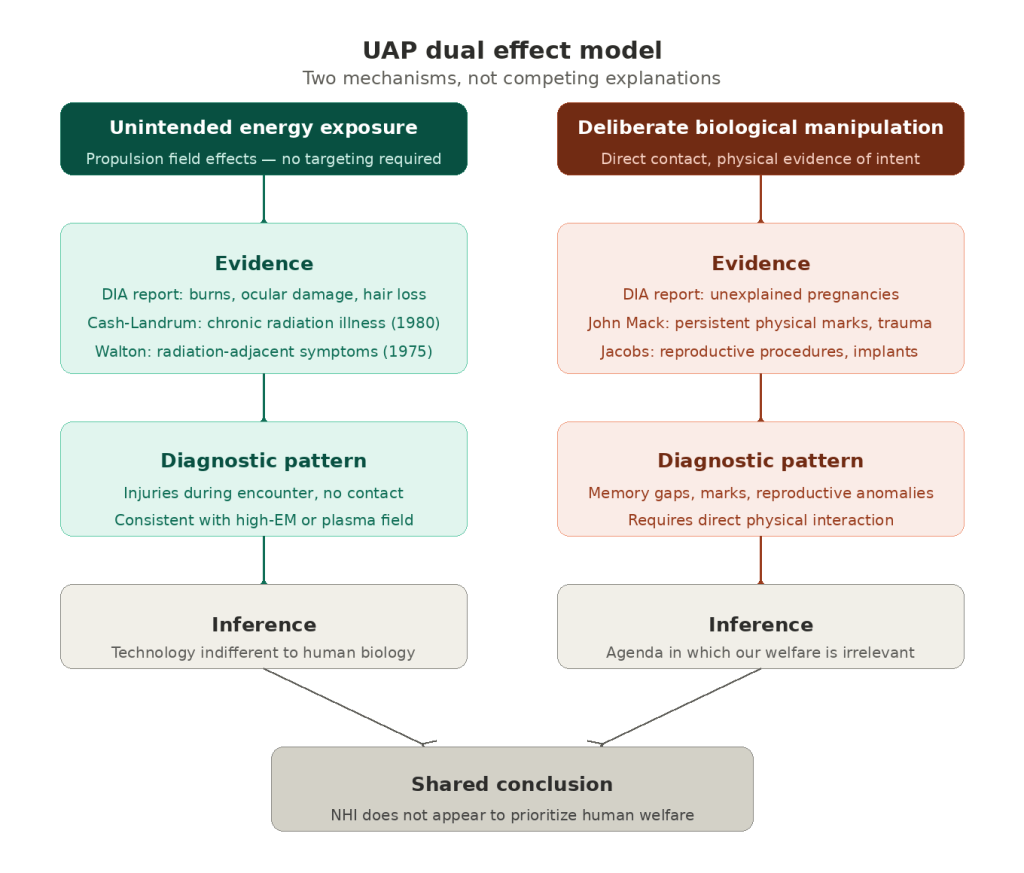
The evidentiary pattern holds. Burns and hair loss consistent with radiation exposure. Ocular damage following intense light bursts. Neurological disruption — anxiety, sleep fragmentation, headache clusters — of the kind documented in populations near high-EMF industrial equipment. Travis Walton‘s 1975 report described a directed energy event that rendered him unconscious; the subsequent symptoms were radiation-adjacent, not torture-adjacent. The Cash-Landrum witnesses in 1980 developed severe radiation burns and chronic illness after sustained exposure to a hovering object — a pattern with a direct parallel in documented cases of EM-field injury from UAP proximity. Both cases are consistent with proximity to a high-energy system that was not modulating its output for human biological tolerance.
The operative inference here: the technology may simply not have been designed with our vulnerability in mind. Whether that represents indifference, ignorance of our biology, or the equivalent of a car exhaust that doesn’t care about pedestrians is a separate question.
The case for directed interference
The second category of evidence resists the unintended-exposure explanation. It involves physical outcomes that require physical contact — not field proximity.
The DIA report’s reference to “unaccounted-for pregnancies” doesn’t describe an EM field effect. Neither does the pattern of abductee physical findings catalogued by Harvard psychiatrist John Mack: persistent trauma, anomalous physical marks, and symptom profiles that don’t reduce cleanly to sleep paralysis or psychological projection. Mack was not a credulous witness; he was a Pulitzer Prize-winning psychiatrist whose methodology was peer-scrutinized precisely because his conclusions were uncomfortable.
David Jacobs’ research adds a body of abductee case files documenting reported medical procedures — frequently reproductive in character — aboard UAP. Memory suppression as a recurring reported element. Implants recovered and analyzed. The pattern that emerges isn’t environmental exposure. It describes systematic interaction with human biology that requires intentionality. You don’t accidentally collect genetic material. The physical and psychological aftereffects of these events are examined in detail in our analysis of abduction physiology and the mechanisms of contact.
This is where the Dual Effect Model becomes analytically necessary rather than just convenient. The two categories aren’t competing explanations for the same phenomenon. They describe different mechanisms operating across different encounter types. Field-proximity damage and directed biological manipulation are both present in the record. Forcing one to explain the other produces worse fits than holding both open.
What the pattern implies
If the unintended-exposure hypothesis covers the first category, three possible frameworks apply to the second: pure indifference (we tag animals without worrying much about the tag), active control mechanisms (memory suppression generating neurological sequelae as a side effect), or a longer-horizon biological program — hybridization, genetic sampling, longitudinal monitoring — for which abduction events are the collection methodology.
Vallee’s challenge to the hybridization framing is worth keeping on the table. In Dimensions he argues that entities capable of this level of intervention would have simpler ways to collect genetic material. His alternative reading — that the phenomenon operates as a control system, with abduction theatrics serving a behavioral-modification function rather than a reproductive one — doesn’t rule out physical collection. It just questions whether reproduction is the primary objective. Both can be true. The theater and the extraction aren’t mutually exclusive. We’ve covered the broader implications of NHI intent and its relationship to human civilization separately.
The Nimitz encounter adds a separate data point. The engaged pilot described a craft that matched every maneuver and then appeared at the designated rendezvous point before the jets arrived. In operational terms, that’s a demonstration of capability — a behavior pattern we’ve examined in the context of how the phenomenon signals intent to human observers. Not an attack. Not a greeting. A demonstration. The gorilla beats its chest to communicate something specific: I can do this, you cannot stop me, and I want you to know it. That is not the behavior of an intelligence that views us as partners or equals in the interaction.
Where the evidence sits
Energy-field exposure accounts for most of the documented physical harm and fits cleanly within the unintended-byproduct framework. A subset of cases — those involving physical marks, reproductive anomalies, and direct contact — require a different explanation, and the deliberate-interference framework fits those residuals better than any environmental model does.
What the DIA report establishes, and what the abduction literature corroborates at the pattern level, is that the phenomenon interacts with human biology in ways that cause measurable harm, and that some fraction of that harm reflects purposeful engagement with human physiology. The entities involved do not appear to be operating under a framework that prioritizes human welfare. Whether that reflects a different moral structure, a different understanding of what we are, or simply an agenda in which our wellbeing is irrelevant, the record doesn’t yet resolve.
That question isn’t answered. It’s open. But the data is no longer speculative.
Notes on the sources
The DIA report referenced here is the 2009 document on anomalous physiological effects associated with UAP encounters, portions of which were declassified and reported on by investigative journalists beginning in 2017. The AARO 2024 historical record report documents 1,652 UAP cases, 171 classified as unexplained with anomalous flight characteristics. The UK Condign Report (2006) confirms electromagnetic and sub-acute physiological effects in a subset of documented encounters. John Mack’s abduction research was published across two peer-reviewed volumes (Abduction, 1994; Passport to the Cosmos, 1999) before his death in 2004. David Jacobs’ hybridization research is documented in Secret Life (1992) and The Threat (1998); his methodology is contested within the field and should be read with that in mind. Vallee’s control-system argument is developed in Dimensions (1988).
 Fortean Winds: Anolmalous Research