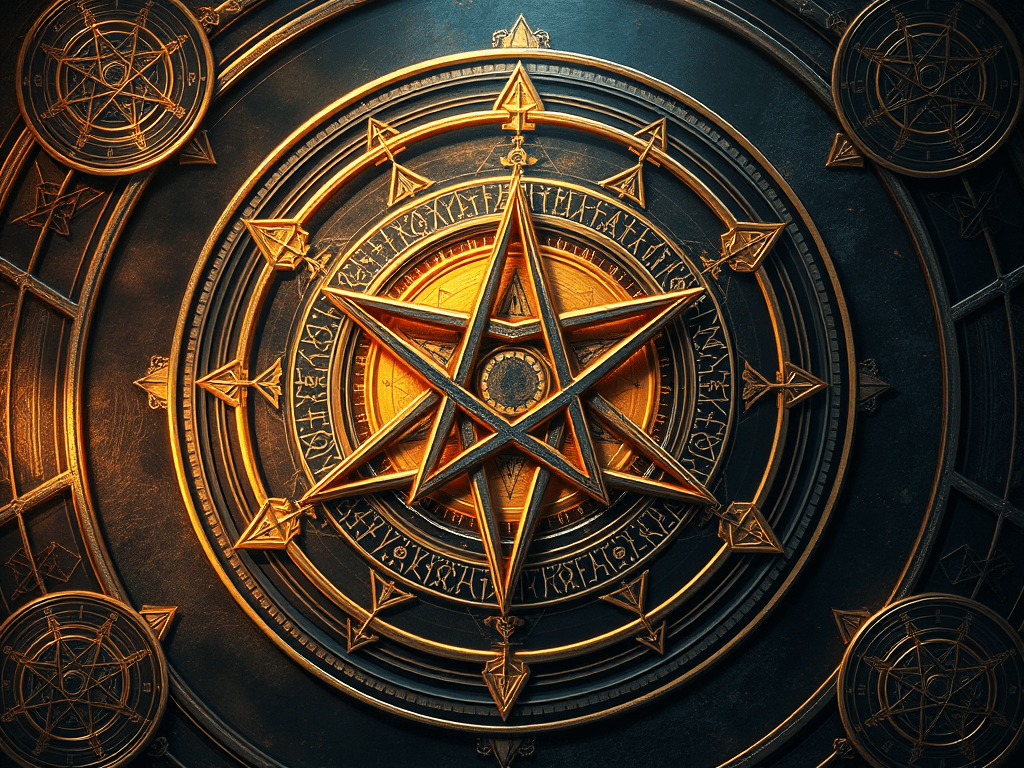
This analysis of grimoires—combining their symbolism, geometry, and ritual practices—can provide unique perspectives for serious scientific inquiry. We identify practical and informative insights derived from our AI-driven Grimoire analysis begun here.
By examining the theoretical and practical frameworks in these texts, we identify parallels with emerging and established scientific principles, offering fresh insights and potential avenues for exploration.
1. Geometry as a Universal Framework
Practical Insight: Exploring Energy Flow and Symmetry in Physical Systems
- Application: Ritual diagrams like magic circles and pentagrams demonstrate precise geometric arrangements that could inform studies of energy distribution, field resonance, or structural integrity in physical systems.
- Example: Sacred geometry principles in pentagrams involve the golden ratio, a concept already prominent in physics, biology, and material science.
- Scientific Potential: Use similar symmetrical designs to model energy fields in quantum mechanics or design efficient energy storage devices (e.g., capacitors inspired by concentric circles).
Call to Action:
- Apply computational geometry to explore the mathematical rules behind grimoire diagrams.
- Investigate whether their symmetry correlates with principles of harmonic resonance or energy efficiency.

2. Mental Preparation and Intention: The Observer Effect
Practical Insight: Investigating Consciousness-Driven Outcomes
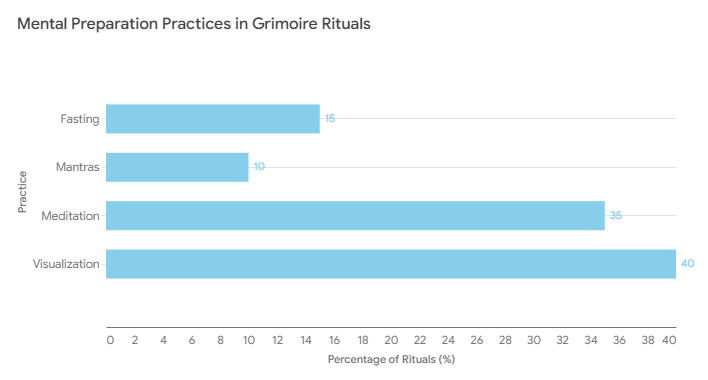
- Application: Many grimoires emphasize altered mental states (visualization, fasting, meditation) to influence outcomes, aligning with modern research into the mind’s role in quantum mechanics and the placebo effect.
- Example: Studies on focused intention affecting water crystallization or random number generators mirror the “mind-matter interaction” principles outlined in ritual practices.
- Scientific Potential: Design experiments testing the influence of meditative states on physical systems, such as influencing biological growth patterns or subtle energy fields.
Call to Action:
- Collaborate with neuroscientists and psychologists to study the physiological effects of grimoire-inspired practices (e.g., specific chants or visualization techniques).
- Analyze whether these practices alter neural activity patterns, focusing on regions linked to intention and focus.
3. Vibrations and Sound: Resonance Theory
Practical Insight: Harnessing Sound for Physical and Psychological Effects
- Application: Grimoire invocations often use specific frequencies or phonetic patterns that align with principles of resonance and cymatics (visible sound vibrations).
- Example: The chants described in texts like the Goetia could be analyzed for their acoustic properties and their effects on matter or consciousness.
- Scientific Potential: Develop therapeutic tools based on these sound patterns for mental health or physical well-being, akin to sound baths or binaural beats.
Call to Action:
- Perform spectral analysis of chants and mantras described in grimoires to identify resonant frequencies.
- Experiment with these frequencies to observe their impact on matter (e.g., cymatic patterns in liquids) and brain activity.
4. Temporal and Spatial Anomalies: Space-Time Exploration
Practical Insight: Geometric Models of Space-Time
- Application: Ritual diagrams involving concentric circles, intersections, and sigils may unintentionally model aspects of energy fields or even space-time curvatures.
- Example: The symmetrical overlays in grimoire diagrams resemble theoretical models of gravitational fields or quantum foam.
- Scientific Potential: Use these designs as inspiration for visualizing and modeling complex multi-dimensional fields.
Call to Action:
- Analyze whether sacred geometry shapes correlate with theoretical physics models, like Einstein-Rosen bridges or quantum entanglement.
- Explore whether their use in rituals (e.g., focusing energy) aligns with principles like energy convergence in closed systems.
5. Tools and Artifacts: Biomimicry and Energy Design
Practical Insight: Engineering Inspired by Ritual Tools
- Application: Tools described in grimoires—wands, rings, talismans—may serve as early conceptual models of modern energy manipulation tools (e.g., antennas, circuits).
- Example: A wand could be seen as a primitive capacitor, focusing and directing energy flow.
- Scientific Potential: Develop new materials or devices inspired by the functionality of these ritual tools.
Call to Action:
- Examine the materials and construction methods described in grimoires for practical applications in modern energy systems.
- Prototype devices modeled after these tools to test their energy dynamics in physical systems.

Bridging Mysticism and Modern Science
Framework for Future Research
- Interdisciplinary Collaboration:
- Involve physicists, mathematicians, psychologists, and historians to dissect grimoire practices using empirical methods.
- Data-Driven Validation:
- Use machine learning to analyze textual patterns in grimoires and their potential correlation with scientific principles.
- Experimental Replication:
- Test grimoire-inspired hypotheses in controlled environments, such as acoustic resonance studies or energy flow in geometric designs.
Potential Impact
- Philosophical: Provides a historical perspective on humanity’s quest to understand universal forces.
- Scientific: Inspires innovative frameworks for studying energy, consciousness, and geometry.
- Technological: Leads to new tools or methods derived from ancient concepts.
Conclusion
Grimoires are not merely mystical artifacts—they encapsulate a rich tapestry of human ingenuity, weaving together geometry, intention, and sound to explore the unseen forces of the universe. By combining modern scientific rigor with ancient insights, we open new frontiers for understanding the interplay between mind, matter, and energy.
The legacy of grimoires, when examined through a scientific lens, reminds us that the boundaries of knowledge are ever-expanding, bridging the gap between the mystical and the empirical.


 Fortean Winds: Scientific Research into the Unexplained, Paranormal and Anomalous
Leave a comment