
It might be the most important aspect of the Bigfoot phenomenon. If there’s one thing we’d like to make clear upfront: the name “Bigfoot” did not appear until 1958. A newspaper gave it that name based on one set of footprints found by a construction crew in Humboldt County, California. The creature had been encountered and documented across North America for centuries before that — and independently, across the world, under dozens of other names. Here they all are.
The Name Problem
The name “Bigfoot” was granted by a newspaper. A crew member named Jerry Crew found giant footprints in 1958. The Humboldt Times ran a story wondering if the area was inhabited by a cousin of the Abominable Snowman, which they called “Bigfoot.” Decades later a prankster claimed he faked the footprints, but the name stuck.
Native Americans referred to the same creature as Sasquatch — and many other names depending on the nation and region — long before American colonists arrived. The phenomenon they were describing was not new in 1958. It was just rebranded. Names have power. The name Bigfoot turned a global multi-century phenomenon into a piece of American roadside folklore, in the same way that “Mothman” obscured a winged humanoid phenomenon that stretches back millennia.
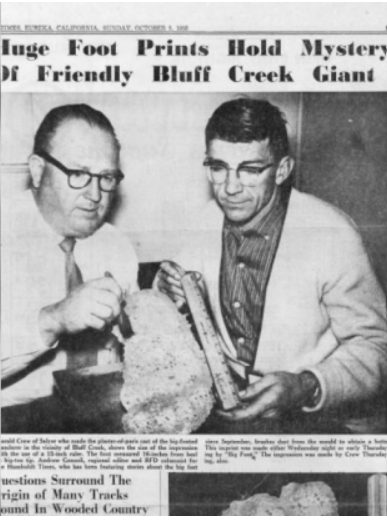
Below is a May 1851 article from the Arkansas Gazette demonstrating that the same phenomenon — giant hairy bipedal humanoid, 13-inch footprints, enormous leaping stride — was already being documented in American newspapers 107 years before Bigfoot had a name.

From the article: “A Wild Man of the Woods — …an animal bearing the unmistakable likeness of humanity. He was of gigantic stature, the body being covered with hair… The ‘wild man’ after looking at them deliberately for a short time turned and ran away with great speed, leaping from 12 to 14 feet at a time. His footprints measured thirteen inches each.”
Sasquatch — North America
Sasquatch is the original name used by Indigenous peoples of the Pacific Northwest, derived from the Halkomelem word sæsqʰac. Large, bipedal, hair-covered humanoid. Height 6 to 9 feet. Hair color varies: black, brown, grey, and occasionally white or reddish. Accounts are consistent across nations that had no contact with each other and go back as far as oral tradition allows.
Skunk Ape — Florida, Georgia, Alabama
The southeastern United States variant, named for a reportedly powerful odor associated with sightings. Ape-like, 5 to 7 feet, dark or reddish fur. Florida has a long documented history of sightings concentrated in the Everglades. Physical description closely matches Sasquatch; the smell is the distinguishing regional detail.
Yowie — Australia
On the continent of Australia, Aboriginal peoples encountered a creature matching the same description as Sasquatch. According to legend, the Yowie comes in two types: one growing to around 10 feet tall, the other to around 5 feet. There is no documented contact between Aboriginal Australians and the cultures of North America. Two types. Two continents. Same encounter.
Yeren — China
In China, the phenomenon is referred to as a Yeren. References date to 300 BCE — long before anyone named the North American version Bigfoot. The Yeren is often reported as shorter than the North American Sasquatch, which some researchers note correlates with average height differences between populations. Hair described as black or red.
Yeti / Abominable Snowman — Nepal, Tibet, the Himalayas
The Himalayan version is the Yeti. Westerners renamed it “The Abominable Snowman” — we seem to have a penchant for the absurd. Same general physical profile as Sasquatch. Also called “the Mountain Man” in some accounts. The Himalayas have produced some of the most seriously investigated physical evidence in the broader phenomenon.
Almas / Almasty — Central Asia, Mongolia, the Caucasus
The Almas is brown or reddish-haired, typically shorter (5 to 6.5 feet), and described as more “hairy human” than ape. Soviet-era scientists conducted field investigations. Some researchers have proposed the Almas may represent a surviving population of Neanderthals or Denisovans given the more human-adjacent physical description.
The Full List: 20 Regional Names
To illustrate the widespread nature of this phenomenon, we’ve collected the names, locations, and distinguishing traits of 20 regional cryptids that bear a consistent resemblance to Sasquatch. We stuck with creatures that have documented sighting records rather than purely mythological sources.
| Name | Location | Unique Traits | Height |
| Sasquatch, Bigfoot | North America | Multiple colors — black, brown, white | 6–9 ft |
| Skunk Ape | Florida, Georgia, AL | Ape-like, strong odor, dark or reddish | 5–7 ft |
| Skookum | Northwest USA, Oregon | Ape-like, vicious, reported shape-changing | 7 ft |
| Mapinguary, Maricoxi | Brazil | Some say ape, some say giant sloth | 8–10 ft |
| Yeti, Abominable Snowman | Nepal, Tibet | Similar to Sasquatch; “Mountain Man” | 6–9 ft |
| Woodwose | England, Wales | Medieval wild man of the woods accounts | Variable |
| Yeren | China | Black or red hair; records to 300 BCE | 5–6.5 ft |
| Boggy Creek Monster | Arkansas, South USA | Southern Sasquatch | 7 ft |
| Chuchunaa, Chuchunya | Russia, Siberia | Siberian Sasquatch; wears animal skins | 6–7 ft |
| Barmanu | Afghanistan, Pakistan | Ape-man; wears animal skins | 6 ft |
| Almas, Almasty | Central Asia, Mongolia | Brown-reddish, “hairy wild man” | 5–6.5 ft |
| Batutut | Vietnam | Black, brown or grey hair | 5–7 ft |
| Otang | Africa | Hairy hominid, Sasquatch-like | 7 ft |
| Yowie, Yahoo | Australia | Lighter or reddish; two size variants | 5–9 ft |
| Big Muddy Monster | Illinois, USA | Lighter, possibly white | 8 ft |
| Fouke Monster | Arkansas, South USA | Hairy bipedal creature | 7–10 ft |
| Momo, Missouri Monster | Missouri, USA | Dark fur, reportedly purplish | 7 ft |
| Orang Pendek | Indonesia | Smaller, ground-dwelling primate | 3–5 ft |
| Mono Grande | Amazon Basin | Large primate, unconfirmed to science | 5 ft |
| Gruagach, Beast of Blessington | Ireland | Dark, Sasquatch-like | 7 ft+ |
Analysis: The Uncomfortable Third Category
The public wants this phenomenon to fit one of two categories: either Bigfoot is a real undiscovered animal, or it’s a mass delusion. It doesn’t fit either.
If Sasquatch is a conventional biological creature that exists globally, we would expect the extensive hunts across multiple continents — helicopters, drones, thermal cameras, DNA collection — to have produced remains or confirmed DNA by now. We still discover new animals. We occasionally rediscover ones thought extinct. We have never confirmed a large mammal that exists globally near human populations without producing physical remains. It just doesn’t make sense.
Our conclusion is that Sasquatch is a phenomenon rather than a conventional animal. We found police officers, park rangers, scientists and other credible witnesses with consistent accounts across multiple continents. They weren’t all lying and they weren’t all misidentifying bears. The witness encounters are the hardest evidence in this case — and those encounters, from 300 BCE China to 1851 Arkansas to 2022 Utah, describe the same thing.
Sasquatch is regularly seen near areas where UAPs are also reported, including Bradshaw Ranch and Skinwalker Ranch, where government-funded scientists documented cryptid encounters alongside UAP sightings and electromagnetic anomalies. That’s not coincidence. It’s a pattern. Uncanny quiet, missing time, and the sense of an intelligent presence are often described alongside Sasquatch encounters, leading researchers to explore interdimensional or non-biological explanations for what can’t be explained as an undiscovered mammal.
The names only change according to local custom. The phenomenon remains the same.
For further reading: Nick Redfern’s The Bigfoot Book: The Encyclopedia of Sasquatch, Yeti and Cryptid Primates covers the global scope of this phenomenon in depth.
 Fortean Winds: Anolmalous Research
One response to “The Many Names of Bigfoot: Sasquatch, Yeti, Yowie, Yeren and the Global Phenomenon”
[…] to explain when someone asks a question like “Do you believe in Bigfoot?” I think Bigfoot is as real as a grey alien. They are real for the moment. Whether or not they were independently intelligent and conscious for […]
LikeLike