The Book of Enoch didn’t make the cut into the modern King James version of the Bible. Yet, it is among the oldest Abrahamic religious texts known to exist. It was found among the Dead Sea Scrolls in a cave in 1947. One often stated reason for its exclusion from the Christian Bible is that it’s an exegesis(an explanation of an existing text) of a story found in Genesis. A story which briefly mentions events unfolding before the flood.
The Nephilim were on the earth in those days—and also afterward—when the sons of God went in to the daughters of humans, who bore children to them. These were the heroes that were of old, warriors of renown
Genesis 6:4
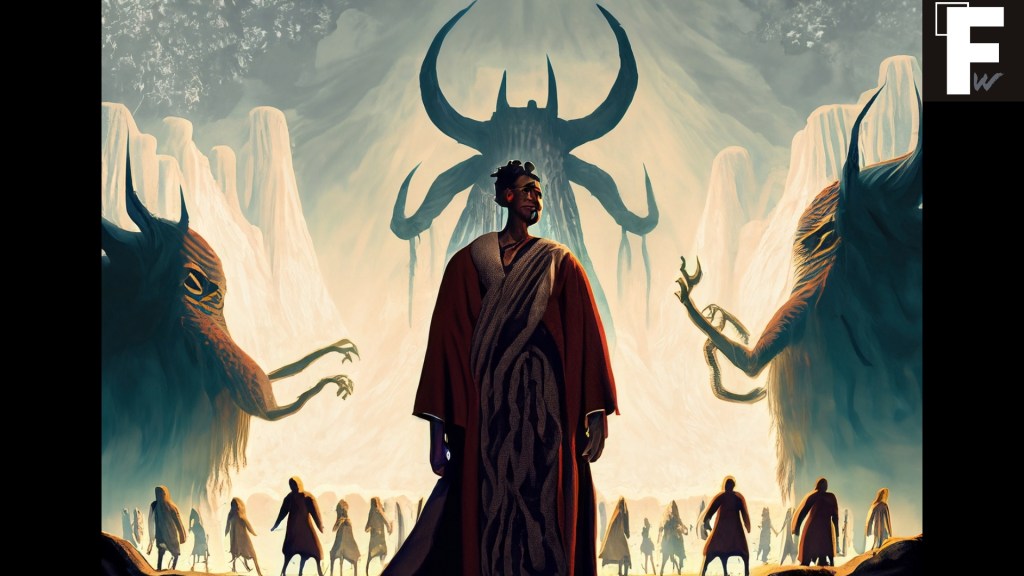
Yet, within the pages of the Book of Enoch a narrative of immense significance unfolds—the tale of the Watchers.
This account, found within the pages of the “Book of the Watchers,” stands as a cornerstone of the text and has reverberated through the corridors of religious thought for centuries. It is a narrative that has captured the imagination of scholars, theologians, and curious minds alike, leaving an indelible mark on the way we perceive celestial beings.
Shaping Perceptions of Angels and Demons
The story of the Watchers transcends the boundaries of a simple narrative. It has played a pivotal role in shaping our perceptions of angels and demons within the Judeo-Christian tradition.
Prior to this narrative, angels were often viewed as divine messengers and servants of God, embodying purity and obedience. However, the Watchers’ rebellion challenged this conventional understanding, introducing a complex dimension to celestial beings. They were no longer confined to a singular role but could also be agents of rebellion and corruption when swayed by earthly desires.
A Connection to UFO Folklore
Beyond its impact on religious thought, the story of the Watchers has found its place in the intriguing realm of UFO folklore. Researchers and enthusiasts have contemplated whether this ancient narrative holds clues to unexplained phenomena.
Some have wondered whether the tale of the Watchers might not be a mere allegory, but a reflection of a human and non-human hybridization program gone awry. This speculation leads to fascinating questions about the possibility of non-human involvement in human history and the idea of a program that was reset by those overseeing it.
An Ongoing Source of Inquiry
The narrative of the Watchers, with its layers of theological significance and its connection to contemporary discussions of UFOs and hybridization, remains a source of ongoing inquiry.
It exemplifies the enduring power of ancient texts to spark curiosity and exploration across diverse domains of knowledge. As we navigate the complex interplay of religious narratives, folklore, and modern interpretations, the story of the Watchers continues to challenge our perceptions and provoke thought-provoking discussions about the mysteries of the universe and our place within it.
The Watchers’ Descent:
The narrative unfolds with the descent of a group of celestial beings known as the Watchers. These angels, seduced by earthly desires, transgress divine boundaries by taking human women as their partners.
This forbidden union results in the birth of the Nephilim, a race of giants. The consequences of this celestial dalliance ripple through the narrative, setting the stage for profound theological exploration.
Influence on Angelology:
The story of the Watchers fundamentally reshaped the way angels were perceived in Judeo-Christian traditions. Prior to this narrative, angels were often seen as messengers of God, serving obediently in the heavenly realm. However, the Watchers’ rebellion portrayed angels in a different light—they could be agents of rebellion and corruption when led astray by their own desires.
This shift in perspective prompted deeper theological reflections on the nature of angels. It led to the development of angelology, a branch of theology dedicated to the study of angels.
Scholars and theologians grappled with questions about the free will of angels, their capacity for sin, and their role in the human experience. The story of the Watchers served as a foundational text for these discussions.
Emergence of Demonology:
Equally significant is the narrative’s influence on the development of demonology. The Watchers, once holy beings, become fallen angels as they succumb to their earthly desires.
This transformation raises questions about the nature of evil and the existence of malevolent entities. As the fallen angels father the Nephilim, they contribute to the corruption and wickedness in the world, further solidifying their association with malevolence.
The concept of fallen angels, driven by their own desires to rebel against the divine order, laid the groundwork for the emergence of demonology. Scholars began to explore the origins and characteristics of these fallen entities, paving the way for a deeper understanding of evil forces in the world.
Impact on Eschatology:
The narrative of the Watchers also left its imprint on eschatological thought—the study of end times and the final destiny of humanity. The Book of Enoch, with its vivid descriptions of the Watchers’ transgressions and divine judgment, contributed to the shaping of eschatological beliefs.
The fate of the Watchers, who are bound and cast into darkness as punishment for their actions, offered a glimpse into the consequences of cosmic disobedience. This imagery played a role in the development of apocalyptic thought, influencing discussions about the end of the world, divine judgment, and the ultimate resolution of good versus evil.
Impact on UFO Lore:
In relation to UAP lore, there are a few points of connection:
- Ancient Astronaut Theory: Some proponents of UAP lore and ancient astronaut theories suggest that the Nephilim were, in fact, extraterrestrial beings. They interpret the “sons of God” as aliens who visited Earth and had offspring with human women. This theory is part of a larger set of beliefs that suggest extraterrestrial beings have been involved in human history.
- Technological Anomalies: In some interpretations, the abilities or technologies attributed to the Nephilim in ancient texts are seen as evidence of advanced technology, possibly extraterrestrial or non-human in origin. This is analogous to how some modern UAP sightings involve reports of advanced technology.
- Cultural and Mythological Patterns: A broader connection is the way in which both Nephilim legends and UAP sightings reflect human culture’s deep interest in and speculation about beings from the sky or from other worlds. Both sets of lore deal with the idea of contact with non-human intelligences.
- Government and Religious Documents: Some UAP researchers look into historical religious and government documents for evidence of UAPs or extraterrestrial life, sometimes drawing parallels with stories like that of the Nephilim.
In summary, the story of the Watchers in the Book of Enoch serves as a pivotal narrative that profoundly influenced the development of thought surrounding angels, demons, and eschatology within Judeo-Christian traditions. It challenged conventional views of celestial beings, paving the way for in-depth theological explorations that continue to shape religious discourse to this day.