
This article accompanies our podcast episode of the same name. Listen first if you can — the article is the receipts.
There are currently between four and nine scientists, engineers, and researchers dead or missing — depending on who is drawing the circle and how loosely. Every list circulating right now lumps them together. Most do not tell you which cases have documented institutional connections to classified aerospace programs, which have identified suspects and apparent non-UAP motives, and which are included because they worked somewhere near something sensitive once.
That distinction matters. A circle is not an argument. When you actually sort the cases by evidentiary standard — documented, traceable, institutional connection to a classified program, yes or no — the pattern that survives is narrower than what is being circulated, and more defensible. Two cases anchor it. One thread connects them in a way that almost no coverage has examined, because it requires going through patent filings and federal contract databases rather than social media.
We are calling it the Mondaloy chain. Here is what the record shows.
The Evidentiary Standard
Before the cases: the methodology. We are sorting on one question. Is there a documented, traceable connection between this individual and a classified aerospace or UAP-adjacent program? Not prestigious institution. Not clearance held at some point. Documented. Traceable. That standard excludes some names being widely circulated. We will explain why as we go.
Node One: Monica Jacinto Reza
Monica Jacinto Reza, 60, was a former Technical Fellow at Aerojet Rocketdyne and had recently joined NASA’s Jet Propulsion Laboratory. The Technical Fellow designation is the highest individual contributor rank in an engineering organization — it is not an honorific, it means you are the technical authority on a specific domain.
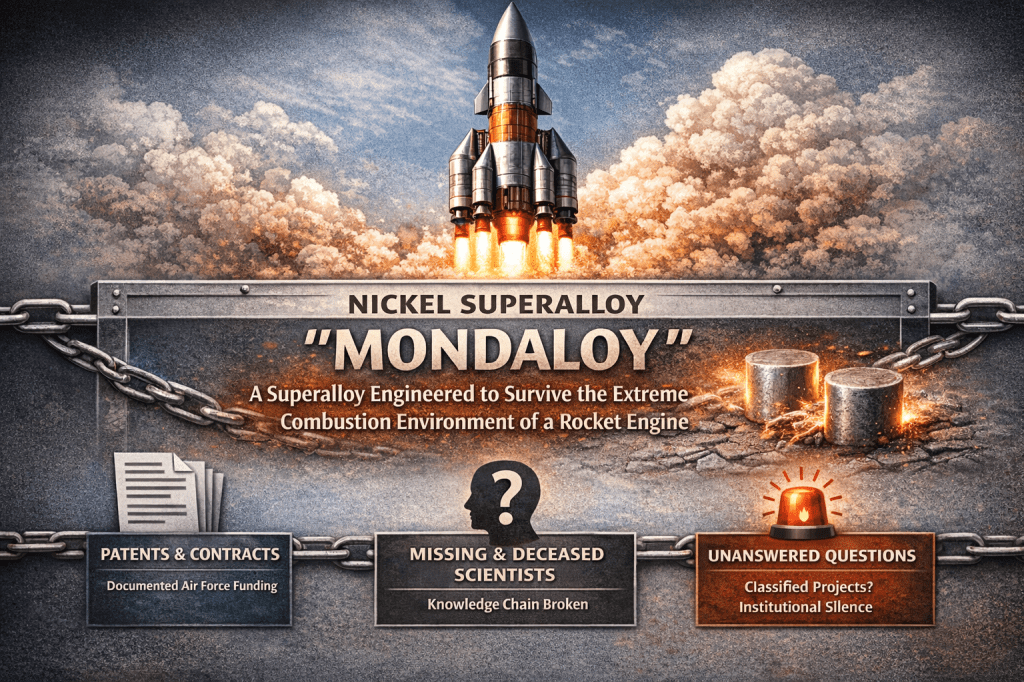
Her domain was advanced rocket materials. Specifically, she is the co-inventor of Mondaloy, a family of nickel-based superalloys engineered for oxygen-rich combustion environments — the conditions inside the most powerful and strategically significant rocket engines. The material was developed under direct Air Force funding. The patent record is publicly accessible by searching her name alongside “superalloy” and “Aerojet” on the USPTO database.
On June 22, 2025, Reza vanished while hiking near Mount Waterman in the Angeles National Forest with two companions. She was last seen at approximately 9:10 a.m., waving to a companion on the Upper West Ridge Trail. She was thirty feet behind them. The search involved helicopters, FLIR, canine units, and drones across multiple agencies for more than a week. It recovered a beanie and lip balm. No body. No further trace.
The case was transferred to the LA County Sheriff’s Homicide Bureau Missing Persons Unit. It remains open.
On June 26, 2025 — four days after she disappeared, three days before the official search was suspended — someone created a memorial page for her on Find a Grave. Memorial ID 284387277. Monica Jacinto Reza. Born December 30, 1964. Died June 22, 2025. Death location: Angeles National Forest. Remains: green burial. The memorial creator’s profile is no longer publicly accessible. The page remains live.
The institutional response: Aerojet Rocketdyne issued no public statement. NASA issued no public statement. JPL issued no public statement. The AIAA issued no acknowledgment. SpaceNews, which published a feature profile of her in 2017, did not cover her disappearance. The only signal from inside the aerospace community was a Reddit comment on r/socalhiking: “Any updates on the search? I’m a JPLer and something is not right about this story.”
Node Two: William Neil McCasland
Retired Air Force Major General William Neil McCasland, 68, commanded the Air Force Research Laboratory at Wright-Patterson Air Force Base from 2011 to 2013. His portfolio: $4.4 billion in classified aerospace research and development, spanning directed-energy weapons, hypersonic propulsion, advanced aerospace materials, and classified satellite systems.
Beyond AFRL, McCasland served as executive secretary of the Special Access Program Oversight Committee — the body with legal visibility over every compartmented program in the entire Department of Defense. Not one branch. All of them.
His name appears in the 2016 WikiLeaks release of John Podesta’s emails, in messages from Tom DeLonge describing McCasland as having direct knowledge of non-human craft and crash retrieval programs and as having helped assemble DeLonge’s UAP disclosure advisory team. McCasland’s wife confirmed in a public Facebook statement that her husband had a brief association with the UFO community and worked with DeLonge as an unpaid consultant on military and technical matters.
On February 27, 2026 — eleven days after President Trump’s Truth Social post directing federal agencies to declassify UAP records — McCasland left his Albuquerque home and did not return. He left behind his phone, prescription glasses, and wearable devices. He took his wallet, hiking boots, a red backpack, and a .38 caliber revolver with a leather holster.
His wife’s 911 call, released April 3, 2026, is a primary source document. She told dispatchers he planned not to be found. She noted he had changed his clothes before leaving. She described him as experiencing mental fog, anxiety, short-term memory loss, and sleep disruption, and said he had been stepping down from advisory roles because of it.
The FBI joined the search. In March 2026, Congress held a classified SCIF briefing specifically addressing McCasland’s disappearance and its relationship to UAP programs. The contents of that briefing are not public. Representative Eric Burlison (R-MO) requested FBI involvement and called the case deeply concerning. Representative Tim Burchett stated publicly: “We will not have UFO disclosure. They don’t want it out. I think it’s too deep and too strong. They’re gonna claim military intelligence, that it weakens our military.”
The institutional response: Wright-Patterson referred all press inquiries to the Pentagon. The Pentagon did not respond.
The Chain
The connection between Reza and McCasland is not proximity. It is programmatic, and it is traceable.
Reza trained professionally in the lineage of Dallis Hardwick, a materials scientist who worked under McCasland’s command at AFRL. Hardwick’s work laid the foundational science for what became Mondaloy — the crystallography and thermodynamic behavior of nickel-based alloys under oxygen-rich combustion conditions. Hardwick died of cancer in 2014. Natural causes, nothing anomalous. But his death was when the first link in the knowledge chain went dark.
Reza took the foundational science and made it producible. The co-invention of Mondaloy under Air Force contract, documented in patent filings and her Aerojet Rocketdyne professional record, is the product of that lineage. McCasland ran the laboratory that funded, classified, and directed the programs that Hardwick and Reza worked under. As executive secretary of the SAP Oversight Committee, he held visibility over where the material went and what it went into.
The Sentinel Network’s analysis, which traced the professional connections through patent filings, congressional testimony, DTIC records, and federal contract databases, states the argument directly: the complete knowledge chain for this specific propulsion material — from bench science to operational application — is severed. The metallurgist who built the foundation is dead. The engineer who scaled it is missing. The general who held classification authority over its downstream applications is missing.
We are not asserting that chain was deliberately cut. We are asserting it is documentable. The Defense Technical Information Center holds the contract records. The USPTO holds the patent filings. The institutional affiliations are in the public biography record. The chain is real. Whether it was deliberately severed is the question that requires an investigation.
The Cases That Don’t Hold — And Why That Matters
Intellectual honesty requires naming these, because lumping weak cases with strong ones gives the pattern’s critics an easy exit.
Nuno Loureiro was director of MIT’s Plasma Science and Fusion Center when he was murdered at his Brookline home on December 15, 2025. The suspect, identified as Cláudio Manuel Neves Valente, also shot two people at Brown University two days earlier before dying by suicide. The firearm was forensically matched. The assessed motive is documented academic fixation. The suspect is identified. The connection to classified UAP-adjacent programs is not established. This case belongs in a separate examination on its own terms.
Carl Grillmair, a 30-year Caltech research scientist, was shot on the front porch of his Llano home on February 16, 2026. The suspect had trespassed on Grillmair’s property carrying a rifle in December 2025, was arrested, had the felony charge reduced, was released on recognizance, and killed Grillmair two months later. The suspect is in custody. There is no established link to classified UAP programs. What this case demonstrates is a concrete institutional failure by the criminal justice system — and a notable institutional communication choice: Caltech’s official announcement described Grillmair as having “passed away,” with no reference to the homicide.
Melissa Casias (Los Alamos administrative employee), Anthony Chavez (Los Alamos-affiliated), and Jason Thomas (Novartis researcher with DoD contracts) are included in most cluster lists. LA Mag’s investigation assessed Casias as likely unconnected — she held an administrative position and was reportedly experiencing private financial difficulties. These cases are not excluded because nothing happened. They are excluded from the core pattern because the documented institutional link to classified aerospace programs is not established.
The Institutional Silence Pattern
Strip out the cases that don’t hold. What remains is a consistent behavioral variable across the cases that do.
JPL on Reza: nothing. NASA on Reza: nothing. Aerojet Rocketdyne on Reza: nothing. Caltech on Grillmair: “passed away.” Wright-Patterson on the October 2025 deaths of three cleared personnel — an Air Force acquisition manager, his wife, and a 25-year-old operations analysis officer, assessed as murder-suicide, captured on security cameras — offered counseling services to staff. No investigative statement. Pentagon on McCasland: no response to press inquiry.
Each of these organizations operates under different chains of command, different institutional cultures, different communications policies. In any individual case the minimum-disclosure posture could be explained by standard crisis communications doctrine. The consistency across separate organizations, separate incidents, and an eight-month window is harder to explain by that standard alone. It is not proof of coordination. It is a pattern of institutional behavior that is itself data.
The Timing Bracket
Every core case falls inside the same window.
Reza disappears: June 22, 2025. Wright-Patterson deaths: October 2025. Loureiro murdered: December 15, 2025. Grillmair murdered: February 16, 2026. Trump’s Truth Social UAP declassification post: February 20, 2026. McCasland disappears: February 27, 2026. Classified congressional SCIF briefing on McCasland and UAP programs: March 2026.
The window runs from mid-2025 to the present. It maps onto the period of escalating institutional pressure toward UAP disclosure — the FY2026 NDAA UAP provisions, the Oversight Task Force hearings, the executive declassification order. We are not asserting that disclosure pressure caused these incidents. We are asserting that a cluster of incidents involving people with documented connections to the programs most likely to be affected by disclosure — occurring entirely inside the window of maximum disclosure pressure — is a temporal pattern that meets the threshold for formal investigation.
What a Real Investigation Requires
We do not have subpoena authority. We do not have access to classified records. What we have is the open source record, the patent databases, the DTIC contract filings, the primary source documents, and the institutional statements — or the absence of them. That record establishes the chain, the silence pattern, and the timing bracket. It does not resolve causation.
Resolving causation requires three things. First, someone with congressional authority needs to establish which specific Special Access Programs McCasland held visibility over in the final two years of his advisory work, and whether any of those programs intersect with the Mondaloy application domain. Second, the Reza case needs investigative resources proportional to who she actually was — she was the co-inventor of a classified-grade propulsion material who vanished without trace in minutes, thirty feet behind a companion. The LA County Sheriff’s Homicide Bureau has the case. It should not be quiet. Third, every institution that issued no statement about a person who worked for them should be asked directly and on the record: why?
Source Reference Package
On Monica Reza:
- LA Magazine — Congress UAP Briefing and Reza reporting
- The Sentinel Network — The Green Burial (Reza/McCasland chain analysis)
- Men’s Journal — Full case list with timeline
- Newsweek — Case summary
- USPTO / Google Patents — Mondaloy patent filings (search: Reza, superalloy, Aerojet)
- DTIC — Defense Technical Information Center contract database
On William Neil McCasland:
- CNN — FBI joins search
- CNN — Wright-Patterson history and UAP context
- ABC7 — Disappearance and UAP context
- NewsNation — Who is McCasland, wife’s statement
- NewsNation — Ross Coulthart, “grave national security crisis”
- WikiLeaks Podesta Emails — DeLonge/McCasland correspondence (search: McCasland)
- LA Mag — 911 call reporting and SCIF briefing
On the congressional record:
- Washington Today — Burchett classified briefing context
- House Oversight — Luna UAP transparency investigation
- DefenseScoop — FY2026 NDAA UAP provisions
- Congress.gov — UAP Transparency Act text
On Nuno Loureiro:
- NBC News — Initial reporting
- Wikipedia — Nuno Loureiro biography and murder details
- Fox News — Motive reporting
On Carl Grillmair:
On the broader pattern:
- Based Underground — Institutional non-response analysis
- Above the Norm — Nine scientists pattern
- Newsweek — Full case list
- Yahoo Finance — Bank of England / Helen McCaw disclosure warning
As always: confirmed fact, direct record, recurring pattern, and theory under examination are different things. We have tried to label them as such throughout. If you are a researcher, journalist, or congressional staffer who finds this useful — the source package above is where the work starts. The chain is real. The gap is real. What fills the gap is the job of people with standing we do not have.
— Fortean Winds


4 responses to “The Mondaloy Chain: What the Record Actually Shows”
[…] Technological Advancements: The study of UAP technology could potentially lead to significant technological breakthroughs, giving those with access a considerable advantage in both economic and military domains. The documented pattern of researchers connected to classified propulsion programs going missing or dying is examined in The Mondaloy Chain. […]
LikeLike
[…] A small subgroup of an estimated 50 to 200 people within the intelligence and defense communities (including AARO and Lockheed Martin) likely controls this data, funded by $10 billion in defense R&D (GAO 2024). Official dismissals (“drones”) and the 80% redactions in the AARO report shape public perception, with about 70% of Americans doubting UAP significance (Gallup 2024). For a deeper look at how elite families and intelligence agencies have historically shaped the secrecy architecture around this subject, see Economic Power, CIA, and UAP. For the documented chain of researchers connected to classified aerospace programs who have gone missing or died, see The Mondaloy Chain. […]
LikeLike
[…] Fortean Winds — The Mondaloy Chain (full Reza case documentation) […]
LikeLike
[…] is a companion note to the Mondaloy chain series, and it stays in its lane. It does not touch the programmatic chain, the institutional-silence […]
LikeLike