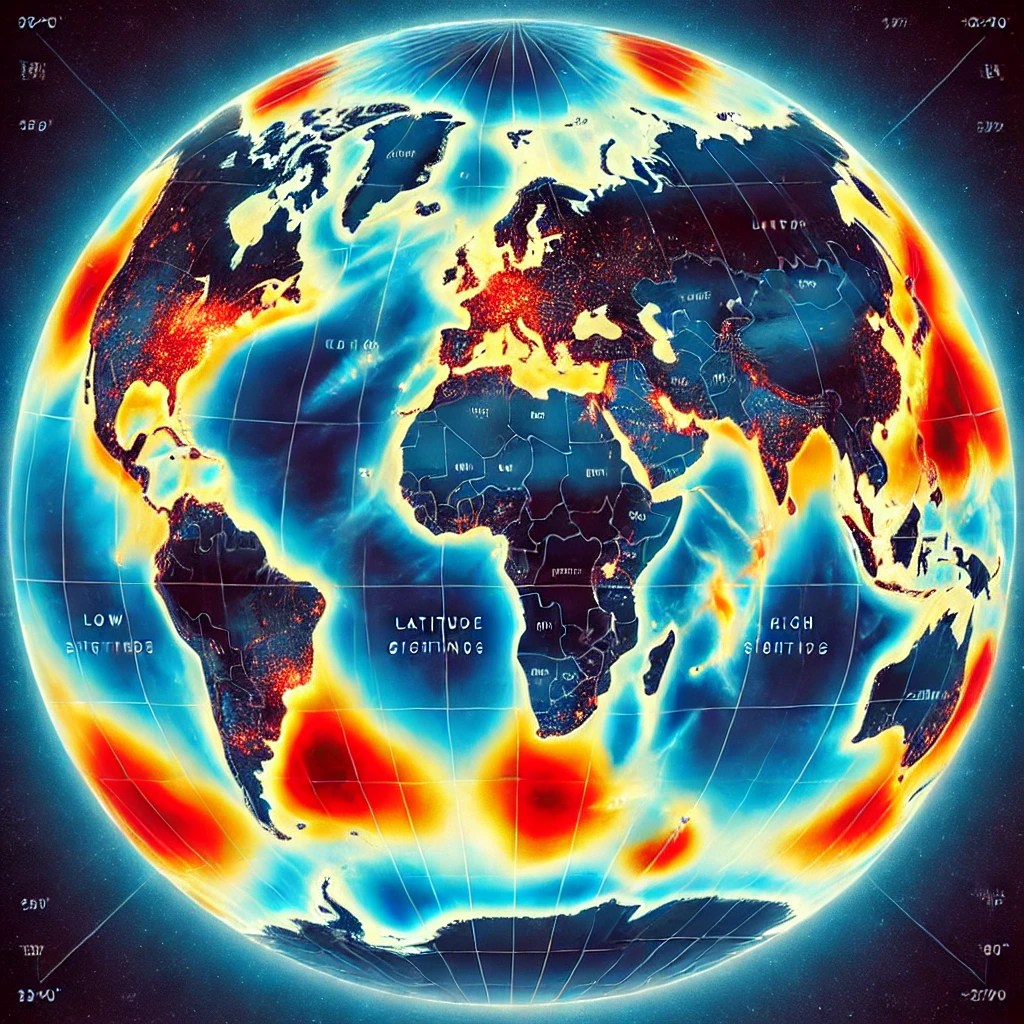
Unidentified Aerial Phenomena (UAP) sightings are a fascinating subject to researchers, with various studies attempting to uncover patterns and predictors of these mysterious events.
Recent advances in machine learning and data analysis have enabled us to explore these patterns with greater precision.
A study conducted by RamX of Fortean Winds utilizing logistic regression and Random Forest models has revealed that latitude, more than any other factor, is the most significant predictor of UAP sightings. This essay highlights the methodology and implications of this discovery, emphasizing the importance of latitude in understanding UAP phenomena.
Data Sources and Methodology
1. UAP Sightings Data: The study analyzed UAP sightings data from the National UFO Reporting Center (NUFORC), focusing on reports from California due to its large volume of sightings. The dataset included various features such as latitude, longitude, time, date, UAP shape, and duration, providing a comprehensive overview of UAP activity in the region.
2. Machine Learning Models: The researchers employed both logistic regression and Random Forest models to predict UAP sightings based on the dataset. Logistic regression was initially used to explore the relationships between different features and the likelihood of a UAP sighting. However, the Random Forest model was eventually favored due to its ability to handle complex, non-linear relationships and its higher overall accuracy.
3. Feature Importance Analysis: As part of the model development, the study conducted a thorough feature importance analysis to determine which factors most influenced the predictions. Features such as latitude, longitude, day of the week, month, hour, UAP shape, and duration were incrementally added to the models to assess their impact on prediction accuracy.

Key Findings
1. Latitude as the Dominant Factor: The analysis revealed that latitude was overwhelmingly the most significant factor in predicting UAP sightings. In the Random Forest model, latitude alone accounted for an astonishing 84.18% of the model’s predictive power, far outstripping other features such as longitude (15.31%) and duration (0.03%). This finding was corroborated by the logistic regression model, which also highlighted latitude as the primary determinant of UAP sightings, with minimal impact from additional features.
2. Limited Impact of Temporal Features: Temporal features such as the day of the week, month, and hour had a negligible impact on the model’s accuracy. This suggests that the timing of UAP sightings is less important than their geographical location, specifically latitude. Even when these temporal features were combined with geographical coordinates, they did not significantly improve the model’s predictive accuracy.
3. Implications for UAP Research: The discovery that latitude is the most critical factor in predicting UAP sightings has profound implications for UAP research. It suggests that certain latitudinal bands may be more prone to UAP activity, potentially due to environmental, atmospheric, or even magnetic factors unique to those regions. This finding challenges the traditional focus on temporal or shape-based patterns in UAP sightings and redirects attention toward understanding the geographical characteristics that make certain latitudes more susceptible to these phenomena.
Discussion
1. Methodological Rigor: The study’s methodological rigor, particularly the use of advanced machine learning models like Random Forest, lends significant credibility to the findings. The incremental feature testing approach ensured that the results were not merely artifacts of the modeling process but reflected genuine underlying patterns in the data.
2. Limitations and Caveats: While the study’s findings are compelling, several limitations must be acknowledged. The focus on California, though data-rich, may limit the generalizability of the results to other regions. Additionally, the reliance on reported UAP sightings introduces potential biases, as the data may be influenced by factors such as population density, media coverage, and public awareness.
3. Future Research Directions: The discovery that latitude plays such a crucial role in UAP sightings opens up new avenues for research. Future studies could explore whether this pattern holds true in other parts of the world or if certain latitudinal bands are particularly prone to UAP activity. Researchers could also investigate the environmental or atmospheric conditions associated with these latitudes to better understand why they may attract more UAP sightings.
Conclusion
The identification of latitude as the most determinant characteristic of UAP sightings marks a significant breakthrough in UAP research. This finding shifts the focus from traditional temporal and shape-based analyses to a more geographically centered approach, offering new insights into the conditions that may give rise to UAP phenomena. As researchers continue to refine their models and explore the implications of this discovery, the importance of latitude in predicting UAP sightings will likely become a central theme in future investigations. This discovery not only enhances our understanding of UAPs but also sets the stage for more targeted and effective research in the field.


 Fortean Winds: Scientific Research into the Unexplained, Paranormal and Anomalous
Leave a comment