
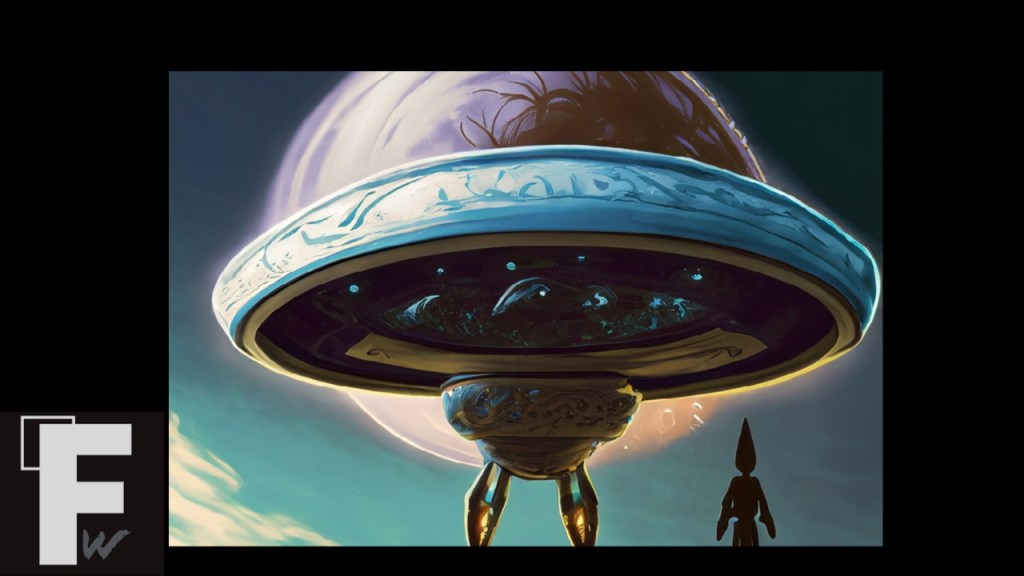
What are the odds we look alike and have a similar sense of humor?
The UAP phenomenon, across a century of documented encounters, exhibits deception that is specifically calibrated to human psychology. It doesn’t just evade detection. It performs. It mocks. It appears on its own schedule and refuses to appear on yours. It breaks equipment and then shows up the moment the camera is put away. It hides prize bulls in a trailer on a ranch in Utah and waits for the family to find them.
That last one isn’t metaphor. That’s a documented incident from Skinwalker Ranch, reported by the Sherman family, consistent across multiple witnesses. The phenomenon did something inconvenient, theatrical, and harmless. It demonstrated that it could access the bulls. It demonstrated that it knew what the family cared about. And then it waited.
That is not random behavior. That is trickster behavior. And it is the most important data point in UAP research that almost nobody treats seriously.
What the Trickster Framework Actually Is
The trickster is one of the most consistent archetypes in human mythology. Loki in Norse tradition. Coyote across dozens of Native American cultures. Anansi in West Africa. Nanabozho among the Ojibwe. Hermes in Greece. These figures share a behavioral profile: they are boundary-crossers, rule-breakers, shape-shifters. They are simultaneously creative and destructive, sacred and profane. They operate in the liminal spaces where categories break down. They reveal truths through deception. And they are, almost universally, associated with communication between the human world and whatever exists outside it.
John Keel — whose research remains the most underappreciated body of work in UAP studies — argued in The Mothman Prophecies and UFOs: Operation Trojan Horse that the phenomenon was not extraterrestrial but ultraterrestrial: something that has always been here, that understands human psychology at a deep level, and that interacts with us on its own terms according to rules we don’t understand. Keel didn’t use the word trickster, but the description is exact.
Jacques Vallee formalized the framework. In Passport to Magonia and Dimensions, Vallee argued that UAP encounters are functionally identical to historical accounts of contact with faeries, djinn, angels, and demons — not because they are the same entities, but because the behavioral pattern is the same. The phenomenon adapts its presentation to the cultural expectations of the witnesses. Medieval peasants saw angels. Twentieth-century pilots saw craft. The behavior underneath is consistent.
This is not fringe speculation. It is the hypothesis that best fits the data.
What Fortean Winds Has Found
We have documented the trickster pattern across multiple independent lines of evidence. Here is what the record shows.
Equipment failure on demand. At Skinwalker Ranch, government-funded researchers documented repeated instances of sensors failing specifically when anomalous phenomena appeared, and functioning normally when they didn’t. Cameras malfunctioned. Recording equipment died. The phenomenon appeared visually to witnesses while generating no signal on instruments placed to detect it. This is not random equipment failure — the pattern is selective and responsive. It suggests awareness of the observation attempt.
Selective visibility. One of the most consistent findings across UAP research is that the phenomenon appears to specific observers and not others standing feet away. At Skinwalker Ranch, objects were reported by witnesses with no corresponding sensor data. At Bradshaw Ranch outside Sedona — where we conducted on-site measurements and found anomalous EMF readings up to 60mG with no identifiable source — the former owners reported decades of selective sightings: some family members experienced activity regularly, others on the same property did not. Selective visibility implies the phenomenon is making choices about who sees it.
The 1.6GHz signal. Among the most interesting data points from Skinwalker Ranch is a repeating electromagnetic signal at 1.6GHz that appears in association with anomalous events. This frequency is in the L-band, used by GPS and certain satellite communications. The fact that the phenomenon produces a consistent, measurable signal in a specific part of the spectrum suggests it is not purely psychological — it has physical correlates. But the signal appears intermittently and inconsistently, which is itself a trickster characteristic: enough to confirm something is there, not enough to pin it down.
UAP flight behavior. The documented flight characteristics of UAPs — instant acceleration, right-angle turns, no sonic boom, no apparent propulsion — are not just physically anomalous. They are also performative. The objects don’t need to make right-angle turns. They could simply disappear. The elaborate maneuvers, the sudden changes in direction, the behavior described by Navy pilots as “cubing” and “tic-tac” — these are demonstrations. The phenomenon is showing off. That is trickster behavior.
The Roswell incident and the 1947 crash narrative. Whether or not anything actually crashed at Roswell, the aftermath — the initial press release confirming a recovered disc, the immediate retraction, the weather balloon explanation, the decades of contradictory official statements — reads like a script designed to maximize confusion. If the phenomenon has any influence over the information environment surrounding its appearances, Roswell is a case study in trickster information management: give just enough to generate maximum uncertainty.
Faeries, Djinn, and the Long Pattern
One of the most durable objections to the trickster framework is that it feels too literary — too convenient. Researchers want physics, not mythology. But the mythological parallels are themselves data.
Faerie accounts from medieval and early modern Europe describe beings that: appear and disappear without warning, take people away for periods of missing time, return them with no memory or false memories, cause physical effects on the body including burns and paralysis, operate according to rules that humans can learn but not control, and respond to observation by retreating. The list of behavioral characteristics is nearly identical to the modern UAP contact record.
Djinn in Islamic and pre-Islamic Arabian tradition are described as beings that share the earth with humans but occupy a different dimensional register, can take any form, have a penchant for misdirection and contract-violation, and interact with specific individuals rather than appearing universally. The djinn are not extraterrestrial visitors — they are native to this world and have been here as long as we have. That is exactly what Keel’s ultraterrestrial hypothesis proposes.
The parallel is not that UAPs are faeries or djinn. The parallel is that across widely separated cultures and centuries, humans have been encountering the same behavioral pattern and describing it in whatever framework their culture made available. The phenomenon has always been here. The names change. The behavior doesn’t.
The Competing Explanations
Several hypotheses attempt to account for trickster behavior, and they are not mutually exclusive.
The interdimensional hypothesis — advanced most rigorously by Vallee — proposes that UAPs originate from other dimensions or parallel realities and that their elusive behavior reflects the physics of dimensional transit rather than deliberate evasion. The trickster pattern would then be an artifact of how the phenomenon crosses between states of existence rather than a choice it makes.
The cryptoterrestrial hypothesis — developed by Mac Tonnies in The Cryptoterrestrials and supported by our own analysis of UAP clustering near ancient tunnel systems — proposes that the phenomenon represents intelligence native to Earth that has been concealed from human awareness. The trickster behavior would then be a survival strategy: an intelligence that cannot reveal itself directly uses misdirection as its primary defense. The human-like quality of the deception would make sense because the intelligence is, in some sense, human-adjacent — it evolved alongside us, knows us well, and has been managing our perception of it for a very long time.
The consciousness hypothesis — drawing on Jung’s analysis of UAP as a manifestation of collective unconscious content — proposes that the phenomenon is at least partially generated or shaped by the observer. The trickster would then be a projection, a mirror that shows us our own expectations back at us in altered form. This doesn’t explain the physical evidence, but it might explain the selective visibility.
The Von Neumann probe hypothesis proposes that UAPs are self-replicating machines sent by a distant civilization, and that the trickster behavior represents a programmed data-collection strategy. The deception and evasion are features, not bugs — designed to study human responses without contaminating the sample. This is the most mechanistic explanation and the one least able to account for the apparent awareness of individual psychology that the phenomenon demonstrates.
What the Human-Like Quality Implies
The trickster pattern across cultures encodes a specific kind of interaction: the trickster is never ignorant of the person it’s dealing with. Loki knows exactly which of the Aesir’s vanities to exploit. Coyote knows where the weakness in the plan is. The djinn know the exact terms of the wish that will ruin it.
This requires a model of human psychology. You cannot run a successful long-term deception against a species you don’t understand. The phenomenon has been running this particular operation against us, across cultures and centuries, without running out of material. That implies something more than sophisticated — it implies intimate familiarity with how we think.
The two possibilities this leaves open are: the phenomenon developed this understanding over a very long period of observation (the extraterrestrial or interdimensional model), or it already had it because it shares some origin with us (the cryptoterrestrial or ultraterrestrial model). The shape of the phenomenon — bipedal entities, human-adjacent biology, genetic interest in our species, preference for specific geographic locations on this planet over millions of square miles of accessible space — weights the evidence toward something with deep roots here.
It looks like us. It makes the same kinds of jokes we make. It knows what we value and what we’re afraid of. It has been here, by the account of every culture that has recorded contact with it, for as long as we have.
The question isn’t what it is. The question is what it wants. And the trickster, in every tradition that describes it, never quite answers that question directly. It answers it sideways, in riddles, with a misdirection built into the response.
Which is, of course, the most trickster-like answer possible.
See also: The Hitchhiker Effect — the pattern in which trickster contact doesn’t end when you leave. And The Shape of the Phenomenon — the macro view of what all of this, taken together, implies.
 Fortean Winds: Anolmalous Research
7 responses to “The Trickster Phenomenon: Why UAPs Deceive, Evade, and Play Games”
[…] UFO phenomenon behaves reactively, responding to the unique set of inputs provided by the contactee. Like a quantum system that takes […]
LikeLike
[…] “Trickster” Element: The phenomenon is famously absurd, lacing high-strangeness events with surreal, nonsensical, or […]
LikeLiked by 1 person
[…] intelligence(s) there seem to have a wicked sense of humor. This behavior is a textbook example of the Trickster Phenomenon — a pattern documented across UAP encounters worldwide in which the phenomenon appears to […]
LikeLike
[…] is also worth noting that the hitchhiker effect appears connected to what researchers call the Trickster Phenomenon — the broader pattern in which UAP and associated intelligences interact with observers on their […]
LikeLike
[…] witnesses while remaining invisible to others standing feet away. This is the core of what we call the Trickster Phenomenon — the documented pattern in which UAP and associated intelligences appear to play games with […]
LikeLike
[…] hurt anything. Like an especially dangerous child seeking negative attention. This is the Trickster Phenomenon at its clearest — UAP and related intelligences that perform, evade, and provoke rather than […]
LikeLike
[…] The frameworks are culturally specific. The phenomenon is not. This is exactly the pattern Vallee identified in UAP encounters: the presentation adapts to the cultural context of the witness, but the underlying behavioral […]
LikeLike