UAP over Ukraine

Scientists in the Ukraine recorded some interesting UAP observations that may say a lot about the phenomenon.

We’ve discussed these papers numerous times on our Fortean Winds UFO podcast.  So, we thought it best to give you a quick summary and links to where you can find the full papers. 

They are well worth reading. The astronomists in Kyiv did a fantastic job of capturing and sharing this data.  We  would especially like to draw your attention to the classification of the two objects (Phantoms and Cosmics) they observed.  

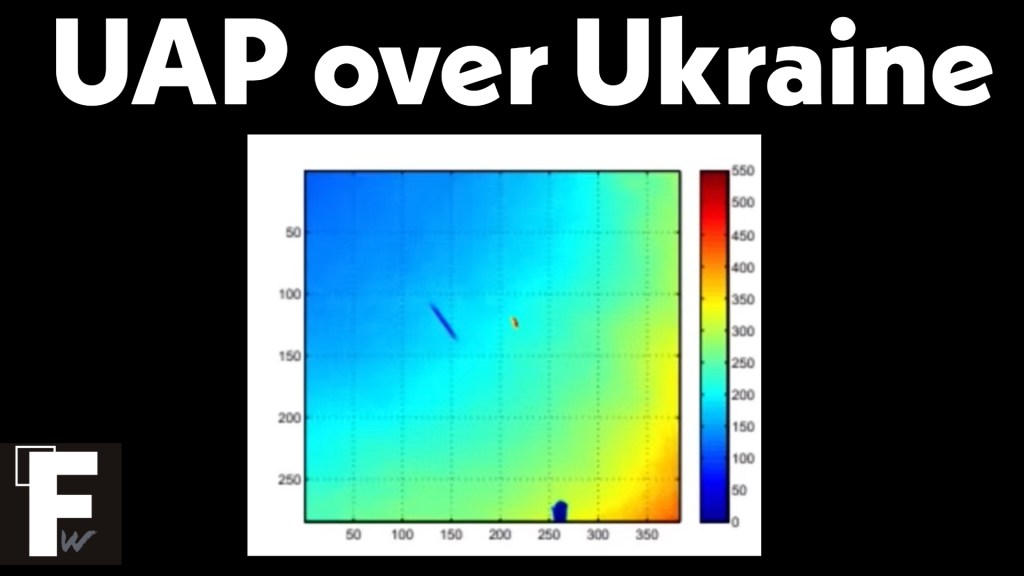
The observations were carried out by the Main Astronomical Observatory of NAS of Ukraine, and this was a rare independent scientific UAP study.  The Cosmics are very bright and much easier to detect than Phantoms which are dark and contrast with the sky. 

Both objects are moving at extremely high speeds (30k mph plus).  These challenges required the fine tuning of equipment and observations carried out at two different recording stations to verify the sightings.

 The Phantoms have no albedo*, which means they appear to not emit radiation, and rather absorb all of the radiation around it.  This could have several implications (absorbing energy, camouflage…both).  It’s also  good to note that speeds of 30k mph would tear apart any conventional aircraft.

Over 150 miles per a second and they have varying luminosity.  Our sensors aren’t calibrated to pick these up.  No one’s sensors are looking for these.  These objects could be doing what they want, when they want…just sayin.  Read the papers and decide for yourself.

*the proportion of the incident light or radiation that is reflected by a surface, typically that of a planet or moon.

A phantom UAP as recorded in the paper by Ukrainian scientists

SUMMARY

The paper titled “Unidentified Aerial Phenomena I: Observations of Events” by B.E. Zhilyaev, V.N. Petukhov, and V.M. Reshetnyk from the Main Astronomical Observatory NAS of Ukraine, discusses the study of Unidentified Aerial Phenomena (UAP). It details observations and analyses of these phenomena, categorizing them into two types, ‘Cosmics’ and ‘Phantoms’, and provides insights into their characteristics using specialized observational techniques.

AUTHORS

  • B.E. Zhilyaev
  • V.N. Petukhov
  • V.M. Reshetnyk

Date

Submitted on 23 Aug 2022 (v1)

AUTHOR ORGANIZATIONS

Main Astronomical Observatory, National Academy of Sciences of Ukraine, Kyiv, Ukraine.

FINDINGS

  • Identified two types of UAP: ‘Cosmics’ (luminous objects) and ‘Phantoms’ (dark objects with variable contrast).
  • Observed high-speed movements of UAPs, ranging from 3 to 15 degrees per second, with some exhibiting brightness variability of 10 – 20 Hz.
  • Utilized colorimetry methods to estimate distances and characteristics of UAPs. For instance, Phantoms were estimated to be in the troposphere at distances up to 10 – 12 km, with sizes ranging from 3 to 12 meters and speeds up to 15 km/s.
  • Detected a variable object at an altitude of 1170 km, flashing at an average of 20 Hz.
  • Highlighted the challenge in detecting UAPs due to their high speeds and the need for specialized equipment and observation techniques.

STUDY DETAILS

  • The study was conducted using two meteor stations in Kyiv and Vinarivka village, Ukraine.
  • Observations were performed with color video cameras in the daytime sky.
  • Special observation techniques were developed to account for the high speeds and characteristics of UAPs.
  • The study included colorimetric analysis and two-site observations for comprehensive data collection.

STUDY QUALITY

  • Study Design: Observational study using specialized techniques for UAP detection.
  • Consistency of Results: Consistent observations of two types of UAPs, though further studies are needed for confirmation.
  • Data Analysis Methods: Employed colorimetry and high-speed video capture, appropriate for the study’s objectives.
  • Researcher’s Interpretation: Findings are presented with caution, acknowledging the limitations in UAP identification and the need for further research.

OVERALL SUMMARY

This paper presents a detailed analysis of UAP observations, categorizing them into two types with distinct characteristics. The study’s methods are well-suited for its objectives, though the lack of statistical testing and details on sample size limit the conclusiveness of its findings. Further research and corroborative studies would enhance the understanding and validity of these observations in the scientific community.

CONTROVERSY
Following questions and comments from the scientific community.  The scientists in Kyiv released a follow-up to their original paper to clarify some outstanding questions.

A cosmic UAP over Ukraine as recorded in the papers linked.

SUMMARY

“Unidentified Aerial Phenomena II: Evaluation of UAP Properties” by B.E. Zhilyaev, V.N. Petukhov, and V.M. Reshetnyk from the Main Astronomical Observatory NAS of Ukraine extends their previous work on UAPs. This paper delves deeper into the properties of UAPs, categorizing them into ‘Cosmics’ and ‘Phantoms’, and evaluates their characteristics based on advanced observational techniques and detailed analysis.

AUTHORS

  • B.E. Zhilyaev
  • V.N. Petukhov
  • V.M. Reshetnyk

Date

Submitted on 13 Nov 2022

AUTHOR ORGANIZATIONS

Main Astronomical Observatory, National Academy of Sciences of Ukraine, Kyiv, Ukraine.

FINDINGS

  • Detailed analysis of two luminous objects at altitudes of 620 km and 1130 km, moving at speeds of 256 km/s and 78 km/s, respectively.
  • Colorimetric analysis indicates these objects are dark, supporting the hypothesis that they are ‘Phantoms’.
  • Phantoms are observed in the troposphere, with sizes estimated between 20 to 100 meters and speeds up to 30 km/s.
  • The study further investigates the color properties of these objects, suggesting extremely low albedo values, making them nearly black bodies.
  • Challenges in detecting these UAPs due to their rapid movement and the necessity for specialized observation methods.

STUDY DETAILS

  • Observations conducted at two meteor stations in Kyiv and Vinarivka village, Ukraine.
  • Utilized color video cameras for daytime sky observation.
  • Advanced techniques developed for detecting and evaluating UAP characteristics.

STUDY QUALITY

  • Sample Size: Continuation of extensive observations from the first study.
  • Study Design: Advanced observational, focusing on detailed analysis of UAP properties.
  • Consistency of Results: Consistent with the findings of the previous study, providing more depth.
  • Data Analysis Methods: In-depth colorimetric and velocity analysis.
  • Researcher’s Interpretation: Cautious interpretation of data, highlighting the need for specialized equipment and techniques in UAP study.

OVERALL SUMMARY

This follow-up paper provides a more detailed evaluation of UAP properties, focusing on their physical characteristics and movement patterns. The authors use sophisticated observational methods to analyze the UAPs, categorizing them as ‘Cosmics’ and ‘Phantoms’. While the study offers insightful data, it maintains a cautious approach to interpreting these phenomena, acknowledging the challenges in observing and understanding UAPs. Further research and collaboration in this field could provide more clarity and potentially corroborate these findings.

Fortean Observations:
The “Phantoms” may be less visible because they are employing cloaking technology.  If we assume the ‘Phantoms’ described in the paper are cloaking, and this accounts for their less visible, dark appearance, we can infer several potential aspects of their cloaking technology:

  • Advanced Light Absorption or Manipulation: The extremely low albedo values (which means they reflect very little light) suggest that these objects might be using a mechanism to absorb or otherwise manipulate light to render themselves nearly invisible. This could be akin to an advanced form of stealth technology that goes beyond merely avoiding detection by radar.
  • Material Properties: The objects may be composed of materials that inherently have low visibility, either by absorbing most of the electromagnetic spectrum visible to the human eye or by bending light around them. These materials could be engineered to have these properties or could be naturally occurring substances unknown to current human science.
  • Active Camouflage: The Phantoms might be using some form of active camouflage, which dynamically changes to match their background. This would require highly sophisticated sensors and processing capabilities to analyze the environment and adjust the object’s appearance in real-time.
  • Non-Reflective Coatings or Surfaces: The objects might be coated with a material that minimizes reflectivity. This type of technology is somewhat understood in current human science (e.g., Vantablack), but the Phantoms’ apparent effectiveness at cloaking suggests a much more advanced implementation.
  • Multi-Spectral Cloaking: If the objects are cloaked, they might be employing technology that works across multiple spectra, not just in the visible range. This could include infrared, ultraviolet, and possibly even radar cloaking.
  • Energy Considerations: The effectiveness of such a cloaking mechanism would likely require significant energy resources, indicating that these Phantoms might have access to advanced energy technologies.  The absorption of radiation (which aids in camouflage) might also provide additional power.
  • Dynamic Response to Observational Techniques: The cloaking mechanism might be responsive to the types of observational techniques used. For instance, if standard visual or infrared observations are employed, the technology might adapt to remain undetected under these specific conditions.

The James Webb Space Telescope and WASP-96b

The James Webb Space Telescope, launched in December 2021, is an infrared space telescope capable of observing distant cosmic events and examining light from the universe’s early history. Its recent discovery of water on the exoplanet WASP-96b showcases its advanced capabilities, reigniting interest in fundamental cosmic questions about our origins and future.

  By now you’ve heard of the James Webb telescope and if you haven’t, you’re probably afraid to ask.  So we’ll run you through a quick primer on what the James Webb telescope is and why it’s such a big deal (just in case).  Once you understand all of that, you’ll know why WASP-96b is important to the James Webb and why some knowledge of it may be important to you. 

The James Webb Space Telescope

     The James Webb Space Telescope, as it is officially known, is an infrared space telescope.  An infrared telescope is what it sounds like.  It detects infrared wavelengths on the infrared (lower than visible) portion of the electromagnetic spectrum.  Which not only allows the James Webb Telescope to see very far, but it can see things our eyes cannot.  This is important to its mission because the goal is to take a look at the beginning of time itself.  That’s not really an exaggeration.  

Carina Nebula Webb Telescope – NASA

Why is the James Webb Space Telescope a Big Deal

      The James Webb Space Telescope is a big deal because it gives us both the ability to see the farthest away from our planet and the farthest back in time of any device to date.  It’s a bit of a window through time.  Light moves at the speed of….well light, but that speed is finite. 

It’s roughly 186,000 miles per second.  So, it’s been moving that fast since the beginning of time.  For example the dinosaurs were around 60 million years ago, and the Virgo Cluster is around 60 million light years away.  If you were standing on a planet in the Virgo Cluster looking at earth with a really big telescope, you’d see dinosaurs.  The light on the earth, including the image of the dinosaurs, would be just reaching the Virgo Cluster now. 

So, with the James Webb we’re able to see light that existed all the way up to 13.7 billion years ago.  The universe is estimated to be 13.8 billion years old (that may change based on the Webb results).  Therefore, the James Webb telescope should be able to show us what the universe looked like all the way down to 100 million years before the big bang.  That’s a big deal.

Stefan’s Quintet – Webb Telescope NASA

The History and Deployment of the James Webb Space Telescope

Discussions of a follow-up to the Hubble Space telescope (the Webb can detect objects up to 100 times more faint than the Hubble) began in the 1980s.  However, the serious planning didn’t start until the late 80’s and early 90’s.  The project took shape over the years and in 2002, NASA renamed the project after their second administrator James E Webb who was instrumental in the Apollo mission. 

The project was infamously delayed, billions of dollars over budget and a few years later than expected. Yet, at a final cost of 10 billion dollars…we can see pretty close to when this whole universal rat race started.  The James Webb finally launched on December 25,2021, and it’s now sitting almost a million miles away from earth taking pictures.

WASP-96b is an Exoplanet 

WASP-96b is an exoplanet 1150 light years from earth.  An exoplanet is a planet which orbits a star outside of our own solar system.  WASP-96b is composed mainly of gas.  This gas giant, which is around half the size of Jupiter, was confirmed to have water recently by the James Webb Telescope.  Why were they looking at WASP-96b…because they thought it didn’t have water aka clouds. 

The absence of water and clouds would have given the James Webb an extremely clear view of the distant planet.  However, the fact it was able to detect water is a miracle of modern science.  As you can see from the wavelength of light analysis below, the Webb was able to detect water more than a thousand light years away. Quite an opening act for an over-budget, long-delayed space project.

WASP-96b Analysis – Webb Telescope NASA

Conclusion

There is nothing particularly Fortean or anomalous about the James Webb telescope.  Yet, it drives us toward the same set of questions and answers.  The answers to the basic questions of who we are, where we came from and where we’re going.  This is the unknown.  The James Webb is an instrument of science.  We are a website devoted to the science of the unknown, and thus consider this a matter of import to all of our readers.  Perhaps the James Webb Space Telescope is the finest Fortean instrument ever conceived….yet.