Unveiling the Connection: The South Atlantic Anomaly and UAP Activity in South America

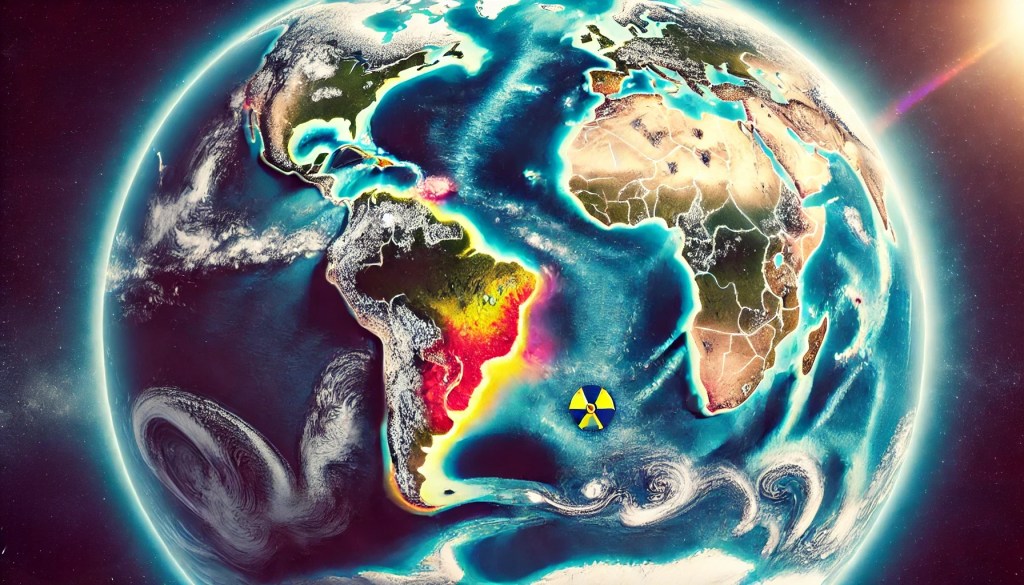
The article discusses the potential link between the South Atlantic Anomaly (SAA) and increased Unidentified Aerial Phenomena (UAP) activity in South America. It highlights ancient tunnels connecting locations like Nazca and Colares, suggesting a relationship between these tunnels and UAP sightings. The SAA’s unique radiation levels may attract UAPs, necessitating further research.

Update: 7/27/2024

We’ve been playing around with mapping ancient tunnel systems (they seem related)…and this article might be mildly wrong. The South American Anomaly might not be the main reason these beings are appearing in this location. Perhaps it’s part of it, but there is a very solid connection in this region between high intensity UAP activity and the ancient tunnels of Peru. As proof we’d submit the following:

Tunnels connect Nazca (the site of the Nazca lines, and the Non-human bodies/mummies currently being studied).

To Iquitios (the site where attacks were reported in 2023, injuries were sustained).

To Colares, Brazil (the site where UAP attacks were reported in 1977 and injuries were sustained).

Map of known ancient tunnels around the world - Fortean Winds
Map of known ancient tunnels around the world – Fortean Winds

Map of Ancient South American Tunnel System - Fortean Winds
Map of Ancient South American Tunnel System – Fortean Winds

We weren’t looking for this connection when we noticed it, so that made it all the more shocking. These regions are well known for intense and hostile UAP activity, and they’re all connected by these tunnels.

Tunnels the Peruvian Government sealed up.

Be great to know more…We’ll dig into this some and get back to you…

Introduction

The South Atlantic Anomaly (SAA) has long been a topic of interest among geophysicists and space scientists due to its unique position where the Earth’s inner Van Allen radiation belt comes closest to the surface. This results in an area with higher-than-normal levels of ionizing radiation. Our research suggests that this anomaly might be linked to increased Unidentified Aerial Phenomena (UAP) activity in regions like Peru and Nazca. This article explores this connection, highlighting historical and recent UAP encounters and examining the potential reasons behind this correlation.

The South Atlantic Anomaly: A Brief Overview

The SAA is a region centered off the coast of South America where the Earth’s magnetic field is weaker, allowing more energetic particles from the Sun to penetrate the atmosphere. This results in increased levels of ionizing radiation, which affects satellites, space missions, and even terrestrial electronics.

Historical and Modern UAP Sightings in South America

  1. The Nazca Lines and Peru:
    • The Nazca Lines, ancient geoglyphs located in southern Peru, have been the center of speculation regarding extraterrestrial activity. These massive designs, visible only from the air, have sparked theories about ancient astronauts and extraterrestrial influence.
    • Modern reports of UAPs in Peru describe unexplained lights and objects performing extraordinary maneuvers in the sky. These sightings are often reported by locals and have been documented by both amateur and professional researchers.
  2. Brazil and the Colares Incident:
    • The Colares incident in 1977 is one of the most well-documented UAP encounters in Brazil. Residents of Colares Island reported being attacked by beams of light from UAPs, which caused burns, puncture wounds, and other injuries. These incidents were investigated by the Brazilian Air Force under Operation Prato.
    • Recent sightings in Brazil continue to report similar phenomena, with lights and objects appearing in the sky and displaying behaviors that defy conventional explanations.
  3. Iquitos Sightings:
    Local residents in Iquitos, Peru have reported numerous UAP sightings. These include physical attacks, strange hovering objects, and Non-Human encounters. The frequency and nature of these sightings suggest a pattern that correlates with the SAA’s influence.
Marko Markovic at English Wikipedia

The Van Allen belt is a zone of energetic charged particles, primarily electrons and protons, that are captured by Earth’s magnetic field. There are two main belts: the inner and the outer Van Allen belts. The inner belt extends from about 1,000 to 12,000 kilometers above Earth’s surface and contains high concentrations of protons with energies exceeding 100 MeV. The outer belt extends from about 13,500 to 58,000 kilometers and primarily contains electrons with energies ranging from 0.1 to 10 MeV. These belts are shaped by Earth’s magnetic field and play a crucial role in protecting the planet from solar wind and cosmic radiation, but they can pose hazards to satellites and astronauts due to the high radiation levels.

Connecting the South Atlantic Anomaly to UAP Activity

The hypothesis that the SAA could be influencing UAP activity in South America is grounded in several observations:

  • Increased Radiation Levels: The SAA’s high levels of ionizing radiation might be attracting UAPs, similar to how they are often reported near nuclear sites and areas with higher radioactivity.
  • Geographical Correlation: The areas with the highest reported UAP activities, such as Peru and Brazil, fall within or near the boundaries of the SAA.

Supporting Evidence

  • Scientific Research: Studies on the SAA have highlighted the increased radiation levels in this region and its effects on satellites and space missions. For instance, the increased flux of energetic particles in the SAA has been shown to cause significant interference with spacecraft electronics​ (Ancient Pages)​​ (Thoughtnova)​.
  • Historical Accounts: A review of historical UAP reports shows a higher incidence of sightings and encounters in regions affected by the SAA. These include well-documented cases like the Colares incident and numerous modern-day reports from areas like the Nazca region​ (ANCIENT ARCHAEOLOGY –)​​ (ANN | Archaeology news network)​.

Conclusion

The correlation between the South Atlantic Anomaly and heightened UAP activity in South America presents a compelling case for further study. The combination of historical evidence, scientific data, and modern reports suggests that the SAA’s unique characteristics may play a role in attracting UAPs to this region. Further interdisciplinary research could provide more insights into this intriguing connection, potentially uncovering new dimensions of both UAP phenomena and geophysical anomalies.

Further Reading and Sources