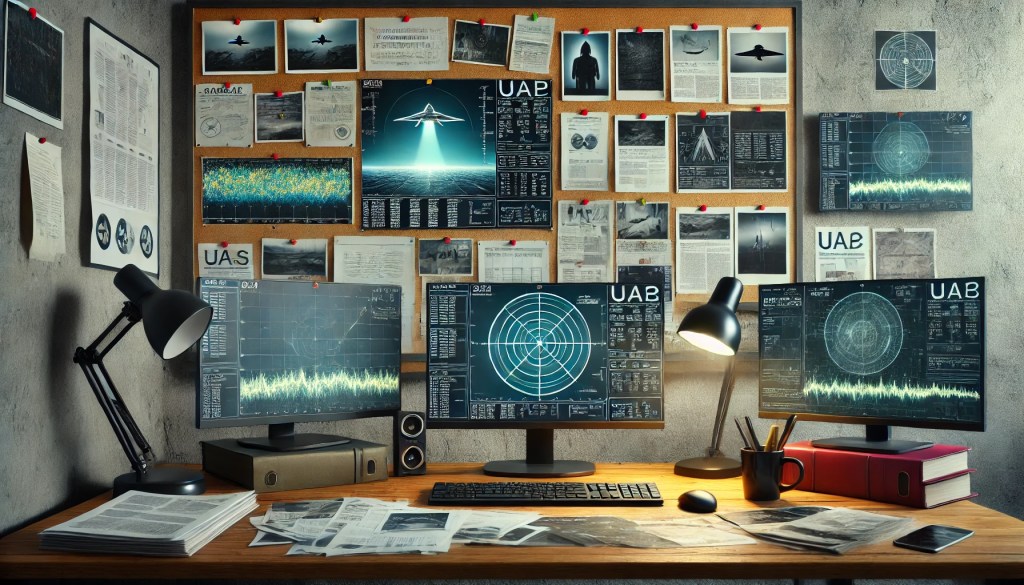
UAP and Paranormal Research: Embracing a Dual-Approach for Deeper Understanding

The article advocates for a dual-approach in researching Unidentified Aerial Phenomena (UAP) and paranormal events, blending traditional scientific methods with intelligence analysis. It highlights the limitations of conventional science in addressing these elusive phenomena and proposes integrating interdisciplinary insights and innovative methodologies to foster a comprehensive understanding of such occurrences.

The field of Unidentified Aerial Phenomena (UAP) and paranormal research has gained significant attention, spurred by numerous credible reports and government acknowledgments of the phenomena.

However, the scientific community remains largely skeptical and constrained by methodologies that may not fully address the unique nature of these occurrences. This article proposes that UAP and paranormal research should diverge from mainstream science, adopting a dual-approach: one rooted in traditional scientific methods and the other in intelligence analysis.

The Limitations of Traditional Scientific Methods

Mainstream science relies heavily on the scientific method, which demands observable, measurable, and repeatable data. This approach has undoubtedly been the bedrock of technological and scientific advancement, providing a structured pathway to understanding the natural world. However, when it comes to UAP and paranormal phenomena, this method encounters significant limitations:

  1. Elusive Nature of the Phenomena: UAPs often appear and disappear rapidly, leaving little to no physical evidence. Paranormal activities, too, are notoriously transient and subjective, often defying conventional measurement.
  2. Technological Superiority: If the intelligence behind UAPs is indeed technologically advanced, it could easily evade our current detection and measurement capabilities, rendering traditional scientific tools ineffective.
  3. Lack of Physical Samples: The absence of tangible artifacts or consistent physical evidence poses a significant barrier to traditional scientific investigation, which depends on the analysis of such samples.

Given these constraints, it is imperative to consider an alternative approach that can complement traditional scientific efforts without being hindered by their limitations.

Intelligence Analysis: A Complementary Approach

The field of intelligence analysis, traditionally used in military and security contexts, offers a promising complementary approach to UAP and paranormal research. This method focuses on collecting, analyzing, and interpreting data to understand capabilities, features, and intentions, even in the absence of direct physical evidence.

  1. Data Collection and Correlation: Intelligence analysis relies on collecting various forms of data, including eyewitness accounts, radar logs, satellite imagery, and other indirect evidence. By correlating these diverse sources, researchers can identify patterns and anomalies that might not be apparent through conventional scientific methods.
  2. Behavioral Analysis: Understanding the behavior and patterns of UAPs can provide insights into their capabilities and possible intentions. This approach mirrors techniques used in intelligence to anticipate the actions of adversaries based on observed behavior.
  3. Predictive Modeling: By developing models based on historical data and observed patterns, intelligence analysis can help predict future occurrences and potentially guide where and how to focus observational efforts.
  4. Interdisciplinary Collaboration: Integrating insights from various fields such as psychology, sociology, and even folklore can enrich the analysis, providing a broader understanding of the phenomena beyond just the physical aspects.

The Path Forward: Integrating Science and Intelligence Analysis

While traditional scientific research remains crucial, it is clear that a new branch dedicated to intelligence analysis is necessary to advance our understanding of UAP and paranormal phenomena. This dual-approach ensures that we are not limited by the constraints of our current scientific paradigms but are also not abandoning the rigorous standards of evidence that science demands.

  1. Establishing Research Frameworks: Developing structured methodologies for intelligence analysis in UAP research will provide a framework for systematic investigation, similar to how the scientific method structures traditional research.
  2. Training and Education: Academics and researchers should be trained in intelligence analysis techniques, fostering a new generation of researchers who can bridge the gap between science and intelligence analysis.
  3. Institutional Support: Universities, research institutions, and government agencies need to recognize and support this dual-approach, allocating resources and funding to both scientific and intelligence analysis efforts.
  4. Public Engagement: Transparency and communication with the public are essential to maintain trust and support for research efforts. Engaging with the public through open forums, publications, and media can help demystify the phenomena and the research process.

In conclusion, the unique and often elusive nature of UAP and paranormal phenomena necessitates a bifurcated research approach. By combining traditional scientific methods with intelligence analysis, we can create a robust framework capable of tackling the complexities of these phenomena, ultimately leading to a deeper and more comprehensive understanding. This dual-approach not only respects the rigor of science but also embraces the innovative and adaptive strategies of intelligence analysis, paving the way for breakthroughs in one of the most intriguing fields of modern research.