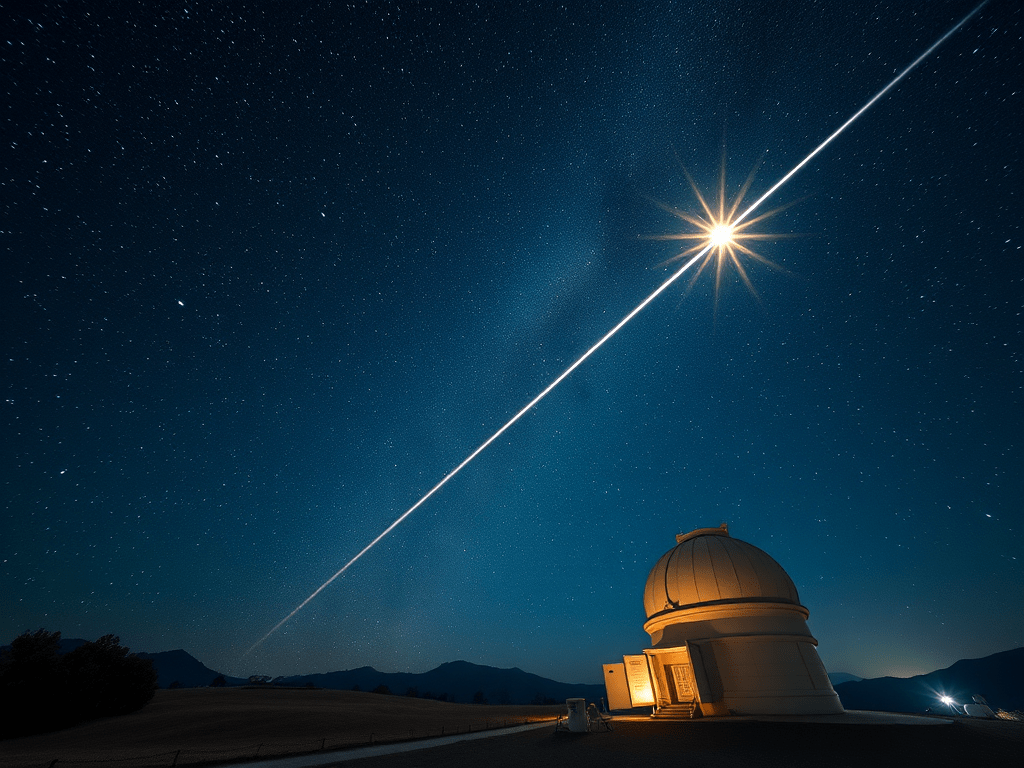
Reflections Before Sputnik: The Strange Case of the Palomar Transients

“We were watching the skies long before we ever left them.”

A new pair of peer-reviewed papers might just upend one of our most basic assumptions about the history of space—and the mystery of what might be watching us from it.

In the quiet decade before Sputnik launched in 1957, the Palomar Observatory in California was photographing the stars with massive, red-sensitive glass plates. These were the days of film, not pixels. No satellites. No SpaceX. No orbital junk. Just deep, slow exposures of the night sky on 14-inch-wide glass, stored away and nearly forgotten for decades.

Until now.

The Transients

Astrophysicist Beatriz Villarroel and anesthesiologist-turned-researcher Stephen Bruehl have led a bold effort to mine these ancient sky photographs for a strange signature: brief, star-like flashes of light that appear on one photographic plate—but not on any taken before or after.

In their 2025 paper in PASP, Villarroel et al. describe how they combed through over 298,000 of these “transients” from the First Palomar Sky Survey (POSS-I). The key was to look not just for isolated flashes—but for multiple flashes aligned in a straight line, captured in a single, long-exposure image.

And they found them.

Five candidate events, each with 3 to 5 point-source flashes, aligned along tight geometries. Statistically, these arrangements are extremely unlikely to occur by chance. In one case, the odds were less than 1 in 10,000. Even more curious: several of these events happened on historically significant dates for aerial phenomena—including the 1952 Washington, D.C. UFO flap.

The Shadow Knows

To rule out photographic or digitization defects, the researchers applied a brilliant control: the Earth’s shadow test.

Objects in orbit that reflect sunlight can only be seen when they’re not in Earth’s shadow. Random photographic defects wouldn’t follow such rules. But these transients do. The events were found almost exclusively outside of Earth’s shadow zone, implying they are reflections requiring sunlight.

Which begs the question: Reflections from what?

The UAP Connection

In a follow-up study published in Scientific Reports, Bruehl and Villarroel cross-referenced over 100,000 POSS-I transients with:

  • All publicly known nuclear weapons tests from 1949–1957
  • UAP reports from the UFOCAT database

They found:

  • Transients were 45% more likely to occur within ±1 day of a nuclear test (p = .008).
  • Every additional UAP report on a day was associated with an 8.5% increase in observed transients.
  • The highest transient counts occurred on days with both UAP reports and nuclear testing.

These aren’t fuzzy lights or fuzzy stats. These are strong correlations, suggesting that something in orbit may have been reacting—or observing—our most violent scientific acts.

Technosignatures Before Spaceflight?

If these aligned flashes are real, and not optical illusions or defects, and if they represent sunlight glinting off objects in orbit during the 1950s, then we are possibly looking at: non-human technosignatures.

That is: artificial objects in Earth orbit before humanity ever launched one.

Long a fringe idea, this is now supported by published data and careful methodology. No wild extrapolation needed—just a willingness to confront the evidence and ask the question: Who was already up there?

What Could They Be?

  • Plate Defects? Dual scans and Earth-shadow filtering rule this out in high-confidence cases.
  • Atmospheric Effects? Cherenkov radiation or gamma flashes are possible—but unlikely, especially one day after tests.
  • Natural Astrophysical Events? Can’t explain the alignments or sun-dependent behavior.
  • Artificial Reflectors in Orbit? The most consistent explanation… if we accept the radical implication.

What Now?

At Fortean Winds, we don’t chase beliefs—we follow the evidence.

And the evidence here says:

  • These are real phenomena captured on legacy data.
  • They avoid Earth’s shadow—indicating sunlight reflection.
  • They correlate with both nuclear activity and UAP reports.

This isn’t disclosure. This is something better: data. And data demands action.

Recommended Next Steps:

  • Launch replication studies using other plate archives (e.g., DASCH).
  • Use AI to better filter plate defects from authentic signals.
  • Incorporate technosignature hunting into SETI and deep-sky surveys.
  • Map transient/UAP correlations in real-time with future orbital sky surveys.

Final Thought

Back in 1960, Bracewell proposed the idea of alien probes silently monitoring Earth from orbit—waiting for a sign of intelligence.
If he was right, what would such a sign be?

A nuclear flash.

Maybe they blinked back.

Stay strange, stay curious.

—RamX
Fortean Winds