
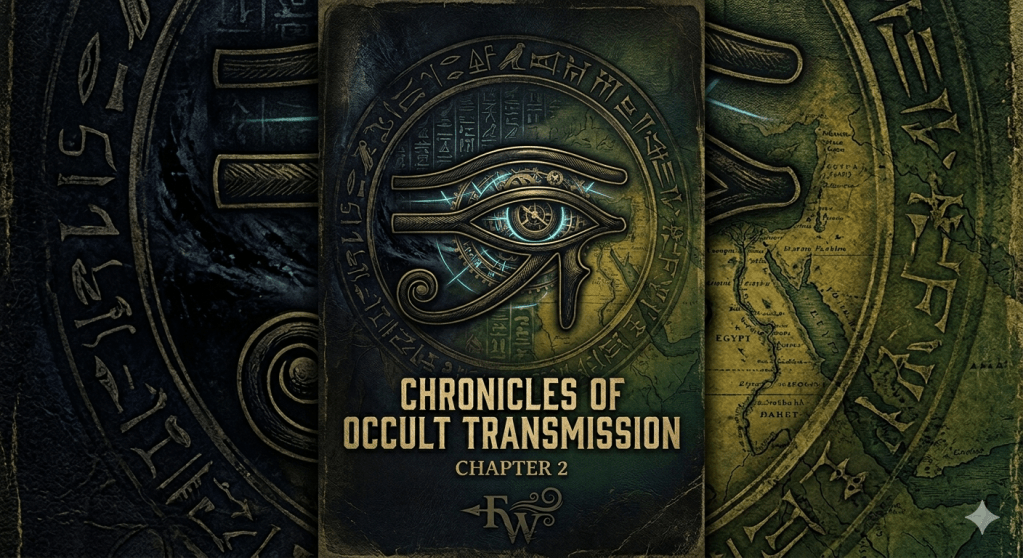
This is the second installment in Fortean Winds’ ongoing series on the history of the occult. Chapter 1 established what the occult actually is. This chapter follows the transmission line — where organized occult knowledge begins, and how it traveled.
Most scholars pin the origin of organized occult practice in Egypt. That’s a reasonable starting point, but it’s already late. By the time Egypt is systematizing heka — Egyptian magic — into temple infrastructure and royal ritual, Mesopotamia has been running state-funded divination operations for centuries. Something was already in motion before either of them wrote it down.
The documented chain runs: Egypt and Mesopotamia in parallel from roughly 3000 BCE, the Greek mystery cults absorbing both traditions from around the 6th century BCE, the Hellenistic synthesis producing the Corpus Hermeticum somewhere between the 1st and 3rd centuries CE, Rome transmitting that synthesis westward, and the Catholic Church inheriting it — officially rejecting it, unofficially preserving it — through the medieval period. That’s the lineage that built what we call Western occultism.
Before that documented chain, the honest answer is we don’t know. What we do know is that shamanic traditions operating through the same core mechanism — initiation, altered state, apparent contact with non-human intelligence, transmission of knowledge to the next practitioner — appear in the archaeological record as far back as we can look. If occult practice means hidden knowledge accessed through structured means, shamanism is the oldest version of it on record, predating every named tradition in the West by tens of thousands of years.
Egypt: Heka and the Infrastructure of Hidden Knowledge
Heka is the Egyptian word that gets translated as “magic,” but that translation loses something important. For Egyptians, heka wasn’t supernatural. It was a fundamental force woven into the structure of reality — as real as gravity, as operational as mathematics. The pharaoh wielded it as a governing tool. Priests were trained in it as specialists. The gods were understood to operate through it.
This is a significant framing choice. The Egyptians weren’t doing magic as we understand the term — something outside nature, operating by different rules. They were working with forces they understood to be natural, just not universally accessible. Knowledge of those forces required training. Training required initiation. That’s the occult structure in its most basic form, and Egypt had it fully operational three millennia before the common era.
The temple system was the institutional container. Priests operated in a hierarchy of knowledge — outer courts open to the public, inner sanctuaries restricted, innermost chambers accessible only to those who had passed through specific initiations. The knowledge held in those inner chambers was documented in texts like the Amduat, the Book of Gates, and the broader funerary corpus that modern scholars call the Book of the Dead. These aren’t prayer books. They’re operational manuals for navigating specific states of consciousness — including death itself, which the Egyptians treated as a transition requiring technical preparation rather than a mystery requiring faith.
Two things stand out from a Fortean perspective. First, the central Egyptian magical concern was words of power — specific vibrational sequences that produced effects in the physical world. The idea that sound, intention, and precise execution produce real-world results shows up in every occult tradition that follows. It’s also structurally identical to what researchers studying anomalous contact describe: states entered through specific practices, producing physiological effects that have now been measured. Second, the Egyptian cosmology was explicitly extraterrestrial in origin. The gods didn’t live on Earth. They came from elsewhere, specifically from a region associated with Orion and Sirius. The priests were maintaining a relationship with intelligences that did not originate here.
Mesopotamia: Divination as State Technology
In Mesopotamia — Sumer, Babylon, Assyria — the occult practice that gets the most institutional investment is divination. Not as a sideshow. As a department of government.
Assyrian kings maintained paid staffs of diviners whose job was to read omens before any significant decision — military campaigns, building projects, treaty negotiations. The divination methods included extispicy (reading the livers of sacrificed animals), astrology, and oneiromancy (interpretation of dreams). Tens of thousands of clay tablets survive from the Assyrian royal archives, many of them divination reports submitted to the king by his specialist readers. This isn’t fringe practice. It’s the intelligence apparatus of a superpower.
The theoretical premise is the same one that runs through all divination: the universe is sufficiently interconnected that patterns in one domain reflect patterns in another. A trained reader extracts signal from what appears to be noise. Whether that premise is correct is a question this series holds open. What’s not in question is that serious, educated people developed it into a systematic discipline over several thousand years, refined it through something resembling empirical iteration — what worked got recorded and repeated, what didn’t got discarded — and used it to make decisions at the highest levels of civilization.
Mesopotamia also gives us the oldest substantial black magic record. The Maqlu and Shurpu texts are ritual collections specifically designed for banishing and curse-breaking — which implies there were curses to break. The darker applications of occult practice aren’t a medieval invention. They’re as old as the systematic practice itself.
The Symbol: Eye of Horus
| Origin | Ancient Egypt, ~3000 BCE. Associated with Horus, the sky god whose right eye was the sun and left eye the moon. The symbol itself represents the restored eye — Horus had his eye torn out by Set, then healed by Thoth. |
| What it actually means | Protection, healing, and restored wholeness. The six components of the symbol correspond to the six senses in Egyptian cosmology — including a sixth sense, tepia, associated with non-ordinary perception. The teardrop marking is a mathematical fraction system used in measuring grain. The sacred and the utilitarian, fused into one glyph. |
| FW relevance | The Eye of Horus persists intact from 3000 BCE through medieval grimoires, Renaissance Hermeticism, and into modern Western occultism. It’s one of the cleaner examples of an unbroken transmission line across five millennia. The symbol didn’t survive because it looked good. It survived because it meant something specific to the people carrying the tradition forward. |
Greece: Mystery Cults and the Question of Direct Experience
The Greek mystery cults — Eleusis, the Orphic mysteries, Mithraism, the Isis cult — are where the transmission from Egypt and Mesopotamia enters the Western mainstream. They’re also where the occult tradition makes its most explicit claim: that direct, personal experience of non-ordinary reality is possible, achievable through specific practices, and transformative in ways that ordinary instruction cannot replicate.
Eleusis is the most documented. The Eleusinian Mysteries ran for roughly two thousand years, from at least 1500 BCE to 392 CE when Theodosius shut them down as part of the Christianization of the empire. Initiates at the highest level underwent a ritual that reportedly produced an experience so significant that writers from Cicero to Pindar described it as permanently changing their relationship to death and to reality. Cicero wrote that Athens had given civilization many gifts, but none greater than the Mysteries, which had taught people not only how to live but how to die.
What happened during the final initiation is not fully known — secrecy was enforced effectively enough that no complete account survives. The current best hypothesis, developed from partial accounts and pharmacological analysis of the kykeon drink consumed during the ritual, is that the initiates ingested an ergot-derived compound producing effects similar to LSD. That explanation, if correct, shifts the frame. The Mysteries weren’t a ritual performance producing a spiritual insight. They were a controlled altered state producing a direct experience, with two thousand years of institutional structure built around preparing people to navigate it, integrate it, and not lose their minds in it.
Whether the experience was pharmacologically induced or not doesn’t actually settle the question of what was being experienced. It just tells us the mechanism of entry. The content of the experience — which initiates consistently described in terms of contact with something real rather than a hallucination — remains exactly as open as it was before.
The Hermetic Synthesis
The Corpus Hermeticum is a collection of texts attributed to Hermes Trismegistus — “Thrice-Great Hermes,” a fusion of the Greek Hermes and the Egyptian Thoth — compiled in Hellenistic Egypt sometime between the 1st and 3rd centuries CE. For a long time, Renaissance scholars believed the texts were ancient — contemporaneous with Moses, predating Plato. That dating turned out to be wrong. The texts are Greco-Roman era. But they synthesize something genuinely ancient: Egyptian cosmological ideas, Platonic philosophy, Stoic natural philosophy, and Jewish mystical influence from the large Jewish community in Alexandria.
The core Hermetic claim — “as above, so below” — is the most concise statement of the occult premise in the historical record. The universe is structured by correspondence. What happens at one level of reality is reflected at every other level. Macro and micro mirror each other. The practitioner who understands that mirroring can work with it — using operations at one level to produce effects at another. It’s the same logic as Egyptian heka and Mesopotamian divination, now formalized into a philosophical system.
The Hermetic texts also introduce the concept that became central to the entire Western esoteric tradition: that the human being contains within itself a spark of the divine, a fragment of the original creative intelligence of the universe, which can be recovered through proper practice. The goal of Hermetic work is not external power. It’s the recognition and development of something that was always already there. This is the reading of alchemy that makes it coherent — the transmutation of base metals into gold isn’t the goal. The transmutation of the practitioner is the goal. The laboratory work is a technology for facilitating an internal process.
Rome, the Church, and the Suppression Problem
Rome absorbed Greek occult traditions enthusiastically and added institutional legitimacy through practices like augury — reading omens from bird flight — which was a formal function of Roman state religion, not a folk practice. The Roman Senate had its own college of augurs. This is occult practice embedded in the highest levels of government, identical in structure to the Assyrian divination apparatus two thousand years earlier.
The Council of Nicaea in 325 CE and the Theodosian decrees of the late 4th century did something that had not happened in the ancient world: they established a single orthodoxy with the legal authority to suppress alternatives. The mystery cults were closed. The philosophical schools of Alexandria were eventually dismantled. The Library itself — the repository of the ancient world’s accumulated knowledge — was destroyed by degrees across a century of official and unofficial action.
What happened to the knowledge is the question worth asking. Some of it was demonstrably destroyed. Some of it survived in scattered manuscripts. Some of it went underground — the pattern that makes the occult “occult” in the literal sense. And a significant portion of it was absorbed into the Church itself, carried by the educated clergy who were the only literate class maintaining institutional continuity across the collapse of the Western Roman Empire.
This is the point that tends to surprise people: popes wrote grimoires. Not a few rogue clerics — actual popes, documented in the historical record. The spell structures in those papal grimoires follow the same operational logic as the Mesopotamian divinatory texts from three thousand years earlier: timing, symbol, invocation, altered state, result. The Church officially condemned magic while some of its highest officials practiced it. This is not a conspiracy theory. It’s in the manuscripts. What the Vatican archives actually contain beyond what has been released is, as of this writing, not fully known.
The Transmission Problem
Here’s the question the historical record raises but doesn’t answer: is this a single thread, or multiple independent convergences on the same structure?
The Egypt-to-Mesopotamia-to-Greece-to-Rome-to-Church line is documented. You can follow the manuscripts. But the same operational structure — initiation, altered state, contact with non-human intelligence, transmission of knowledge, secrecy — appears independently in traditions that had no contact with the Western line. Chinese magical traditions. Japanese esoteric Buddhism. The shamanic traditions of the Americas. Identical structural logic, different content, no common source.
Two explanations are available. Either humans independently converge on this structure because it describes something real about consciousness and its possible states — in which case the occult traditions are mapping genuine territory, whatever we call what’s on the other side of the map. Or the structure is a feature of human neurology that generates consistent experiences regardless of cultural context — in which case the occult traditions are mapping a consistent interior landscape that has nothing external to it.
Both explanations are compatible with the data. Neither is disproven by the data. This is where the research sits.
What we know is that the structure persisted. From Mesopotamian liver-readers to Egyptian temple priests to Greek mystery initiates to Roman augurs to medieval Christian mystics to Renaissance alchemists — the same operational logic survives every political transition, every suppression, every attempt to replace it with something more manageable. That persistence is itself data. Next chapter pulls the thread through the medieval period, where the Church’s relationship with its own hidden tradition gets considerably more complicated.
Previous: Chapter 1 — What the Occult Actually Is
Next: Chapter 3 — The Medieval Period (publishing May 4)
Back to the series hub →
Sources and Further Reading
- Jan Assmann, The Mind of Egypt (Metropolitan Books, 2002) — Egyptian cosmology and the structure of priestly knowledge.
- Garth Fowden, The Egyptian Hermes (Princeton, 1986) — The Hermetic tradition from Egypt through late antiquity.
- Marvin Meyer, ed., The Ancient Mysteries: A Sourcebook (HarperCollins, 1987) — Primary texts from Eleusis, Mithras, Isis, and Orphic traditions.
- Wouter Hanegraaff, Esotericism and the Academy (Cambridge, 2012) — How Western esotericism was defined, suppressed, and studied.
- Brian Muraresku, The Immortality Key (St. Martin’s Press, 2020) — The pharmacological hypothesis for the Eleusinian Mysteries.
- Peter Levenda, Sinister Forces, Vol. 1 (Trine Day, 2005) — Occult threads through history; the transmission model.

